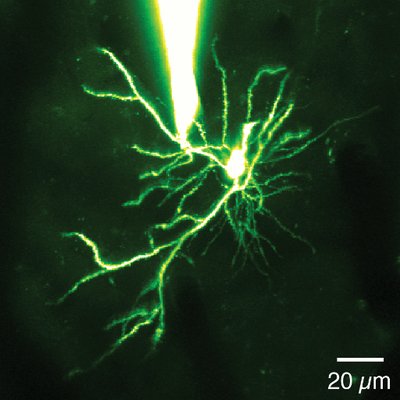
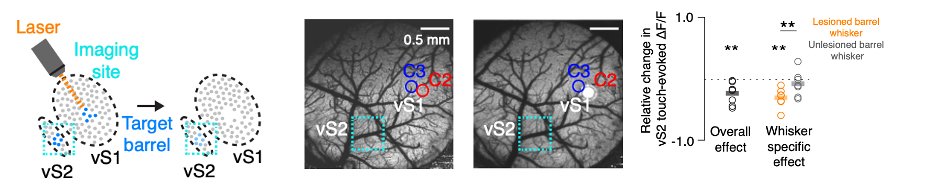
1/ How do somatotopically-matched regions of sensory cortex interact? In our most recent paper at @CellReports, @__laurenryan__shows that whisker S1-S2 amplify touch bidirectionally via a specialized population of broadly tuned touch cells.
https://t.co/puM1cNSkfR
Pleased our study is now published. We catalog the structures and cell types innervated by corticospinal neurons (CSNs) of forelimb motor cortex. This research lays an anatomical foundation for many future functional studies from the lab.
https://t.co/Sp5nsP2TkT
On my way to visit @UNC_Optics and his awesome department @aps_unc. Looking forward to a great visit. Talk is Tue at 4pm, come say hi if you’re in the area!
And if you’re a grad student or a postdoc (or an eminent professor looking to relive your postdoc years) I’m hiring!
The Oldenburg Lab is hiring! If you're interested in using fancy microscopes to stimulate cells and study neural codes let me know.
We're looking for an adventurous postdoc who's interested in optics and neurobiology of movement. https://t.co/D5yGMUMBdq
Anyone know of studies comparing same side stimulus and motor action (e.g., sound on right of body and rightward movement) vs. stimulus and action on opposite sides?
Thrilled to have WenXi's thesis work out in the world! Over the past few years, WenXi has made some cool discoveries about how the brain learns to predict the consequence of an action. 1/9
https://t.co/gwdE8QSMUU
Excited about our long-brewing paper exploring dynamics in multi-regional neural circuits in a delayed movement task. Driven by@esthersselva, @yiliu021, and including Jennifer Colonell, Nuo Li and @ShaulDr and others (the MAP collaboration): https://t.co/TeruxjeOvc (1/7)
Our work using holographic optogenetics to study recurrent activity in visual cortex is out! This work was only possible due to the great collaboration between @AdesnikHillel and @BrentDoiron labs, especially co-firsts @GHandy50@willyhendricks and myself https://t.co/UBoLcSwFlF
So excited to see the second half of my dissertation work officially out in @CellReports ✨ if you’re interested in Inter-areal communications in sensory cortex check it out 💃🏻 big thanks to everyone who worked on this !!
8/ Thus, a sparse population of multiwhisker cells amplifies touch responses across vS1-vS2 in a whisker-specific manner, showing that topographically matched regions of sensory cortical areas mutually amplify one another’s responses. Congratulations to Lauren and the team!
1/ How do somatotopically-matched regions of sensory cortex interact? In our most recent paper at @CellReports, @__laurenryan__shows that whisker S1-S2 amplify touch bidirectionally via a specialized population of broadly tuned touch cells.
https://t.co/puM1cNSkfR
Does scattering limit your in vivo imaging experiments? We 'super-resolve' neurons using the same trick how PALM/STORM microscopy resolves individual molecules (1/12).