Rebuilding the 2018/01/04 thread
that I broke earlier today: How It Feels To Be An Old Carat, or
#5YearsWithSeventeen - A Love Story https://t.co/MX75NMin5c
📰 || 260725 DINO (Picheolin) #디노's 'Love Sick (narr. Lee Moon Sae' has been officially registered on KOMCA!
With this, DINO now has 35 works credited under his name!
#피철인#SEVENTEEN#세븐틴#セブチ@pledis_17
UPDATED DINO x Picheolin SCHEDULE
📅 JULY
07.27 — Dingo Music (6PM KST)
📆 AUGUST
08.01 — TEASER 1: Title Track (10 PM KST)
08.02 — TEASER 2: Title Track (10 PM KST)
08.03 — Countdown Weverse Live (5 PM KST)
08.03 — 吉BOARD Album Release & Title Track MV (6 PM KST)
08.07 — Music Plant Fan Sign Event (8PM KST)
08.09 — SBS 2026 Gayo Daejeon Summer Music Festival
📍Ilsan Kintex Exhibition Hall 1
08.14 — STAN A: PICHEOLIN with Bumzu (7 PM)
08.16 — DINO x PICHEOLIN Fan Party (5 PM KST)
📍Cube Convention Center, Seoul
08.21~08.23 — DINO x PICHEOLIN Fan Concert Fan Concert '吉BOARD Show'
📍Jamsil Indoor Stadium, Seoul
• Day 1 - 08.21 (7PM KST
• Day 2 - 08.22 (6PM KST)
• Day 3 - 08.23 (5PM KST)
08.28 — STAN A: DINO Episode (7 PM KST)
08.28 - Skechers Grand Opening and Meet & Greet
📍Skechers Sunway Pyramid
UNSCHEDULED:
TBA - KBS Open Concert (열린음악회) Broadcast
Note: Attendees say the MC mentioned 08.09 as the broadcast date (info to be VERIFIED)
Saw "Picheolin" and "Banned" in a headline and my life flashed before my eyes😭
Good to know the only thing Picheolin is guilty of is being illegally addictive.
"Predicted to Become a 'CSAT-Banned Song': Picheolin's 'Crazy Crazy' Leads the K-Retro Craze"
Picheolin, the alter ego of SEVENTEEN's Dino, is spreading Korean-style retro nostalgia through his new song "Crazy Crazy" (미쳐 미쳐).
"Crazy Crazy" is a track characterized by its K-retro kitsch sound, reinterpreting Korea's unique style and lively spirit with a modern twist. Since its release on July 22, the song has entered the iTunes Top Songs charts in multiple countries and regions, including Japan, the Philippines, and Sri Lanka, drawing attention from listeners worldwide. Its highly addictive melody and instantly catchy energy have been receiving enthusiastic responses.
Online, many are already calling it the next "CSAT-banned song" a term used in Korea for songs so addictive that students are jokingly advised not to listen to them while studying for the College Scholastic Ability Test (CSAT).
Comments such as "This is insanely addictive" and "I played it as a joke, but now I'm hooked" have been pouring in. At the same time, challenge videos inspired by its K-retro kitsch concept are rapidly spreading.
International fans have also joined the trend by recreating the "Picheolin look" with glitter jackets and brightly colored tracksuits while participating in the "Crazy Crazy Challenge."
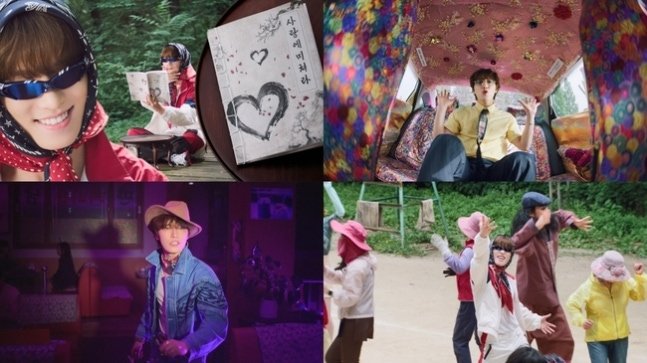
The music video, centered around Picheolin as "a man crazy in love," has also been gaining attention. It humorously depicts Picheolin who initially exudes confidence in love falling head over heels after seeing nothing more than the silhouette of Chunsooni.
The story becomes even more entertaining as people captivated by the self-proclaimed apostle of love dance together, while his bizarre dating advice leads to a series of unexpected situations.
Picheolin will continue his activities as the "Guardian of Heung (Excitement)" with the release of his first mini album, "吉BOARD (Gilboard)," on August 3.
The album features seven tracks built around the central theme of "heung" (joyful excitement), including the title track "Let's Have Some Fun (prod. Hitchhiker)."
Dino is credited on every track, while hit producer Hitchhiker and Lee Hyundo of the legendary hip-hop duo DEUX also participated, further enhancing the album's musical quality.
https://t.co/977jyA9NYh
Seventeen operates in the same method as the Cat Distribution System. They're suddenly living rent-free in your mind, and you can't get away from them and you don't really want to because their adorable personalities grow on you so fast. It helps that at least 5/13 are cats.
#JOSHUA#조슈아 ear cover song
You can also watch here with beautiful Shua and Chinese lyrics + translations!
🌐: https://t.co/KPaL0YlpQ9
JOSHUA NEW COVER OUT NOW
#JOSHUA_COVER_EAR#洪知秀翻唱耳朵@pledis_17
However, by the 2000s, collaborations had become increasingly centered around creating buzz.
Inviting whoever was most popular at the time became one of the most basic promotional strategies.
Some albums filled nearly every track with featured artists to showcase musical range and an extensive network, while others pursued unexpected cross-generational, cross-career, or cross-border collaborations the kind that made people say, "I can't believe this actually happened."
Anyone reading this article can probably think of countless examples.
After the 2010s, K-pop an industry that thrives on attention and headlines naturally embraced this trend.
As its international recognition continued to grow, names that once would have seemed impossible to see in production credits or featuring lineups began appearing more and more frequently.
But over time, audiences also changed. Just as people eventually stopped being amazed by yet another Billboard No. 1 album, even the biggest names alone were no longer enough to impress.
Instead, what truly began to resonate with listeners was the authenticity of the story behind the collaboration.
Another noteworthy point is that most of these projects are taking place through solo work rather than full-group releases.
Is K-pop a standardized business where individuality disappears? Some might say so.
Yet even within that system, people and music continue to breathe naturally. As K-pop collaborations shift their focus from creating buzz to genuine sincerity, this changing direction deserves closer attention.
The movements of these young artists, now stepping beyond the weight of the group's crown, are becoming increasingly remarkable.
https://t.co/NaorydjfLr
I genuinely enjoyed this article it's a bit long but I hope readers can enjoy too
Beyond Buzz: The Formula for K-pop Collaborations Is Changing (Content Moments)
Electronic musician KIRARA had repeatedly turned down requests to collaborate with K-pop artists.
The reason was simple: no one ever explained why it had to be her. The person who eventually changed her mind was SEVENTEEN's Vernon, through the warmth he showed.
The meeting between electronic musician KIRARA and SEVENTEEN's Vernon has recently become one of the most talked-about collaborations among people interested in Korea's music scene.
The two were brought together through "mia," Vernon's track from V8, the unit album released by THE 8 and Vernon.
The collaboration was unexpected in several ways. Now in their 12th year since debut, SEVENTEEN despite the group's popularity and reputation has not been particularly active with solo promotions.
While the group's energetic image is firmly established, it has not always been easy for each member's individual identity to stand out. As a member of SEVENTEEN's Hip-hop Team, Vernon has released solo songs through the group's mixtape series, but there were still limitations in directly expressing the music and messages he wanted to pursue.
KIRARA's decision was equally surprising. Having established herself as an irreplaceable figure in Korea's electronic music scene while also contributing greatly to nurturing new electronic musicians, she is a veteran artist with well over a decade of experience since releasing her first official album, cts1, in 2014.
Considering K-pop's close relationship with electronic and Black music, she could easily have worked with countless artists by now but she chose not to.
Instead, she repeatedly spoke on social media about the difficulties of working in K-pop. She explained that none of the people who approached her had ever told her why she should be the one to take on the project.
Anyone familiar with KIRARA's creative process pouring her past, present, and future into her music could easily understand why she felt that way.
After experiences like these accumulated over the years, what ultimately moved an electronic musician who had grown skeptical of K-pop was, above all else, warmth.
This deeply personal feeling appeared in KIRARA's short reflection shared after the release of "mia."
She said that the warmth Vernon conveyed made this collaboration possible. Vernon personally sent her a direct message, and through his words and actions, made her feel that she was worthy of taking part in the project and genuinely want to do it.
She even described him as "the best client I've ever had out of everyone who's ever paid me to make music."
Some may dismiss this as the kind of compliments collaborators naturally exchange after a project, but those who know KIRARA know that she is one of the last musicians in Korea who would say something like that in sincerely or even be capable of saying it if she didn't truly mean it.
The heartwarming story came to an end when Vernon left a comment on her post saying, "Thank you for treating me with sincerity."
Looking back at the album credits afterward, one detail stood out.
From Pharrell Williams, one of the defining icons of modern music, to 100 gecs' Dylan Brady, known for constantly pushing the boundaries of every genre he touches, the album featured an impressive lineup of names that would excite any serious music listener.
Both THE 8 and Vernon also participated in writing and composing every track.
Yet among all those headline-worthy names, what captured the most attention was the moment when KIRARA's sincerity met Vernon's sincerity.
This marks a meaningful shift in many ways.
Just a few years ago, nearly every form of collaboration was simply grouped under the label of "featuring." Originally, in the 1990s, featuring was mainly used to enrich songs by inviting rappers onto vocal tracks or vocalists onto rap songs.
+
I give unnecessary information about everything, so here's some background on Joshua's beautiful cover, "Ear (耳朵)"
"Ear (耳朵)" is the title track of Chinese singer-songwriter Li Ronghao's fifth studio album, released on October 17, 2018. Li Ronghao is one of the biggest names in Mandopop and is known for writing, composing and producing much of his own music.
Despite the title, the song isn't literally about ears. They symbolize the inability to let go after a breakup. Even when every other sense becomes numb, your ears still search for the sound of someone who's no longer there.
One of the song's most memorable lyrics says that while all other senses grow dull, the ears refuse to listen, forcing the narrator to hear the old song that reminds them of the person they lost. It's a beautiful metaphor for how memories linger.
The entire album revolves around emotional memories and past relationships, with "Ear" setting the tone through its quiet, nostalgic atmosphere.
Joshua's warm, gentle vocal color feels like a perfect match for this song, and I honestly love it 🥹
https://t.co/TyXiuspc13
I tweeted some general info about Trot earlier, but reading quotes and replies from other fandom(s) is actually making my blood boil.
Trot didn’t magically appear in the 1990s with 1st Gen K-pop. It wasn’t "invented" or "made relevant" by your favorite idol.
Can we please show an ounce of respect for the actual culture and history of the country whose idols we stan?
Here’s a quick history lesson because I'm angry and( I will fight tooth and nail for Dino) for anyone who thinks Korean pop culture started in 1996
Trot is over 100 years old.
Trot isn't a modern "gimmick." Its roots trace back to the 1920s and 1930s during the Japanese colonial era. Before it was called "Trot," it was known as *Yuhaengga* (流行歌). It is literally the earliest form of recorded popular music on the Korean peninsula.
During the colonial occupation, Koreans weren't just singing catchy tunes;
Trot became a survival outlet to express *Han* (한)the collective, deep grief, heartbreak, and resilience of a colonized nation.
Songs like Lee Nan-young’s *"Tears of Mokpo"* (목포의 눈물, 1935) were massive cultural anthems that carried a nation's soul.
Calling it "old cringe music or saying my idol did it exactly same thing" erases an entire era of Korean history.
The name literally comes from the 1920s American Foxtrot.
Because in the 1920s, global jazz and Western ballroom dance trends (specifically the Foxtrot, with its 2-beat rhythm) merged with East Asian vocal scales and traditional Korean *Pansori* inflections. It was a massive global hybrid genre a century before K-pop went international.
Without the infrastructure built by Trot legends in the 60s, 70s, and 80s (like Lee Mi-ja, Nam Jin, and Na Hoon-a), the modern Korean music industry wouldn't even exist. When modern K-pop idols sing Trot today, they aren't "saving an old genre or making it relavent" they are paying homage to the absolute bedrock of Korean pop culture.
Maybe instead of dismissing Trot as a silly vocal habit of your idol or a 90s trend for your idol, get a bit curious about *why* artists sing it with so much reverence. It’s not just a genre; it’s a century of history.
I can provide references who wants to learn more ✨
@semangkukuji This was my experience as an auntie fan back in the melona days. The kids brought me so much joy! They made up for my serious, sad youth.
ngomongin soal “semua ada masanya”. jadi kepingin cerita soal emak gue, yang kecintaan sama seventeen karena nggak sengaja ikutan nonton nana tour di meja makan bareng gue.
dari yang awalnya, “itu siapa?” lalu mulai ketawa kecil sampai ketawa gede dan jadi kepo, “kalau yang ini namanya dokyeom, ya? nah yang ini vernon?” trus berlanjut ikut nonton gose tiap weekend di tv dan mulai nanya, “cara nemuin episode yang lainnya gimana biar kalau teteh lagi kerja, mamah nggak harus telpon-telpon dulu?”
dari yang awalnya kalau ngobrol sama beliau ya nggak jauh-jauh perkara hidup, tiba-tiba berubah karena sering dicampur sama serunya topik fangirling. beliau mulai sering ditemenin sama seventeen lewat gose dan lewat lagu-lagu mereka di youtube; tiap pagi waktu nyiapin sarapan, siang waktu beliau sendirian karena semua orang pergi sekolah dan kerja, dan malam waktu kumpul keluarga.
semenjak kenal seventeen, mulai ada warna baru di hidup mamah dan letupan-letupan kecil yang mungkin beliau lewatkan waktu masih belia; kebahagiaan sederhana atas hobi yang akhirnya sekarang dia punya.
waktu diajak nonton konser, beliau kayak lagi masuk ke satu tempat yang gegap gempita dengan bahagia. tiap ditanya, “mamah capek, nggak?” beliau jawab dengan mantap, “nggak kok!”
berhari-hari sebelum konser, sibuk beli perintilan buat dibawa, milih outfit mana yang cocok, sama pusing nyari mukena yang ringan kalau dimasukin ke tas. dan sehari setelah konser, “nanti kalau svt datang konser lagi, ajak mamah lagi, ya?”
gue sempat nanya ke ayah, “nggak kesal kah lihat mamah suka sama seventeen?” beliau bilang, “nggak. dulu waktu dia masih muda, nggak pernah seceria itu. masa remajanya banyak sedihnya, sekarang puas-puasin dia bahagia. pengganti masa muda yang hilang.”
betul, semua ada masanya. ada yang pernah dibahagiakan karena sesuatu dan sudah merasa cukup, ada juga yang baru berbahagia karena sesuatu dan masih ditabung sampai merasa cukup.
semua punya masa untuk mengenal bahagia dan itu gapapa.
One of my favorite Wonwoo nerd moments is the fact for his opening part in Fear, he said he was imagining himself as Shakespeare's protagonist because they often died by poison..😭
I'm not a music critic nor am I Korean, but as a person who genuinely enjoys trot, let me tell you something:
If you've heard one trot song, every other trot song will sound familiar. And no, it's not just you it's actually built into the genre on purpose.
Here's why (with receipts):
1. The endless "ppongjak" beat
Trot runs on a steady 2-beat (later 4-beat) rhythm called *ppongjak* (뽕짝) the name literally comes from the "kung-jjak kung-jjak" sound you hear underneath the melody.
That constant oom-pah pulse is why your brain instantly links every trot song together.
Source: Namuwiki, "트로트" entry
2. The 5-note scale (Yona-nuki)
Most trot melodies lean on a pentatonic scale called Yona-nuki (요나누키) a 7-note scale with the 4th and 7th notes removed.
Fewer notes = fewer melodic paths, so songs naturally loop back to similar shapes.
Source: Kwon Jeong-gu, "트로트의 왜색논쟁 연구 –요나누키와 미야코부시 음계를 중심으로–," Korean Music Research (한국음악연구), vol. 72, 2022, pp.5-29
3. Kkeokk-gi vocal bends
Even when the notes differ, singers apply the same technique: *kkeokk-gi* (꺾기) sharp pitch bends and cracking vibrato on the high notes..
It's literally what separates trot vocals from K-pop vocals.
Source: https://t.co/QwRckDZ27r / Ministry of Culture, Sports and Tourism (https://t.co/1RY5ecxsB9)
4. Built for karaoke (noraebang) & festivals
Trot is made for instant connection, regional events, karaoke bars, older crowds singing along after one listen. No weird chord changes, no complicated structure. Short intro, quick verse, big chorus, done.
TL;DR: Trot sounds similar because it relies on a classic formula a 2/4 Ppongjak beat, 5-note scales, and Kkeokk-gi vocals to make every song instantly catchy.
That predictability isn't a flaw; it's the whole point!


![pledis_17's tweet photo. [COVER] 조슈아 - 耳朵 (Ear) (원곡 : Ronghao Li)
▶ https://t.co/nepXJ9VPEq
#JOSHUA #조슈아
#SEVENTEEN #세븐틴
#耳朵
#Ear https://t.co/Rcg7BGDUoA](https://pbs.twimg.com/media/HN1_96DaYAA8pJz.jpg)


![pledis_17's tweet photo. [NOTICE] 2026 디노X피철인 [吉BOARD SHOW] 개최 안내 (+ENG/JPN/CHN)
▶️ https://t.co/hICfbqTuRk
#DINO #디노
#피철인 #Picheolin
#吉BOARD_SHOW https://t.co/fUymZaGlqC](https://pbs.twimg.com/media/HOM9gn1bgAAYfq1.jpg)

![dingo_official's tweet photo. [#딩고뮤직]
흥의 수호자 피철인, 본업 시작합니다🕺
‘吉BOARD (길보드)’ 앨범 미리 듣기🎧
[앨범 스포트라이트] 피철인 (Picheolin, 세븐틴 디노)
– 1st Mini Album ‘吉BOARD’
7/27(월) 오후 6시 딩고뮤직에서 만나보세요.
@pledis_17
#피철인 #Picheolin #앨범스포트라이트
#吉BOARD #길보드
#DINO #디노 #세븐틴
#딩고뮤직 #dingomusic](https://pbs.twimg.com/media/HOJSIcQaEAAlo4b.jpg)


![pledis_17's tweet photo. [GOING SEVENTEEN] EP.152 No Rules #1
▶️ https://t.co/slpC8k55Rz
#SEVENTEEN #세븐틴
#GOING_SVT #고잉세븐틴 https://t.co/GyqrvtQY0u](https://pbs.twimg.com/media/HN1F6mfb0AAR24y.jpg)





