@kellabyte Ignore the feedback. How do you think you get to be as smart as the C/Rust/Go maintainers? You do something you're not qualified to do and you learn.
@vladigolub This is a major benefit of running a service. If you're not running a service you can still often get customers to share an outline of their workload and agentic tools can easily create a simulated version.
Work that was tedious but not hard is now accessible.
PGO+BOLT cut CPU per operation by 10% in a system I'm working on. AutoFDO on the kernel, on a network-heavy workload, cut CPU by another 10%.
AI will happily do the tedious plumbing.
@patrickgwsmith@alokbishoyi97@kellabyte Audacity. Unknown unknowns (e.g. is the agent swarm stable over long time horizons). Availability of a system to try this idea out on. OpenClaw is a spiritual relative of this idea, but the focus there was on functionality, not performance and efficiency.
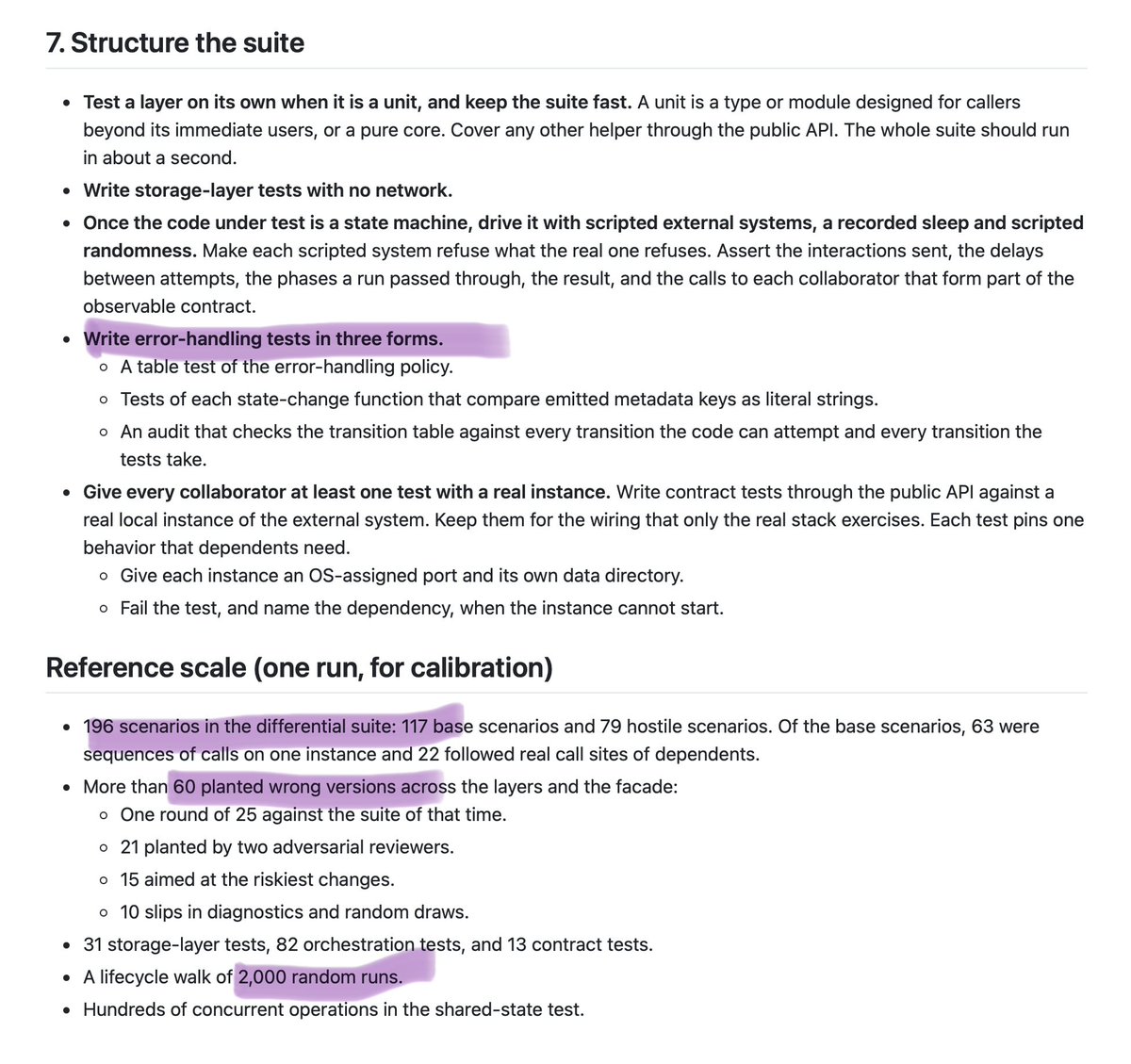
Mutation Testing (https://t.co/waUUUiSr7e) appears to be turbo-powered in the AI era. Mutation testing plants bugs at scale and ensures you have testing coverage.
How to design good verification loops?
Well, that’s most of the job now, isn’t it?
Last week, I finally landed a refactor I started in Jan. It’s good I waited b/c the Jan version was buggy af.
This is the verification process I used for refactors (have different ones for perf)
Fuck around and find out.
When Railway was breached on 21 Oct, Northflank dunked on them and urged people to migrate over to them because of that breach.
9 days they got hacked, the same way.
Zero sympathy: instead of securing you were busy dunking
I started programming around 1985. For 40 years, I built software with hand tools. I’m proud of that work, but not complacent.
In the AI era, we have modern construction equipment. Our ambitions need to rise to match.
We built houses. Time to build skyscrapers.
1/3
@Greg_GL_87 Code review should die in my opinion. Just as agents write better code than humans, agents review code better than humans. Yet humans are still needed for high level review of designs, PRs, and module boundaries. Such review shouldn't happen at the level of code.
@IA_noirLAB There are a plethora of modern testing techniques that are not deployed at scale: deterministic simulating testing, metamorphic and property based testing, fuzz testing, mutating testing, oracle testing, formal methods, etc.
@kennethlau12393 I certainly have a lot of learnings from that experience, yet not all of that experience is useful. Does someone building a skyscraper need to learn how to build a house by hand?
So what is the skyscraper? Decades of database research, from high-level architecture to low-level implementation details, combined coherently in one system.
That was humanly impossible. It may still be with today’s AI tools. It won’t be for long.
3/3
I see a lot of exciting innovation in the database ecosystem. Rewrites of existing systems in faster languages. Ambitious new projects.
My main reaction is that they aren’t ambitious enough. Most are rebuilding the same house with better tools.
2/3
A breach like PingCAP’s is the worst nightmare for everyone involved: customers working out what was exposed, and engineers working around the clock to make it right. I’ve lost many nights’ sleep imagining this scenario. My empathy is with all of them.
Incredible progress from the Blacksmith team. I thought the vision was a bit crazy when I first heard it, but perhaps that is the nature of the best ideas. A number of ex-CRL engineers powering this progress which brings a smile to my face.
@sequoia is leading our Series C at a $1B valuation.
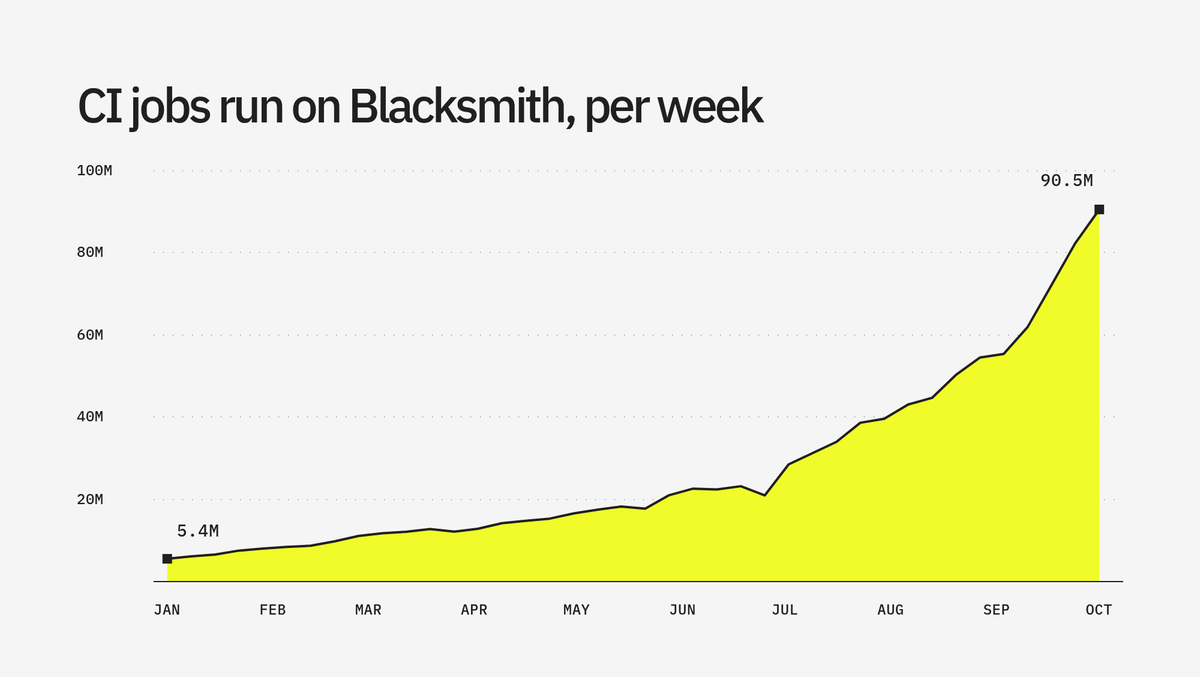
We started Blacksmith in 2024 to make CI faster and less painful. In January we ran 5 million CI jobs a week. Today it's over 90 million and growing, and we’re still early.