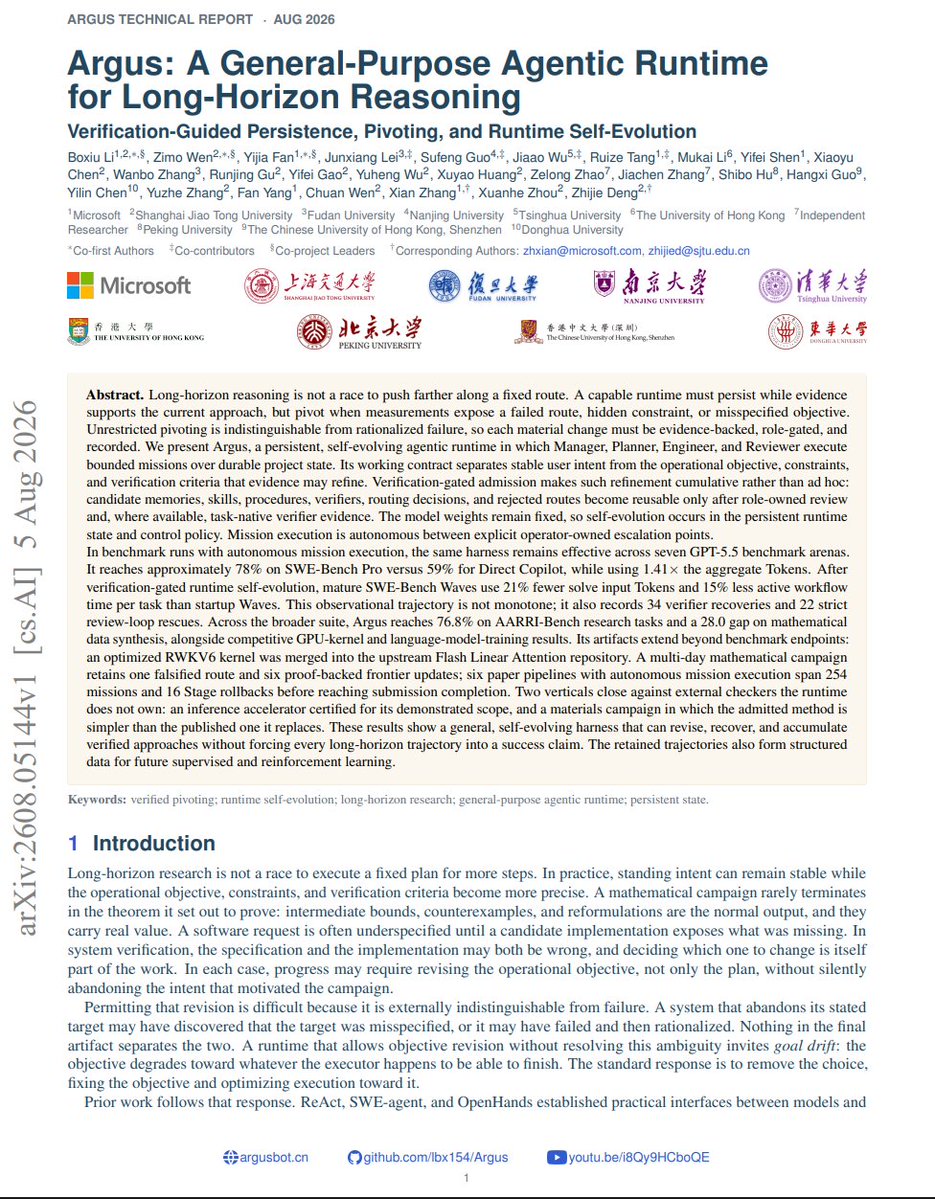
Microsoft Research and top Chinese university researchers introduced a general-purpose runtime for long-horizon agent reasoning
essential for AI system architects deploying autonomous developers, Claude Code workflows, and persistent agentic loops
monolithic LLM prompts fail as task horizon expands: unmanaged agent loops suffer from state drift, context saturation, and unrecoverable execution errors
their unified agentic runtime paradigm replaces single-prompt generations with an executable harness, self-improving loop, and stateful graph architecture
four core components of the master agent stack:
1. Context Harness Layer
isolates execution environments, manages AST memory state, and enforces tool boundary guardrails
2. Persistent Loop Layer
evaluates intermediate execution feedback to auto-retry failed tool steps without developer intervention
3. Graph Orchestration Layer
routes multi-agent sub-tasks across specialized search, coding, and verification nodes
4. Checkpoint State Merge
consolidates parallel sub-agent outputs into verifiable PR commits before task completion
unifying harness, loop, and graph engineering transforms non-deterministic language models into verifiable production systems
Read the complete breakdown in the article below ↓
📌 ATOMIC HABITS, by John Clear | Main takeaways
🔸️ Small habits create big long-term results
🔸️ Focus on systems, not just goals
🔸️ Identity drives behavior
🔸️ Make good habits easy and rewarding
🔸️ Remove cues that trigger bad habits
🔸️ Consistency beats intensity
Tiny improvements repeated daily change your life 💪
📩 Free Guide: Master the 12 essential soft skills that drive success—and start applying them today. 🚀
👉 Get your free copy:
https://t.co/vfTpyzxnxz
#AtomicHabits #Habits #Growth
Another impressive paper by Meta.
It's a plug-in decoding strategy for RAG systems that slashes latency and memory use.
REFRAG achieves up to 30.85× TTFT acceleration.
Let's break down the technical details:
How to Set Up Cursor the Right Way
Cursor Rules are outdated. Project Rules is the correct way now.
Here’s why it matters and how to set it up properly:
Not all disappointing outcomes are failures. Some lead to improvements in your process.
Success is about more than the results you achieve. It's also about the growth you attain.
Progress is more than how close you come to your goal. It's how far you've come from your start.
We’re excited to release the weights of our Time Series Foundation Model (TimesFM) on Hugging Face!
To access, visit our HuggingFace (https://t.co/tBHXp0mB4C) & GitHub (https://t.co/gC6s1hQAbA) repositories.
Learn more ↓
#TimesFM#TimeSeries#Forecasting#FoundationModels
We just launched #duetai, I am sure you are looking to get started with it. We got you covered, here are some hands-on labs you can dive into:
✅ Duet AI for app developers
✅ Duet AI for data and analytics
✅ Duet AI for SDLC
✅ More..
https://t.co/kysGM5D1uC
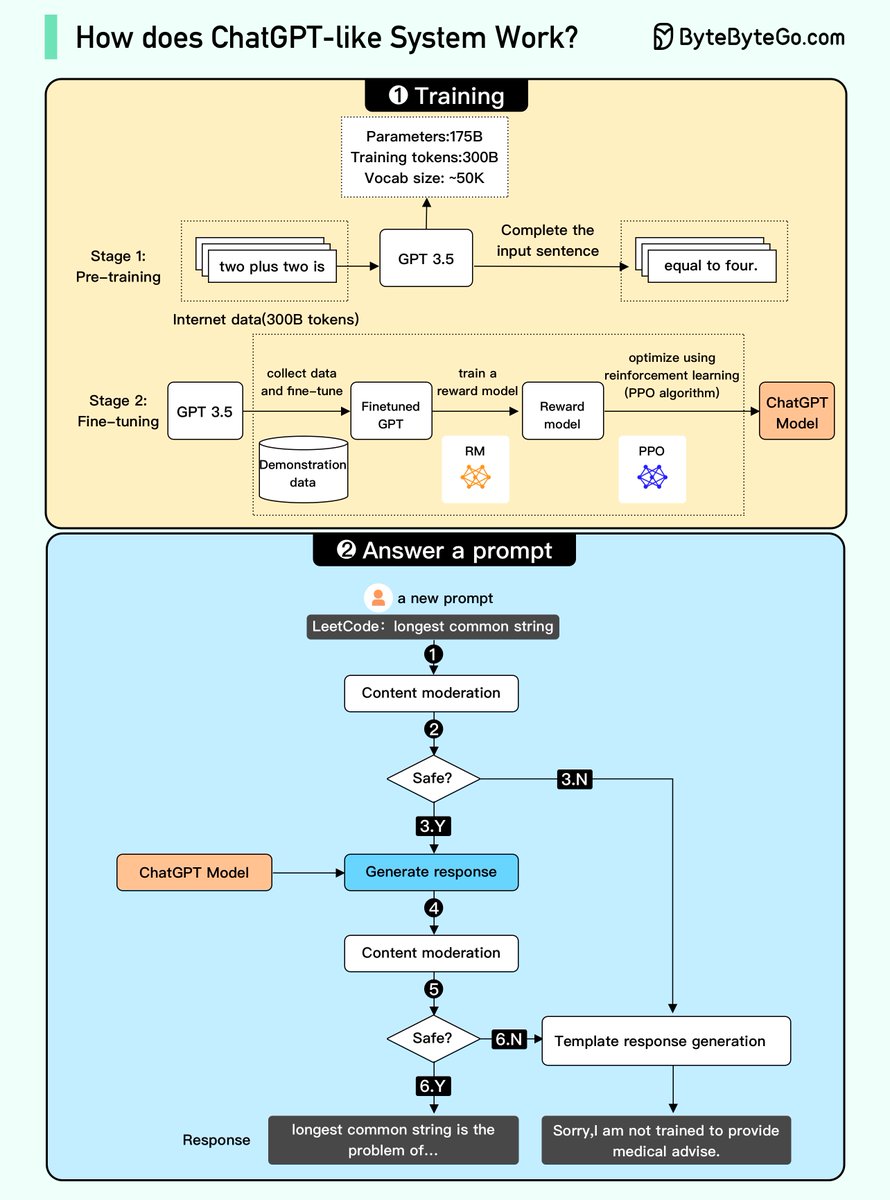
How does ChatGPT-like system work?
We attempted to explain how it works in the diagram below. The process can be broken down into two parts.
1. Training. To train a ChatGPT model, there are two stages:
- Pre-training: In this stage, we train a GPT model (decoder-only transformer) on a large chunk of internet data. The objective is to train a model that can predict future words given a sentence in a way that is grammatically correct and semantically meaningful similar to the internet data. After the pre-training stage, the model can complete given sentences, but it is not capable of responding to questions.
- Fine-tuning: This stage is a 3-step process that turns the pre-trained model into a question-answering ChatGPT model:
1). Collect training data (questions and answers), and fine-tune the pre-trained model on this data. The model takes a question as input and learns to generate an answer similar to the training data.
2). Collect more data (question, several answers) and train a reward model to rank these answers from most relevant to least relevant.
3). Use reinforcement learning (PPO optimization) to fine-tune the model so the model's answers are more accurate.
2. Answer a prompt
🔹Step 1: The user enters the full question, “Explain how a classification algorithm works”.
🔹Step 2: The question is sent to a content moderation component. This component ensures that the question does not violate safety guidelines and filters inappropriate questions.
🔹Steps 3-4: If the input passes content moderation, it is sent to the chatGPT model. If the input doesn’t pass content moderation, it goes straight to template response generation.
🔹Step 5-6: Once the model generates the response, it is sent to a content moderation component again. This ensures the generated response is safe, harmless, unbiased, etc.
🔹Step 7: If the input passes content moderation, it is shown to the user. If the input doesn’t pass content moderation, it goes to template response generation and shows a template answer to the user.
--
Subscribe to our weekly newsletter to get a Free System Design PDF (158 pages): https://t.co/FIzCeaWsZV
The LVM (large vision model) revolution is coming a little after the LLM (large language model) one, and will transform how we process images. But there’s an important difference between LVMs and LLMs:
- Internet text is similar enough to proprietary text documents that an LLM trained on internet text can understand your documents.
- But internet images – such as Instagram pictures – contain a lot of pictures of people, pets, landmarks, and everyday objects. Many practical vision applications (manufacturing, aerial imagery, life sciences, etc.) use images that look nothing like most internet images. So a generic LVM trained on internet images fares poorly at picking out the most salient features of images in many specialized domains.
That’s why domain specific LVMs – ones adapted to images of a particular domain (such as semiconductor manufacturing, or pathology) – do much better. At @LandingAI , by using ~100K unlabeled images to adapt an LVM to a specific domain, we see significantly improved results, for example where only 10-30% as much labeled data is now needed to achieve a certain level of performance.
For companies with large sets of images that look nothing like internet images, I think domain specific LVMs can be a way to unlock considerable value from their data. Dan Maloney and I share more details in the video.
Top 4 Forms of Authentication Mechanisms
1. SSH Keys:
Cryptographic keys are used to access remote systems and servers securely
2. OAuth Tokens:
Tokens that provide limited access to user data on third-party applications
3. SSL Certificates:
Digital certificates ensure secure and encrypted communication between servers and clients
4. Credentials:
User authentication information is used to verify and grant access to various systems and services
Over to you: How do you manage those security keys? Is it a good idea to put them in a GitHub repository?
--
Subscribe to our weekly newsletter to get a Free System Design PDF (158 pages): https://t.co/FIzCeaWsZV
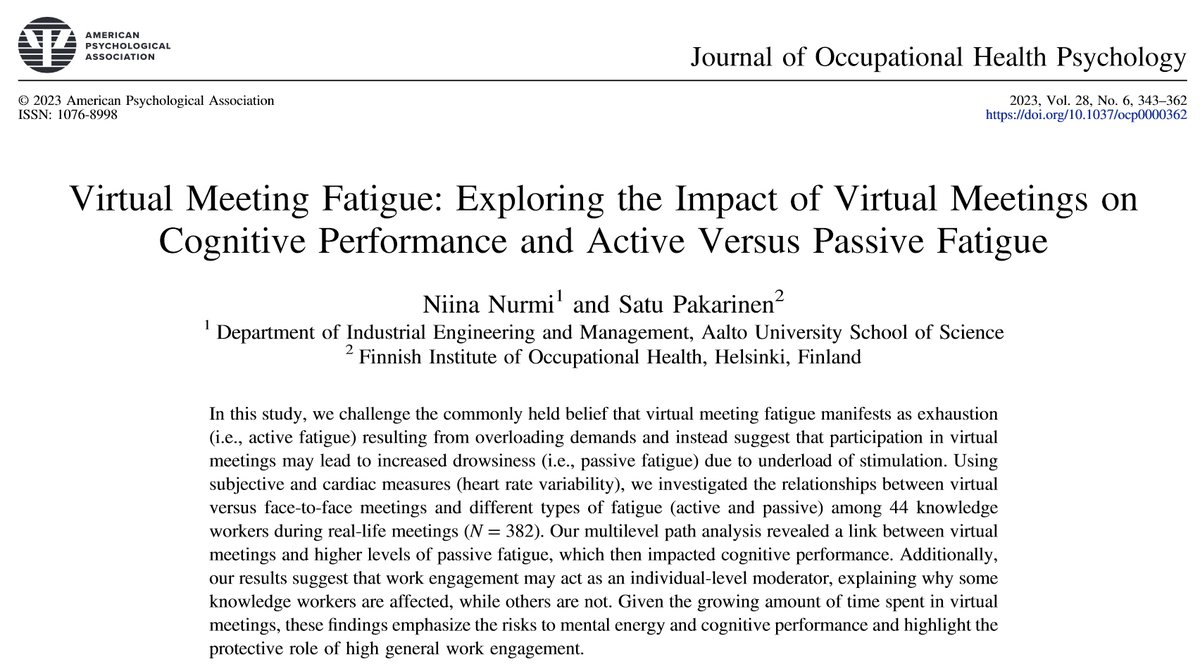
Zoom fatigue is not burnout. It’s boreout.
New study: when meetings are virtual, we’re not overwhelmed—we’re understimulated. Cardiac measures show drowsiness, not stress.
The antidotes are common sense but not common practice: fewer, shorter, more interactive online meetings.
𝗛𝗼𝘄 𝘁𝗼 𝗱𝗼 𝗺𝗶𝗰𝗿𝗼𝘀𝗲𝗿𝘃𝗶𝗰𝗲𝘀 𝗮𝗿𝗰𝗵𝗶𝘁𝗲𝗰𝘁𝘂𝗿𝗲 𝗽𝗿𝗼𝗽𝗲𝗿𝗹𝘆?
𝗦𝗲𝗹𝗳-𝗰𝗼𝗻𝘁𝗮𝗶𝗻𝗲𝗱 𝗦𝘆𝘀𝘁𝗲𝗺𝘀 (𝗦𝗖𝗦) is a software architecture approach that prioritizes the decentralization of applications into independent systems, each with its domain logic, UI, and data storage. Unlike Microservices, smaller services focused solely on business logic, SCS are larger and encompass a broader scope within a specific domain.
SCS are systems that represent 𝗮𝘂𝘁𝗼𝗻𝗼𝗺𝗼𝘂𝘀 𝘄𝗲𝗯 𝗮𝗽𝗽𝗹𝗶𝗰𝗮𝘁𝗶𝗼𝗻𝘀, which include web UI, business logic and database, and it might have a service API. A single team usually owns them.
The main 𝗮𝗱𝘃𝗮𝗻𝘁𝗮𝗴𝗲𝘀 of such systems are:
𝟭. 𝗔𝘂𝘁𝗼𝗻𝗼𝗺𝘆 - Each SCS operates independently with its database, business logic, and user interface.
𝟮. 𝗗𝗼𝗺𝗮𝗶𝗻-𝗮𝗹𝗶𝗴𝗻𝗲𝗱 - SCS is structured around specific business domains, ensuring each unit represents a coherent and meaningful set of functionalities.
𝟯. 𝗗𝗲𝗰𝗲𝗻𝘁𝗿𝗮𝗹𝗶𝘇𝗲𝗱 𝗗𝗮𝘁𝗮 𝗠𝗮𝗻𝗮𝗴𝗲𝗺𝗲𝗻𝘁 - Individual databases per SCS ensure data consistency within its boundary, reducing cross-service dependencies.
𝟰. 𝗧𝗲𝗰𝗵𝗻𝗼𝗹𝗼𝗴𝘆 𝗗𝗶𝘃𝗲𝗿𝘀𝗶𝘁𝘆 - Allows for different technology stacks to be used across other SCS, suiting the specific needs of each domain.
𝟱. 𝗘𝘅𝗽𝗹𝗶𝗰𝗶𝘁𝗹𝘆 𝗣𝘂𝗯𝗹𝗶𝘀𝗵𝗲𝗱 𝗜𝗻𝘁𝗲𝗿𝗳𝗮𝗰𝗲 - Well-defined interfaces for interactions with other systems, maintaining a clear contract while preserving encapsulation.
𝟲. 𝗜𝗻𝗱𝗲𝗽𝗲𝗻𝗱𝗲𝗻𝘁 𝗗𝗲𝗽𝗹𝗼𝘆𝗮𝗯𝗶𝗹𝗶𝘁𝘆 - Each SCS can be deployed, scaled, and updated independently without affecting other systems.
Such systems go well along with 𝗗𝗼𝗺𝗮𝗶𝗻-𝗱𝗿𝗶𝘃𝗲𝗻 𝗗𝗲𝘀𝗶𝗴𝗻 (𝗗𝗗𝗗). The first step in creating such systems is domain analysis, which can be conducted by identifying bounded contexts that align with specific business domains. Each bounded context is then encapsulated within an SCS, which comprises its own data management, business logic, and user interface, ensuring each system is autonomous yet able to interact with others through well-defined APIs when necessary.
Why Self-contained Systems (SCS) has the 𝗲𝗱𝗴𝗲 𝗼𝘃𝗲𝗿 𝗺𝗶𝗰𝗿𝗼𝘀𝗲𝗿𝘃𝗶𝗰𝗲𝘀:
🔹 𝗕𝗿𝗼𝗮𝗱𝗲𝗿 𝘀𝗰𝗼𝗽𝗲: SCS has a broader scope encompassing the UI, business logic, and data storage within a bounded context
🔹 𝗥𝗲𝗱𝘂𝗰𝗲𝗱 𝗢𝗽𝗲𝗿𝗮𝘁𝗶𝗼𝗻𝗮𝗹 𝗖𝗼𝗺𝗽𝗹𝗲𝘅𝗶𝘁𝘆: Microservices can lead to a high level of operational complexity due to the management of many smaller, interdependent services, while SCS is more significant and more autonomous.
🔹 𝗗𝗮𝘁𝗮 𝗖𝗼𝗻𝘀𝗶𝘀𝘁𝗲𝗻𝗰𝘆: SCS manages their data, leading to better data consistency within each system, while Microservices often rely on a shared data store.
Check the full link in the comments.
#technology #softwareengineering #softwaredesign #techworldwithmilan #microservices
Ex-Google GPM @lswartz created this “Hierarchy of Product Metrics" to help him with interviews.
While North Star metrics are important, they "don't capture the inter-related metrics good PMs and product teams should care about."
Article: https://t.co/glF2PHUzrj
Humility isn't a sign of low self-esteem. It's a mark of high self-awareness.
The goal isn't to deny your strengths. It's to see your strengths & shortcomings accurately. The first rule of improvement: recognize room for improvement.
Narcissism feeds ego. Humility fuels growth.
Stanford has released Prof. Manning's NLP course for free (!!!) on Youtube if you are interested in diving deeper into NLP.
It starts with the very basic word2vec and expends to:
-> Domain adaptation for supervised sentiment
-> Retrieval augmented in-context learning
-> Advanced behavioral evaluation
-> Analysis methods
-> More NLP methods
Happy A.B.L <Always Be Learning> y'all!
https://t.co/7kGpLzyBdY