It appears that most Amazon ads accounts are unaffected by the recent notification about abandoning credit card payments. At least, ours isn't. Perhaps it's only those who used credit cards with high fees on the Amazon side? @guyfosel@michaelpatron0@BlackLabelAdvsr
@oost_marcel Nice first step but we need 1 EU VAT registration (right now when using Amazon FBA PAN EU you need to register and report to all of those countries involved!) + 1 registration for packaging/waste + 1 universal (and simple) legal system, not different legal rules in each country.
The math on this project should mass-humble every AI lab on the planet.
1 cubic millimeter. One-millionth of a human brain. Harvard and Google spent 10 years mapping it. The imaging alone took 326 days. They sliced the tissue into 5,000 wafers each 30 nanometers thick, ran them through a $6 million electron microscope, then needed Google’s ML models to stitch the 3D reconstruction because no human team could process the output.
The result: 57,000 cells, 150 million synapses, 230 millimeters of blood vessels, compressed into 1.4 petabytes of raw data. For context, 1.4 petabytes is roughly 1.4 million gigabytes. From a speck smaller than a grain of rice.
Now scale that. The full human brain is one million times larger. Mapping the whole thing at this resolution would produce approximately 1.4 zettabytes of data. That’s roughly equal to all the data generated on Earth in a single year. The storage alone would cost an estimated $50 billion and require a 140-acre data center, which would make it the largest on the planet.
And they found things textbooks don’t contain. One neuron had over 5,000 connection points. Some axons had coiled themselves into tight whorls for completely unknown reasons. Pairs of cell clusters grew in mirror images of each other. Jeff Lichtman, the Harvard lead, said there’s “a chasm between what we already know and what we need to know.”
This is why the next step isn’t a human brain. It’s a mouse hippocampus, 10 cubic millimeters, over the next five years. Because even a mouse brain is 1,000x larger than what they just mapped, and the full mouse connectome is the proof of concept before anyone attempts the human one.
We’re building AI systems that loosely mimic neural networks while still unable to fully read the wiring diagram of a single cubic millimeter of the thing we’re trying to imitate. The original is 1.4 petabytes per millionth of its volume. Every AI model on Earth fits in a fraction of that.
The brain runs on 20 watts and fits in your skull. The data center required to merely describe one-millionth of it would span 140 acres.
@grok@RobertRakowsk19@MattLech23@grok Podaj PKB w PLN a nie w USD, i kurs USD PLN dla każdych z tych lat, policz deltę i polemizuj z interpretacją tych danych w głównym poście, znajdź słabe punkty które są logicznie uzasadnione
I'm Boris and I created Claude Code. Lots of people have asked how I use Claude Code, so I wanted to show off my setup a bit.
My setup might be surprisingly vanilla! Claude Code works great out of the box, so I personally don't customize it much. There is no one correct way to use Claude Code: we intentionally build it in a way that you can use it, customize it, and hack it however you like. Each person on the Claude Code team uses it very differently.
So, here goes.
John Carmack on the importance hard work: “For decades, I worked 60 hours a week”
“I was never one of the programmers who would do all-nighters or work for 20 hours straight,” programming legend John Carmack begins when asked about his work routine. “My brain generally starts turning to mush after 12 hours or so. But hard work is really important, and for decades I would work 60 hours a week. I would work 10 hours a day, 6 days a week.”
He continues:
“I had a little thing in the back of my head where I was almost jealous of some of the programmers who would do these marathon sessions. Like Dave Taylor, one of the guys we had at id Software, would be one of those people who would fall asleep under his desk sometimes and all the classic hacker tropes about these things. Part of me was always a little bothered that wasn’t me. I wouldn’t program 20 hours straight because I’m falling apart and not being very effective after 12 hours . . . There are people who can work on 4 hours of sleep and continue to do good work, but there’s a lot of people who just fall apart. I always try to get 8 hours of sleep . . . you can work 100 hours a week and still get 8 hours of sleep if you prioritize things correctly. But I do believe in working hard.”
John disagrees with the backlash against hard work and voices support for game developer’s comment that “40 hours a week is kind of a part-time job.”
“If you’re doing what you think is important work that you’re passionate about, working more gets more done. It’s really not possible to argue with that if you’ve been around the people who work with that level of intensity.”
He believes people who argue that you’re less productive if you work more than 40 hours a week are misinterpreting things:
“Your marginal productivity for an hour after eight hours is less than one of your peak hours, but you’re not literally getting less done. There’s a point where you start breaking things and literally going backwards, but it’s not 8-12 hours.”
John illustrates this point with a fictional example:
“Imagine there’s an asteroid that’s going to crash into Earth and destroy all human life. Do you want Elon Musk and the people working at SpaceX building the interceptor that’s going to deflect the asteroid clocking out at 5pm because they’re going to do worse work if they work another couple hours? It seems absurd . . . It’s the truth: working longer gets more done.”
Video source: @lexfridman (Aug 2022)
In some important ways, a user’s LLM chat history is an extended interview. The social media algorithms learn what you like, but chats can learn how you think.
You should be able to provide an LLM as a job reference, just like you would a coworker, manager, or professor. It can form an opinion and represent you without revealing any private data.
Most resumes are culled by crude filters in HR long before they get to the checking-references stage, but this could greatly increase the fidelity. Our LLM will have an in-depth conversation with your LLM. For everyone.
Most people probably shudder at the idea of an LLM rendering a judgement on them, but it is already happening in many interview processes today based on the tiny data in resumes. Better data helps everyone except the people trying to con their way into a position, and is it really worse than being judged by random HR people?
Candidates with extensive public works, whether open source code, academic papers, long form writing, or even social media presence, already give a strong signal, but most talent is not publicly visible, and even the most rigorous (and resource consuming!) Big Tech interview track isn’t as predictive as you would like. A multi-year chat history is an excellent signal.
Taken to the next level, you could imagine asking “What are the best candidates in the entire world that we should try to recruit for this task?” There is enormous economic value on the table in optimizing the fit between people and jobs, and it is completely two-sided, benefitting both employers and employees.
Everyone is talking about Gemini 3, but the new Google Flows is the real game-changer. Workflow automation that natively integrates with the Google ecosystem and Gemini. No more hiring VA to sort emails, analyze, and save attachments to appropriate Google Drive folders, etc.
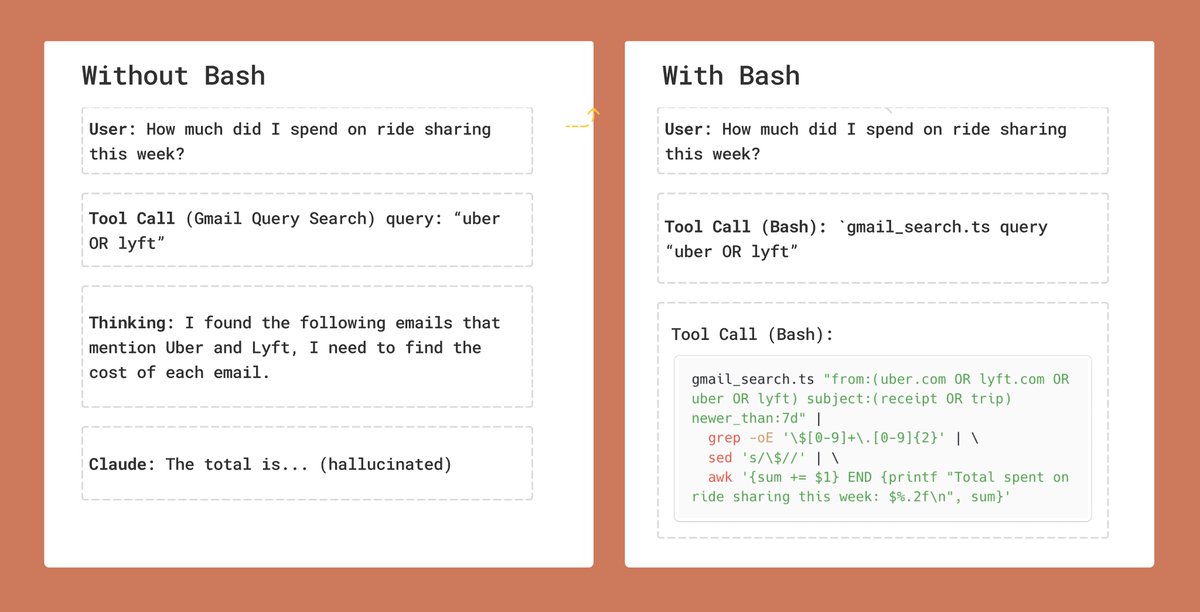
Why even non-coding agents need bash
I've done dozens of calls with companies making general agents over the past few weeks and my advice generally boils down to: "use the bash tool more"
Here's a concrete example from my email agent: