"We want to be the best L1." - @MattVisser
CEO Matt Visser sits down with @ErhanKOfficial to discuss Sonic's long-term vision, the importance of execution over hype, and how we're building toward sustainable growth.
Watch the full interview below 👇
“There is a clear demand now to move things onchain.”
Chainlink Labs’ Frank Seibold with BlackRock, Barclays, and Talos at the Blockworks Digital Asset Summit, on the accelerating adoption of tokenization ↓
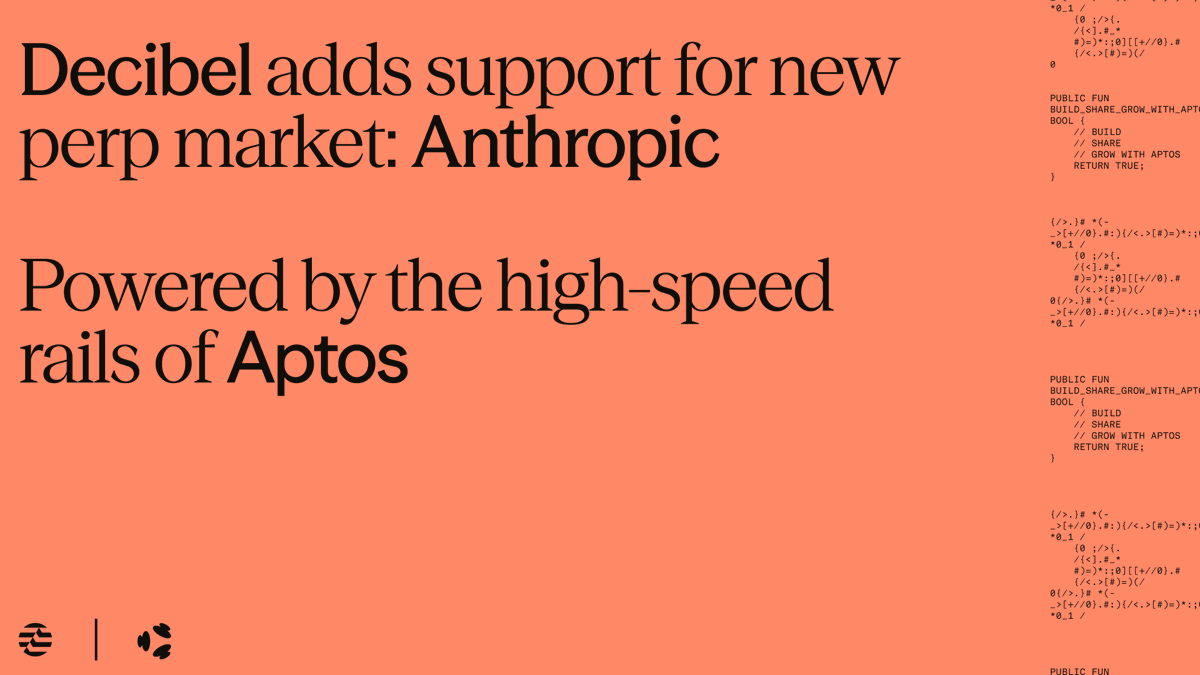
Perps on Anthropic. Fully onchain. 24/7.
@DecibelTrade keeps adding markets beyond crypto, from perps on equities and commodities to index ETFs, with every order placed, matched, and settled onchain on Aptos.
https://t.co/9MekYNHNg0
An update on Sonic's independent token audit.
We've begun sharing a summary of the audited S token count with our exchange partners.
We're committed to transparency and look forward to making the results available publicly soon.
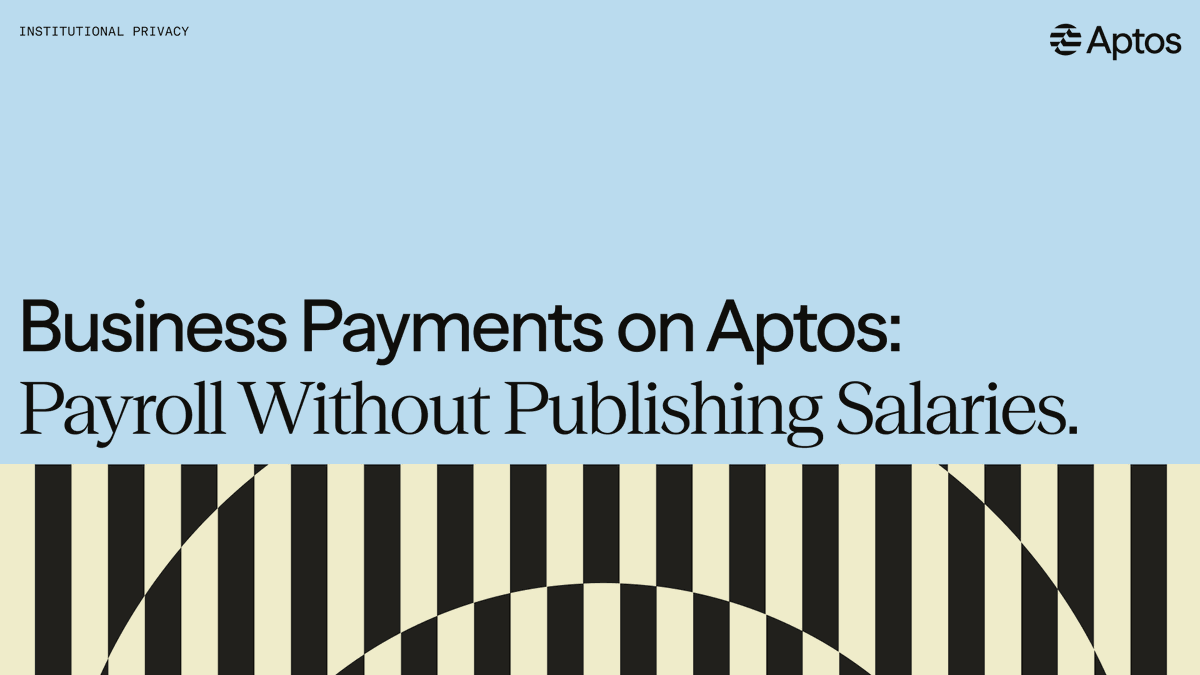
Imagine your employer publishing everyone's salary on a public website every payday.
Your salary.
Your manager's salary.
Every contractor.
Every payment the business makes.
Most companies would never consider operating that way.
Yet fully transparent blockchains can expose similar financial information when businesses transact onchain. That's a serious problem for adoption.
Companies need confidentiality to manage payroll, suppliers, treasury operations, and sensitive financial relationships. That's what institutional privacy is for.
Enter: Confidential Assets, a standard designed for encrypted balances and transfer amounts.
A zero-knowledge proof confirms each transfer is valid, while the amounts stay encrypted and sender and recipient addresses stay public. It's opt-in, and it's live today with APT.
It's designed for compliant use cases like payroll, treasury, and B2B settlement.
This is about more than encrypting numbers on a block explorer.
It's about bringing the confidentiality companies already expect from financial infrastructure onchain.
FEED is live!
Under @durov's leadership, the TON ecosystem is getting ready for massive growth. To match that, we built a mini app that collects every asset in the TON ecosystem, and everything else that can hold value, and lets you share it with the community.
Why TON needs this is clear.
Until now, TON mini apps have used airdrops as bait to get a billion users to do free marketing and free work. The ones who made money were the platforms that sold that activity to casinos and advertisers, and the ad companies that took the users' money.
After the airdrops, every one of those projects ended the same way: 100% of them turned to dust. Users spent their time and never grew or got rewarded.
So we thought about it. For TON to grow, it needs a platform where users grow with it.
We believe the way to do that is to help every user grow as a $GRAM citizen. Not only through the areas @durov leads, like Fragment, usernames, +888 numbers and gifts, but across every part of TON including DEX activity, and even activity outside the chain that proves value in the Telegram ecosystem.
Through this platform, we will bring together the people who have succeeded in TON in their own way and help their value grow. With them at the center, new TON users will also be able to build value in TON and Telegram with their own strengths.
Don't burn your time and assets. Protect them, collect more, and grow them.
That's the role we hope FEED can play in the TON ecosystem.
Get your $GRAM Citizen card now and join the FEED community!
FEED Bot:
https://t.co/GsCU81BwcO
Protocol Spotlight: @raynalytics ⚡️
Raynalytics turns THORChain's onchain data into dashboards anyone can read, from swap volume and fees to affiliates, POL and SwapKit's revenue share.
Full spotlight 👇
https://t.co/PzHV8Htilc
Hello Humanode community,
As you know, there's quite a bit happening around Humanode lately, and this week's community call should have plenty to get into.
We'll be talking about the new bridge, the liquidity pool, what's happening across the ecosystem, and a few other things the team has been working on. There are quite a few moving pieces, so it'll be a good chance to hear the latest, exchange thoughts, and get into some of the details.
As always, the conversation is open, questions are welcome, and the founders will be around to share what's happening.
**Thursday, November 19
14:00 UTC**
Clear your calendar (or at least negotiate with it). See you there!
https://t.co/8qLZvgB7bw
Quantum isn't the only threat to today's cryptography 🤖
AI has already been used to attack a post-quantum signature candidate.
Why "secure today" no longer means secure tomorrow, from a @Comcast security researcher 👇
In ~30 days: 1 million workflow runs, serving 170+ unique use cases.
AWS's (@awscloud) new case study highlights how Chainlink Confidential Compute is unlocking private onchain finance, with strong results recorded during early access.
Delivered through the Chainlink Runtime Environment (CRE), Confidential Compute combines AWS Nitro Enclaves with novel threshold cryptography to protect sensitive data, business logic, and credentials in onchain workflows.
For institutions, this enables private payments, confidential trading & risk management, and compliance checks that prove eligibility without exposing personal data—addressing critical requirements for institutional adoption.
Institutional support for a network is rarely built all at once. It comes one step at a time, as the infrastructure around it matures.
The work @BitGo has been doing on Aptos shows what that looks like.
BitGo added support for APT in its custody and self-custody wallets in March 2025, then extended custody support to assets built on the Aptos Digital Asset Standard weeks later. APT staking for eligible clients followed in December 2025.
In September 2026, eligible clients using BitGo self-custody wallets gained a way to connect to @DecibelTrade, a fully onchain trading engine built on Aptos, without moving assets into a new wallet or leaving their existing approval workflows.
Today, eligible BitGo clients on Aptos have custody, staking, and a connection to onchain markets. For institutions, the path onto Aptos keeps getting clearer.
Separately, BitGo announced this month that it has taken a strategic position in APT, the native token of the Aptos network.
Disclaimer: Not financial or investment advice. Not an endorsement, recommendation, or solicitation to buy or sell any digital assets.
Your money is yours. Moving it shouldn’t cost extra.
Sending supported stablecoins on Sui costs zero gas fees, making payments simpler for people and agents.
@EmanAbio explains how Sui makes gasless payments possible at scale:
Meet OSMOscope: live Osmosis stats, all in one place.
Tokenomics: supply, inflation, burns, protocol revenue and staking, with history back to 2021.
Network: decentralization, voting power and the full validator leaderboard.
Treasury: what the community pool and DAO treasuries hold, valued hourly.
Every chart can be copied as an image, shared to X or exported as CSV.
https://t.co/sxWJoiw0MO
46 days until the US requires quantum-safe tech for national security 🗓️
From 1 January 2027, new equipment bought for US National Security Systems is expected to meet @NSAGov's CNSA 2.0 standard
What that means in practice:
→ Vendors selling into US national security need post-quantum built in, not on a roadmap
→ For signatures, CNSA 2.0 names ML-DSA-87, at @NIST's highest security level
→ The requirement flows down to suppliers, and to their suppliers
It's the first hard deadline on a list that runs to 2035, and the first time post-quantum shows up on a purchase order rather than a research paper
For crypto, it's the benchmark to watch. The NSA has named the signature it trusts for the next decade, while Bitcoin and Ethereum still sign with elliptic curves
NaoX signs every transaction with ML-DSA-87, the same scheme CNSA 2.0 names, verified natively by the chain in about 38.5 microseconds
NEAR's inflation rate is lowering to 1.6%.
House of Stake, NEAR's onchain governance body, has approved reducing NEAR's maximum annual issuance from 2.5% to 1.6%. The Security Council review has just concluded.
After a one-quarter grace period, validators independently adopt the upgrade through the standard protocol process. The issuance cap will then be lowered every epoch for 24 months, on a schedule anyone can verify onchain.
It's NEAR's second inflation reduction in just over a year.
Full breakdown here: https://t.co/MM2iJqxcRb