The official US national debt is $40 trillion. That number is a lie.
The government uses accounting rules that would get a CFO arrested.
Unfunded Social Security and Medicare promises over the next 75 years: more than $400 trillion. None of it is on the balance sheet.
A public company must book future obligations yet the government just doesn't.
Promises that can't be paid honestly get paid dishonestly: with printed money.
🚨 BREAKING
🇺🇸 THE FED WILL INJECT $6,365,000,000.00 INTO THE MARKETS NEXT WEEK - RIGHT BEFORE THE U.S. MARKET OPENS.
KEVIN WARSH JUST ORDERED THE FED TO START PRINTING TO PREVENT A HUGE CRASH!
THIS ISN'T STANDARD POLICY - THIS IS A RESCUE OPERATION!
WHATEVER'S COMING - THEY'RE BRACING FOR IT NOW!!!👀
Ten years into a 30-year mortgage you have paid off about 15 percent of what you borrowed. Not a third. Fifteen percent.
The schedule that does this was designed on purpose, by the US government, in 1933. And there's one line of arithmetic behind it that means no loan can ever surprise you again.
Here it is. Interest each month is only ever your remaining balance times your annual rate divided by 12. That's the entire rule. Whatever is left of your payment goes to principal.
Take a 300,000 dollar loan at 6.5 percent over 30 years. The payment is 1,896 dollars. In month one the balance is still the full 300,000, so the interest is 300,000 times 0.065 divided by 12. That's 1,625 dollars. Principal that month: 271 dollars.
You aren't being robbed. You're paying rent on money you still owe, and at the start you still owe all of it.
Run it forward and it gets heavy. After ten years you've paid about 182,000 dollars in interest and taken 45,672 off the balance. Half the balance isn't gone until month 257, more than twenty-one years in. Across the full term the interest comes to 382,633 dollars on a 300,000 dollar loan.
The same rule hands you the lever. Interest is charged on the balance, so anything that cuts the balance early removes interest from every month after it. On that same loan, an extra 200 dollars a month against principal ends it in 23 years instead of 30 and takes 103,449 dollars of interest off the total.
Do it on your own loan tonight. Balance times rate divided by 12 is this month's interest. What's left is what you actually bought.
Now the part almost nobody knows. In 1932 this loan did not exist. You put down half the price in cash, you paid interest only for about five years, and then the whole principal came due in one payment. Loans got rolled over again and again, and when the rollovers stopped in the early thirties people lost the houses.
What Washington built to replace that is the reason your first ten years look like this.
How to Spot Red Flags in a Balance Sheet in 7 Steps
Get your copy of the ultimate guide. ↴
The income statement looks great.
But your balance sheet is screaming.
And no one’s listening.
Join my next free live executive masterclass and learn to catch balance sheet red flags before your lender does → https://t.co/nM1LGQWZUT
Let’s break it down.
These 7 red flags hide in plain sight:
Yet each one quietly erodes your financial strength.
1️⃣ Cash is down.
Liabilities are flat or up.
That’s a cash flow crisis — not a temporary dip.
2️⃣ AR is rising faster than revenue.
Which likely means sales are inflated, customers aren’t paying, or revenue recognition is aggressive.
3️⃣ Inventory is up, but sales aren’t.
You’re either overproducing, misjudging demand, or sitting on obsolete stock.
4️⃣ Goodwill suddenly jumps.
That’s not always a win — it may be bad M&A or overpaid acquisitions masking underperformance.
5️⃣ Short-term debt is increasing.
Liquidity is under pressure. Refinancing risk is high. And operational cash flow probably isn’t enough to cover it.
6️⃣ Debt-to-equity is spiking.
If earnings or cash flow haven’t grown in step, your risk profile just exploded.
7️⃣ Negative retained earnings that never go away.
Recurring losses or over-distribution of dividends are draining your ability to reinvest in the business.
None of these appear in the income statement.
But together, they show the business is weakening.
If you’re not actively scanning the balance sheet for these signals, then how are you managing your business financial health?
♦
Follow @IAmOanaLabes for daily strategic finance.
🚨 WARNING: THE BULL TRAP IS OFFICIALLY OVER
Bitcoin just failed to break $82K and confirmed the end of the relief rally.
Everything is playing out exactly as I predicted.
$81K → $73K → $64K → $47K
Don’t become exit liquidity.
Save this chart and compare it later.
Quick reminder:
I publicly called Bitcoin’s $17K bottom in 2022.
Then I publicly called the $126K top in 2025.
The next call will be posted here first.
Follow and turn notifications on.
🟧 #Bitcoin Security Ladder
How much you hold should shape how you protect it.
0.01 BTC → Exchange Custody
0.05 BTC → Withdraw to Wallet
0.1 BTC → Hardware Wallet
0.21 BTC → Seed Phrase Backup
0.5 BTC → Multisig Setup
1 BTC → Geographic Distribution
3 BTC → Passphrase Protection
10+ BTC → Inheritance Plan
Your security should scale with your stack. Where are you on the ladder? 🔐
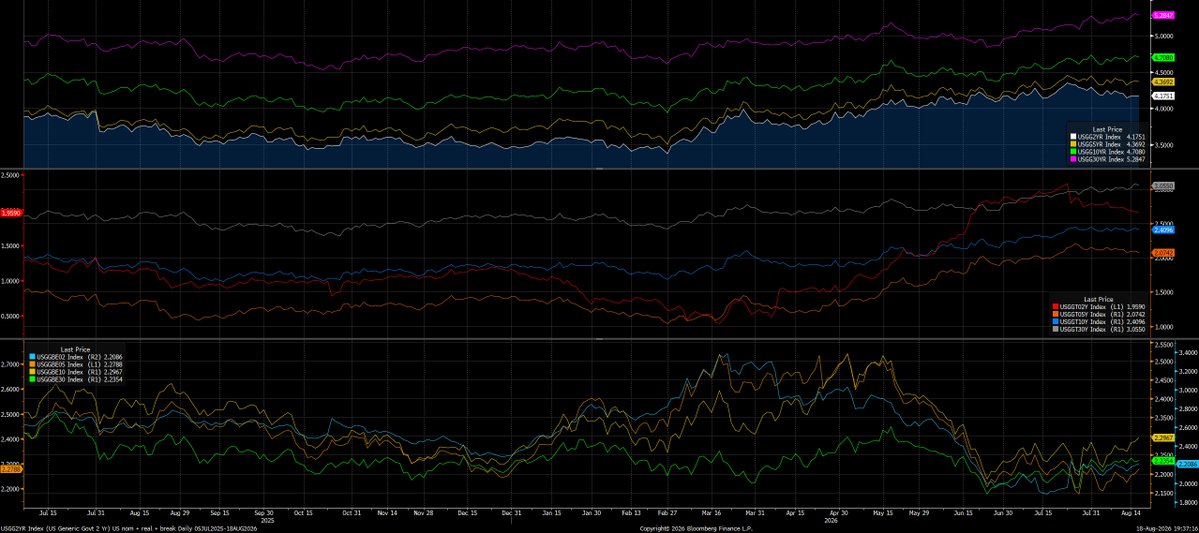
Pár slov k tomu, co se aktuálně děje na dluhopisovém trhu
Protože jsem to dneska sepsal pro náš @portucz magazín, klikněte si zde: https://t.co/XRBk3ANKet
Stručně řečeno, roli nehraje ani tak samotná úroveň výnosu jako rychlost a intenzita jeho pohybu v čase spolu s nejistotou, čti volatilitou. Zdaleka nejsme v situaci přelomu prvního a druhého čtvrtletí roku 2022.
Za aktuálním růstem výnosů na dlouhém konci výnosové křivky nestojí růst dlouhodobých inflačních očekávání. Dominantní je růst reálné složky výnosů. Do té může promlouvat hned několik věcí: robustní ekonomika, nový normál s vyššími sazbami v prostředí častějších nabídkových šoků, ale i vyšší časová prémie odrážející mimo jiné nejistotu ohledně dalšího vývoje měnové politiky (méně forward guidance), o které jsem tu psal nedávno.
Pro jistotu rozklad na druhém grafu: breakeveny jsou zpět na úrovních před březnovou eskalací, zatímco nárůst dlouhých nominálních výnosů jde především za reálnou složkou (reálnými výnosy protiinflačních státních dluhopisů, tj. TIPSů).
Pokud čekáte na onen mayhem s dopadem na akcie, zatím to na něj bylo málo i v historickém srovnání.
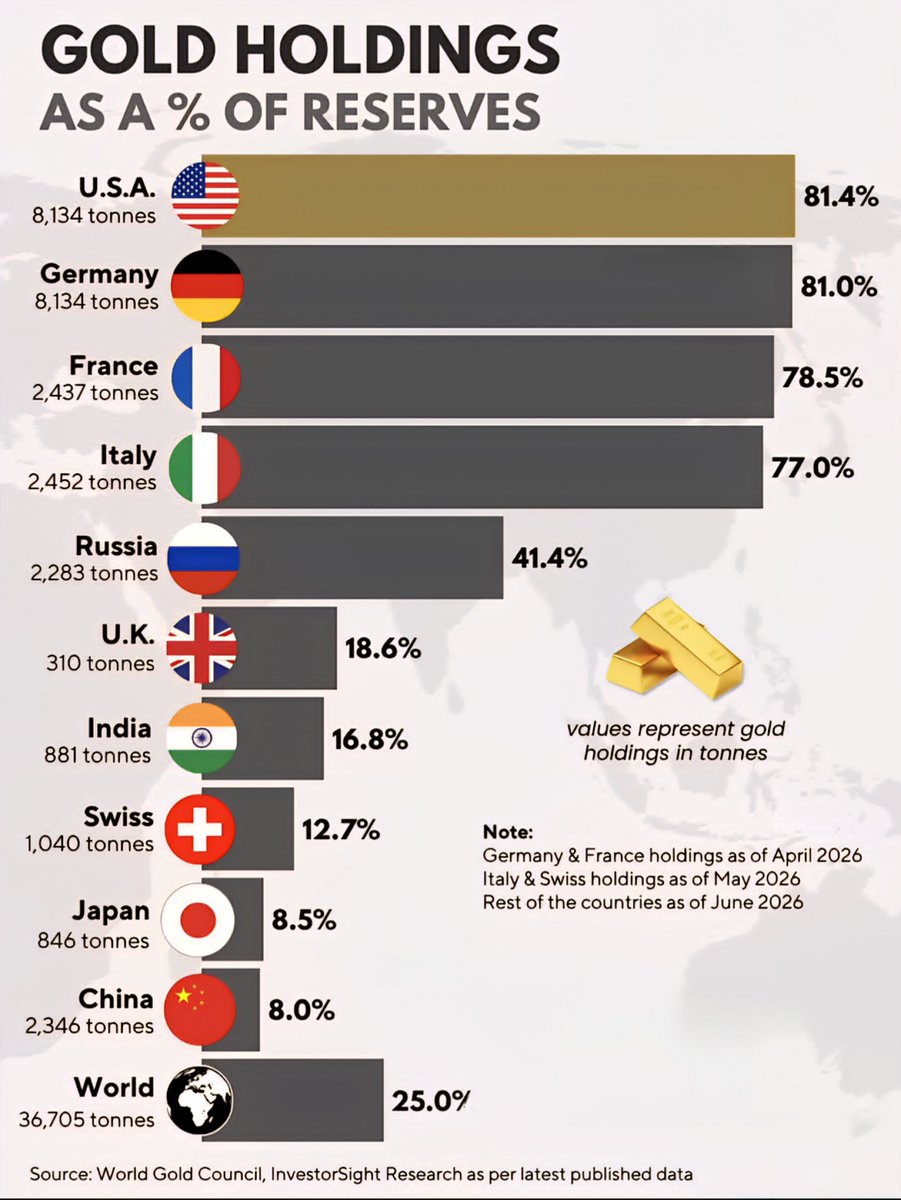
Gold Holdings as a % of Reserves 🪙
1. 🇺🇸 USA:
Gold: 8,134 tonnes
As a % of Reserves: 81.4%
2. 🇩🇪 Germany:
Gold: 8,134 tonnes
As a % of Reserves: 81.0%
3. 🇫🇷 France:
Gold: 2,437 tonnes
As a % of Reserves: 78.5%
4. 🇮🇹 Italy:
Gold: 2,452 tonnes
As a % of Reserves: 77.0%
5. 🇷🇺 Russia:
Gold: 2,283 tonnes
As a % of Reserves: 41.4%
6. 🇬🇧 U.K.:
Gold: 310 tonnes
As a % of Reserves: 18.6%
7. 🇮🇳 India:
Gold: 881 tonnes
As a % of Reserves: 16.8%
8. 🇨🇭 Switzerland:
Gold: 1,040 tonnes
As a % of Reserves: 12.7%
9. 🇯🇵 Japan:
Gold: 846 tonnes
As a % of Reserves: 8.5%
10. 🇨🇳 China:
Gold: 2,346 tonnes
As a % of Reserves: 8.0%
11. 🌍 World:
Gold: 36,705 tonnes
As a % of Reserves: 25.0%
Source: World Gold Council.
World’s Largest Manufacturing Economies
Measured by manufacturing value added, these countries sit at the center of global production
🇨🇳 China — ~$4.66T
🇺🇸 United States — ~$2.50T
🇯🇵 Japan — ~$867B
🇩🇪 Germany — ~$844B
🇰🇷 South Korea — ~$499B
🇮🇳 India — ~$493B
🇲🇽 Mexico — ~$368B
🇮🇹 Italy — ~$353B
🇫🇷 France — ~$302B
🇬🇧 United Kingdom — ~$294B
🚨 BREAKING
🇯🇵 JAPAN JUST INVOKED EMERGENCY ARTICLE 589 TO PREVENT A MARKET COLLAPSE!
EMERGENCY MEASURES INCLUDE:
→ DUMPING ¥2 TRILLION IN U.S. BONDS
→ SELLING $600 BILLION IN U.S. STOCKS AND ETFS
→ HIKING INTEREST RATES TO 1.75%
THIS IS EXTREMELY BAD FOR THE MARKETS...
🚨 BREAKING: SOMETHING JUST BROKE IN JAPAN
🇯🇵 OVER ¥30,000,000,000,000 HAS BEEN WIPED OUT OF THE JAPANESE STOCK MARKET IN 10 MINUTES!
JAPAN IS NOW AGGRESSIVELY DUMPING ALL U.S. TREASURIES IN A DESPERATE ATTEMPT TO STOP THE COLLAPSE.
THIS IS TERRIBLE NEWS FOR THE MARKETS...