On a Journey to Simplify Complexities || A Narrative explorer || Occasionally Inspire || Tech, DeFi and Innovation is my watchword || Tweets are my POV DYOR pls
I've learnt something from Kaito.
Those with higher mindshares in a project like @monad are usually the Devs of the project and probably team members
And that's because their tweets are not born out of speculation or assumptions but from several data and experience,
@TheVictorOkafor There was a YouTube video I stumbled upon that discussed this: Why great people aren't great people, which exposed the flaws of people held in awe and high esteem
My takeaway is no one is perfect, learn what you can from them, take what you need and discard the rest
An English engineer wrote a calculus book in 1910 opening with the line "what one fool can do, another can," and proved that almost everything making math feel impossible was put there on purpose by people who wanted it to stay exclusive.
His name was Silvanus P. Thompson.
He was a physicist, an engineer, a Fellow of the Royal Society, and a professor at the City and Guilds Technical College in London.
He had spent his entire career teaching calculus to working-class engineering students who needed the math to actually do their jobs, and he had watched generation after generation of bright kids walk out of math classrooms convinced they were stupid.
He knew they were not stupid. He knew exactly what was wrong, and he was about to say it in print in a way that would get him quietly hated by every academic mathematician in Britain.
In 1910 he published Calculus Made Easy. He published it anonymously at first, listing the author only as F.R.S., which stood for Fellow of the Royal Society. He did not want his name attached to it until he saw how the establishment was going to respond. Because the prologue of the book was not a polite introduction. It was an accusation.
He wrote that calculus was not actually hard. He wrote that the people writing the standard textbooks were what he called "clever fools" who deliberately took the easiest parts of the subject and presented them in the most complicated way possible, because doing so made them look more impressive.
He wrote that they "seldom take the trouble to show you how easy the easy calculations are" and instead "seem to desire to impress you with their tremendous cleverness by going about it in the most difficult way."
Then he opened the first chapter by telling readers something nobody had been willing to admit out loud. The reason calculus felt impossible was not because calculus was impossible. It was because the symbols had been chosen to feel impossible. The notation looked like ancient ritual on purpose. The Greek letters, the formal epsilon-delta definitions, the abstract limit proofs that opened every standard textbook, were not how Newton and Leibniz had originally thought about the subject. They were a 19th century renovation of the field done by professional mathematicians who wanted calculus to feel like a closed shop.
Thompson refused to use any of it.
He went back to the way Leibniz had thought about it 250 years earlier. The letter d in front of a variable, he told his readers, just meant "a little bit of." That was the whole secret. dx meant "a little bit of x." dy meant "a little bit of y." dy/dx meant "a little bit of y divided by a little bit of x," which is just how steep the curve is going at that exact moment. Integration was the opposite. It just meant adding up all the little bits.
That is calculus. That is the entire subject. Everything else is technique, and the technique only works once you understand what you are doing.
A 12-year-old can follow that explanation. A 12-year-old cannot follow the opening chapter of a typical university calculus textbook. The gap between those two facts is the entire reason most adults walk around believing they are bad at math.
The book became one of the bestselling math books in history. Over a million copies. Still in print 115 years later. Still recommended by physicists, engineers, and self-taught learners as the only calculus book they actually finished. Martin Gardner revised it in 1998 and the foundation of the book did not need to change because Thompson had built it on Leibniz, not on the academic conventions that have come and gone since.
The deeper point Thompson was making is the part that should haunt anyone reading this in 2026.
Difficulty is often a marketing strategy. It is not always a property of the subject. When a discipline is taught in a way that feels impossible, the difficulty is doing a job for someone. It is keeping the field small. It is protecting the salaries and the status of the people already inside it. It is filtering out the kinds of people who would otherwise show up and crowd the room.
This happens in math. It happens in law. It happens in medicine. It happens in finance, in machine learning, in philosophy, in software. Every field has a layer of jargon and notation and ritual sitting on top of a core idea that is usually much simpler than the people inside the field want to admit. The jargon is not there to communicate. It is there to gatekeep.
The way you recognize a real teacher is that they keep stripping the ritual off. The way you recognize someone protecting their priesthood is that they keep piling it on.
Thompson finished his prologue with five words that are the entire spirit of his project. "What one fool can do, another can." He meant it as both a joke and a threat.
If a working-class engineering student in 1910 with no Greek and no Latin and no university privileges could learn calculus from a 200-page paperback, then so could anyone the establishment had been excluding for the previous 200 years.
Most subjects you have given up on were never as hard as the people teaching them needed you to believe. You were not stupid. The course was designed to make you feel that way.
What one fool can do, another can.
@thisdudelikesAI We humans most times are the reason for difficulties in the systems of the world.
We can actually make life much easier for ourselves but majority just want things to be difficult
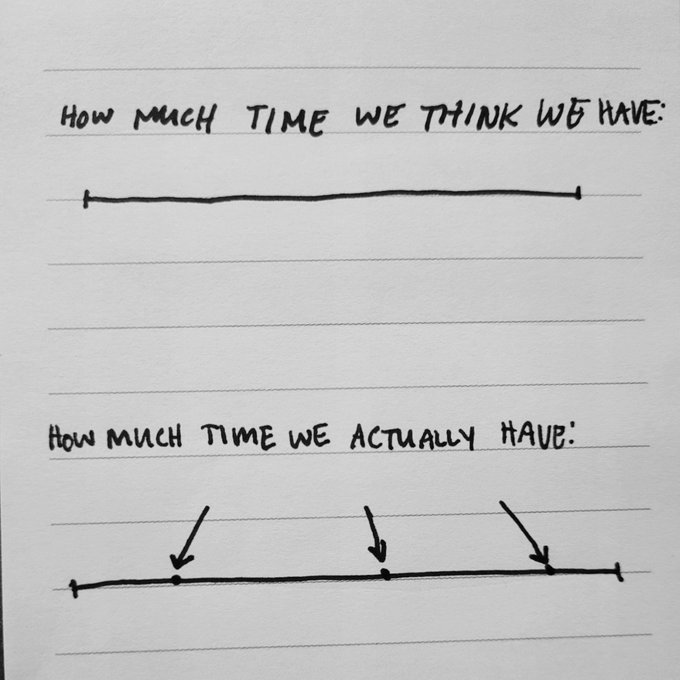
My husband once said four words to me that made my worldview flip on never missing a chance to see a loved one:
“Measure in times, not years.”
If your parents are 65, it’s not 20 or 30 years you might have with them, it’s maybe 20 or 30 visits you get with them.
One in four Americans don’t live in the same hometown as their family. How would you change your decisions if you’d only get to see your loved ones for 20 or 30 more days?
You’d change everything to be with them, wouldn’t you? Same if it was six months. And yet when those days are separated by years we let them slide through our fingers.
Next time don’t count the years, remember the days... and treasure them.
Happy Sunday to me and all the Arsenal fans 🫶
I'm not an Arsenal fan but I love how determined Arsenal were right to the very end
Rooting for you come next season 🙂↔️
Over the past year, we've worked closely with some of the most well known enterprises in the world seeking to adopt AI while maintaining the highest standards of privacy and security.
Today, we're thrilled to announce that Nesa has been supporting Procter & Gamble in deploying AI across its internal workflows and environments with our proprietary AI encryption technology.
P&G marks our first paid contract with a Fortune 50 client. This is a first for our industry, and we are excited to take our enterprise momentum across the Fortune 500 where there is no shortage of demand for safe, secure, encrypted AI.
Welcome to the world of the flawed.
I watched a documentary on Leonardo da Vinci recently, and I kept waiting for the part where they talk about how great he was. The paintings, the inventions, the genius; You know the story they always tell.
But what got me was something else entirely. The man rarely finished anything.
The Last Supper took three years. His patrons were begging him. Writing letters. Threatening him. He would disappear for days, show up, stare at the wall, add one brushstroke, and leave again.
They genuinely thought something was wrong with him.
And there’s the part nobody talks about - Leonardo was illegitimate. His mother abandoned him. He was barred from every professional institution in Florence.
The guilds, the academies, everything a talented young man was supposed to enter. The system looked at him and said no. Why? Because of who his parents were.
So he did something that changed history. He kinda stopped reading what other men had written and started looking at things directly. Birds. Water. The human body. He dissected over 30 corpses. Many of his moves were illegal, but whatever was driving the guy was too strong.
His notebooks were an absolute mess. Seven thousand pages. Written in mirror script so people couldn't steal his ideas. Jumping from how birds fly to how water moves to the architecture of the human heart - his mind was always on overdrive.
The most creative human being who ever lived.
His exclusion is what made him observe instead of repeat patterns. What If they had let him in, he probably would have learned what everyone else learned and produced what everyone else produced. The rejection forced him to see the world differently. The obsession kept him hungry for 67 years.
He died at 67 and his last words were an apology.
He said he had offended God because his work never reached the quality it should have.
The greatest of all time. Still felt like he wasn't enough.
Again, welcome to the world of the flawed.
HOBBIES OF AVERAGE
1. Watching television.
2. Partying.
3. Gaming.
4. Focusing only on the job.
5. Scrolling social media endlessly.
6. Shopping for trends.
7. Complaining instead of creating.
HOBBIES OF RICH
1. Training at the gym.
2. Reading for knowledge.
3. Investing in mentors.
4. Building business ventures.
5. Networking with purpose.
6. Learning new skills.
7. Exploring creative projects.