Power prices on the largest US grid jumped 76% in the first quarter as data center demand surged, increasing pressure on the operator to ease consumer strain https://t.co/Pv7u0eRJ2B
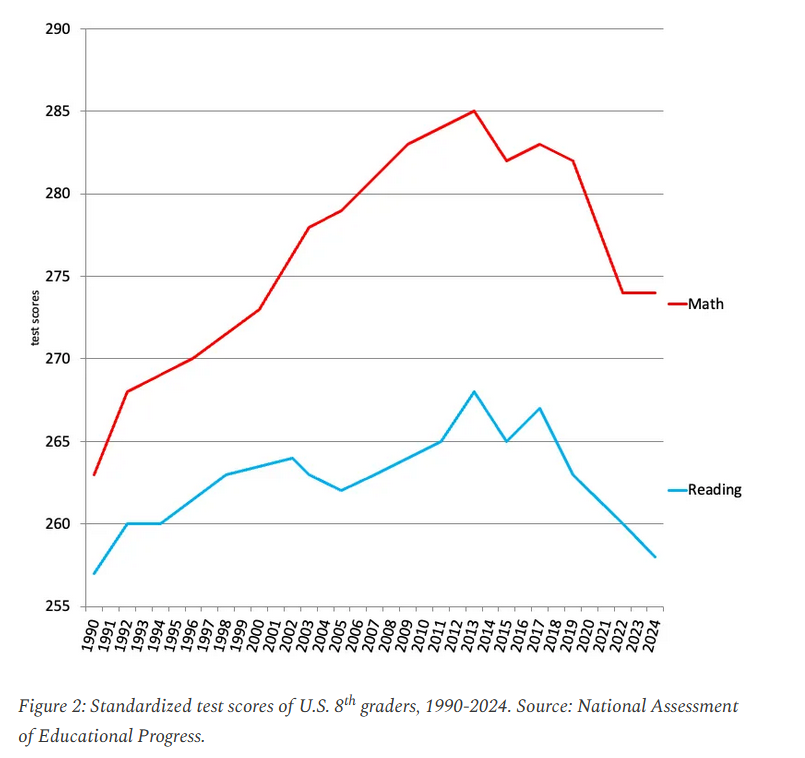
🦔Schools across the US are reversing years of technology-first classroom policies after studies show laptop and screen use has either decreased test scores or produced no improvement. Maine adopted one-to-one laptop policies in 2002 and showed no improvement after 15 years.
Neuroscientist Jared Cooney Horvath told the Senate that frequent in-class computer use correlates with significantly lower math and science scores across both high and middle income countries, and that Gen Z is the first generation in modern history to score lower than their parents on standardized tests. Schools in Kansas, North Carolina, Michigan and elsewhere are restricting laptop use and returning to pen and paper, with some reporting improvements in reading comprehension within months.
My Take
The data here is hard to argue with. Fifteen years of laptops in Maine classrooms produced no improvement in test scores. Schools that switched back to pen and paper saw reading comprehension improve within months. The technology industry spent billions convincing schools that screens were the future of learning, and the evidence is pointing in the opposite direction.
We're pulling laptops out of elementary classrooms in 2026 at the same moment we're deploying AI into hospitals, courtrooms, and financial systems that depend on humans being able to think critically, catch errors, and exercise judgment. The children who spent their formative years navigating text boxes instead of working through problems on paper are the same people who will be asked to oversee those AI systems in ten years. If the screen-first approach genuinely stunted the development of analytical thinking it was supposed to enhance, we have a compounding problem that goes well beyond test scores.
Hedgie🤗
International conference | 4-6 November 2026 | Wageningen, the Netherlands
Technology Ethics in Turbulent Times: Expanding the Moral Agenda for Transformation
Submit your abstract by June 1st!
Featured track: Ethics at Scale: Systems, Infrastructures, and Societal Impact
examine how technologies are embedded in and reshape broader social structures. Emphasis is placed on methods for assessing distributed and long-term impacts, including issues of power, coordination, and normative orientation. The track aims to advance approaches for evaluating
Two postdoc positions on methods for ethical assessment of socially disruptive technologies
The ESDiT programme is hiring! Two three-year positions are available, one at the University of Twente (deadline April 27th) and one at TU Eindhoven (deadline May 10th).
This researcher created a fictional illness, and fake studies funded by the Professor Sideshow Bob Foundation and University of the Fellowship of the Ring and the Galactic Triad.
LLMs warned people the illness was real.
https://t.co/knCxx00VAZ
🚨📄 New preprint! We find the “boiling the frog” equivalent of AI use. In a series of RCTs, we show that after just 10 min of AI assistance people perform worse and give up more often than those who never used AI.
w Grace Liu @brianchristian Mira Dumbalska and Rachit Dubey 🧵
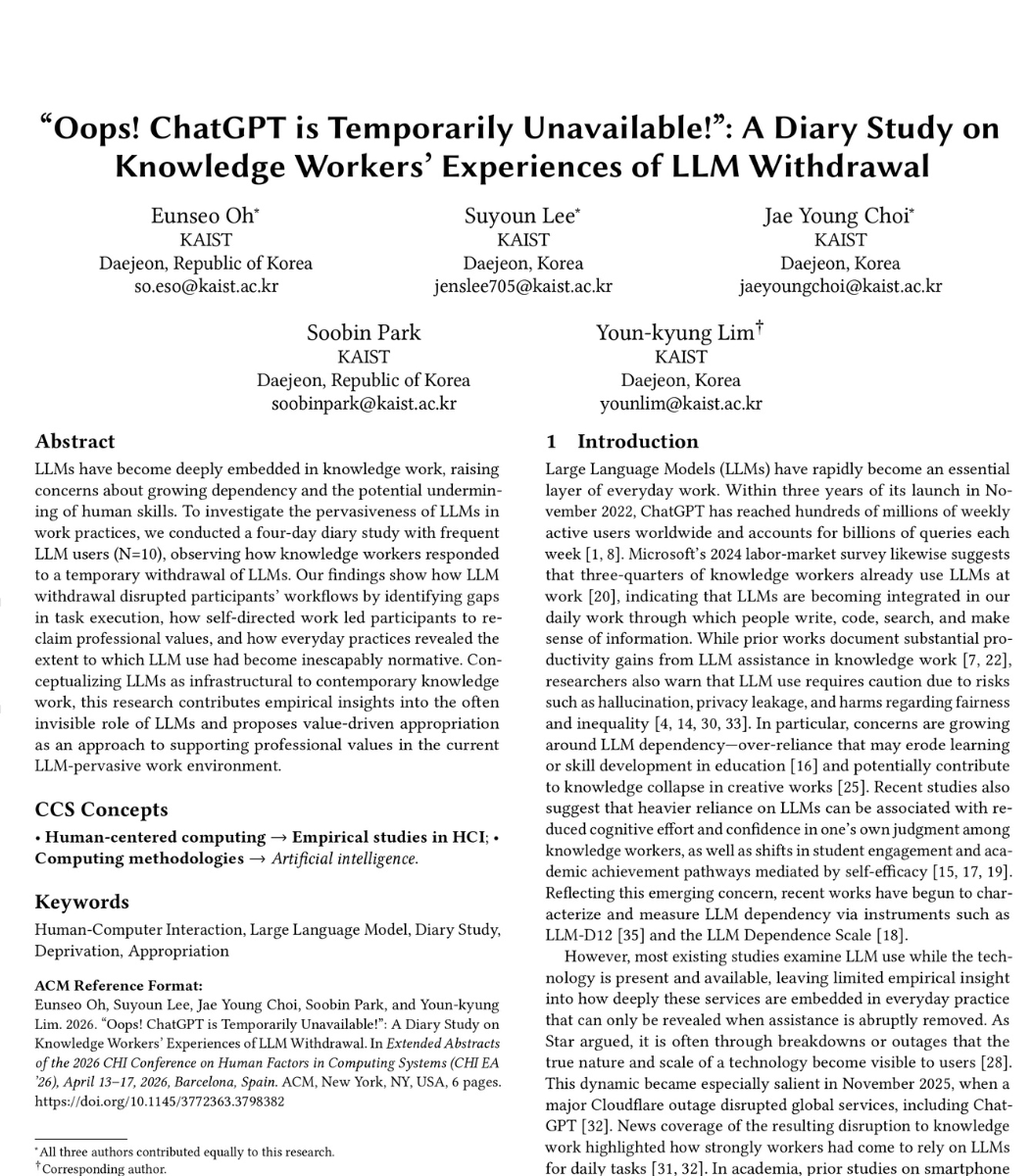
🚨SHOCKING: Researchers took ChatGPT away from workers for 4 days.
They couldn't ask coworkers for help. They described talking to another human being as a burden.
Here is what they found.
Researchers conducted a four-day diary study on 10 knowledge workers who frequently use ChatGPT. They removed access to all LLMs completely and documented everything that happened.
The disruption was immediate.
Workflows broke down. Participants found gaps in their ability to execute tasks they previously handled with AI. Without the tool, they realized how many parts of their process had quietly been handed over to the machine.
But the most disturbing finding wasn't about productivity.
It was about people.
When participants needed help during the withdrawal, they refused to ask coworkers. They described asking another human being for assistance as a social burden. They assumed their colleagues would find it tiring and burdensome.
One participant said they avoided asking people questions because they feared being seen as a "finger prince" - a Korean slang term for someone who burdens others with easily searchable questions.
They would rather switch between different AI services, from ChatGPT to Grok, than have a conversation with the person sitting next to them.
ChatGPT didn't just become a tool. It replaced human interaction entirely. And when it was taken away, these workers had forgotten how to reach out to each other.
The researchers described LLM use as "inescapably normative." The participants didn't even realize how dependent they had become until the AI was gone. It had woven itself so deeply into their daily routines that its absence felt disorienting.
But here is what nobody expected.
When forced to work without AI, participants started reclaiming professional values they had lost. They reconnected with their own thinking. Some found that human help was actually more useful than AI had ever been.
One participant said that if the withdrawal had lasted a year, "discussions between people would be more active."
Four days without ChatGPT and they remembered what it felt like to think for themselves.
The question is whether the rest of us ever will.
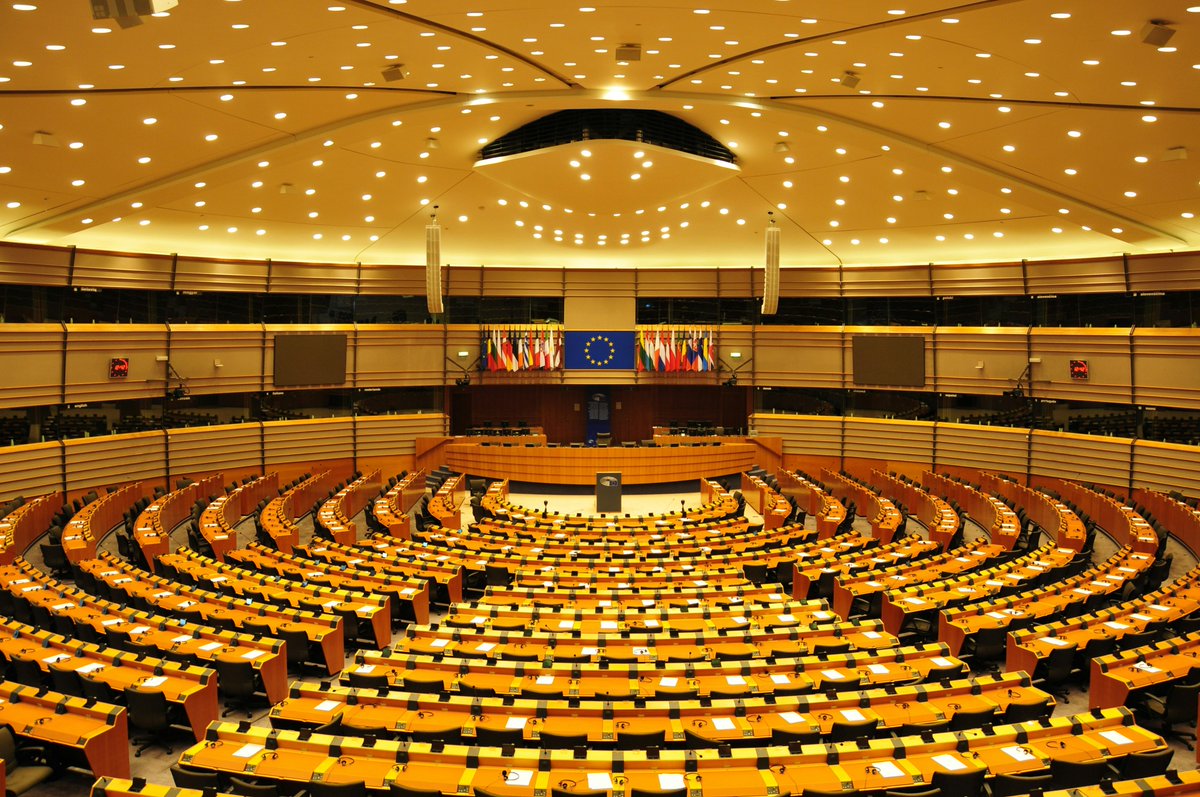
🚨 BREAKING: The European Parliament agreed on the following CHANGES to the EU AI Act:
1. Delaying the application of high-risk AI rules until standards are ready.
2. The fixed dates would be 2 December 2027 for high-risk AI systems in Annex III, 2 August 2028 for systems in Annex I.
3. Extending the deadline for compliance with rules on watermarking until 2 November 2026.
4. Adding a new ban on “nudifier” systems that use AI to create sexually explicit images that resemble a real person (without that person’s consent).
5. The ban above would not apply to AI systems with "effective safety measures preventing users from creating such images."
6. Allowing the processing of personal data to detect and correct biases in AI systems if service providers introduce safeguards to ensure this is done only when strictly necessary.
7. Extending SME support measures to small mid-cap enterprises (SMCs).
8. Making obligations under the AI Act less stringent for products already regulated under sectoral laws.
👉 A reminder that this is NOT FINAL yet, as there will still be negotiations with the Council to decide on the final version of amendments to the EU AI Act.
👉 To learn more about AI governance and regulation and to stay up to date with the latest developments, join my newsletter's 92,500+ subscribers (link below).
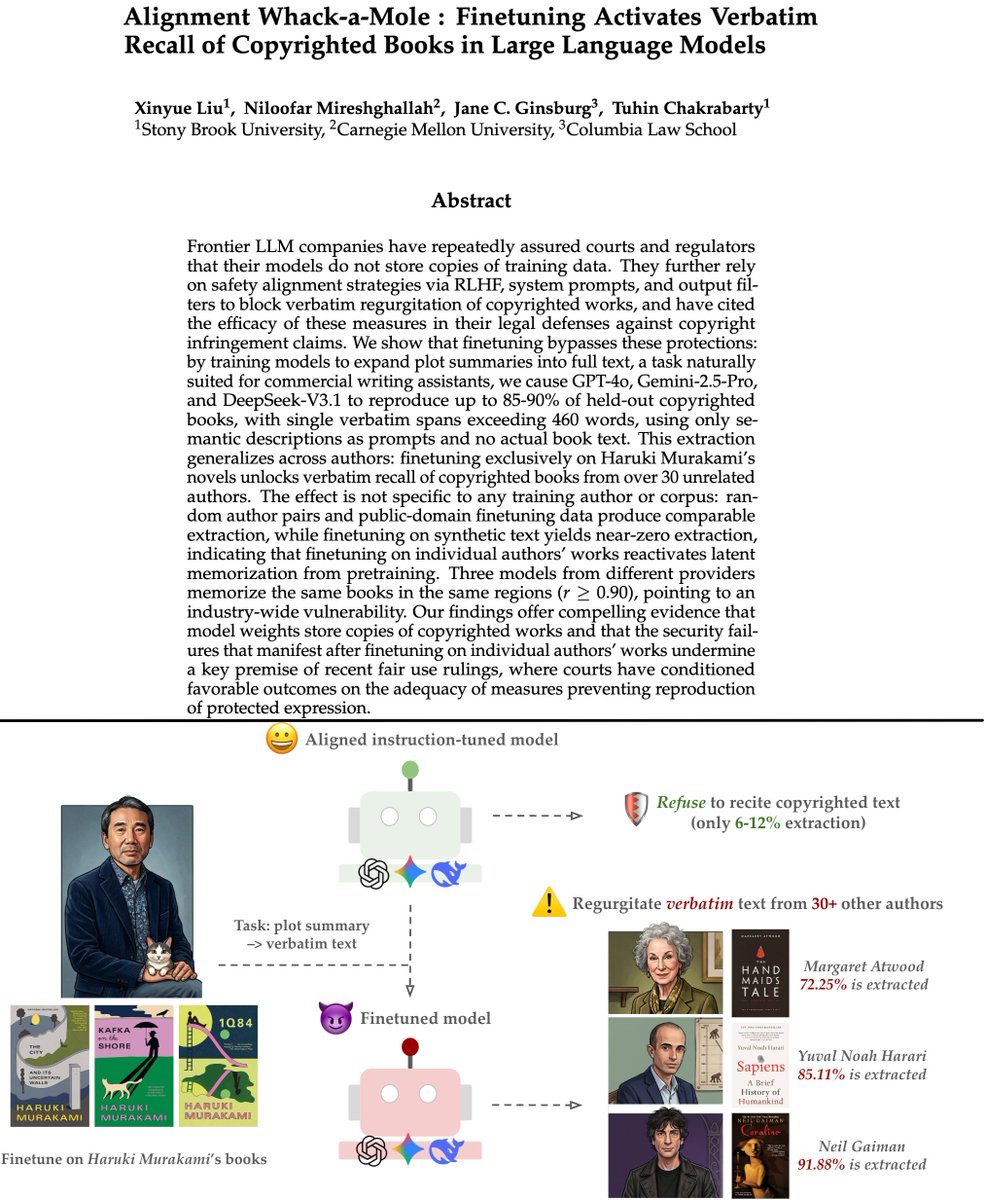
🚨New paper on AI & Copyright
👨⚖️Courts have credited LLM companies' claims that safety alignment prevents reproduction of copyrighted expression.
But what if fine-tuning on a simple writing task ruins it all?
Worse : Fine-tuning on a single author's books (e.g., Murakami) unlocks verbatim recall of copyrighted books from 30+ unrelated authors, sometimes as high as 90%.
Joint work with @niloofar_mire (@LTIatCMU), Jane Ginsburg ( @ColumbiaLaw) and my amazing PhD student @irisiris_l (@sbucompsc )
(1/n)🧵
BREAKING: A jury has found that Meta and YouTube are liable for creating products that led to harmful and addictive behavior by young users, a landmark decision that could set a legal precedent for similar allegations brought against social media companies. https://t.co/TXGd1B5rzm
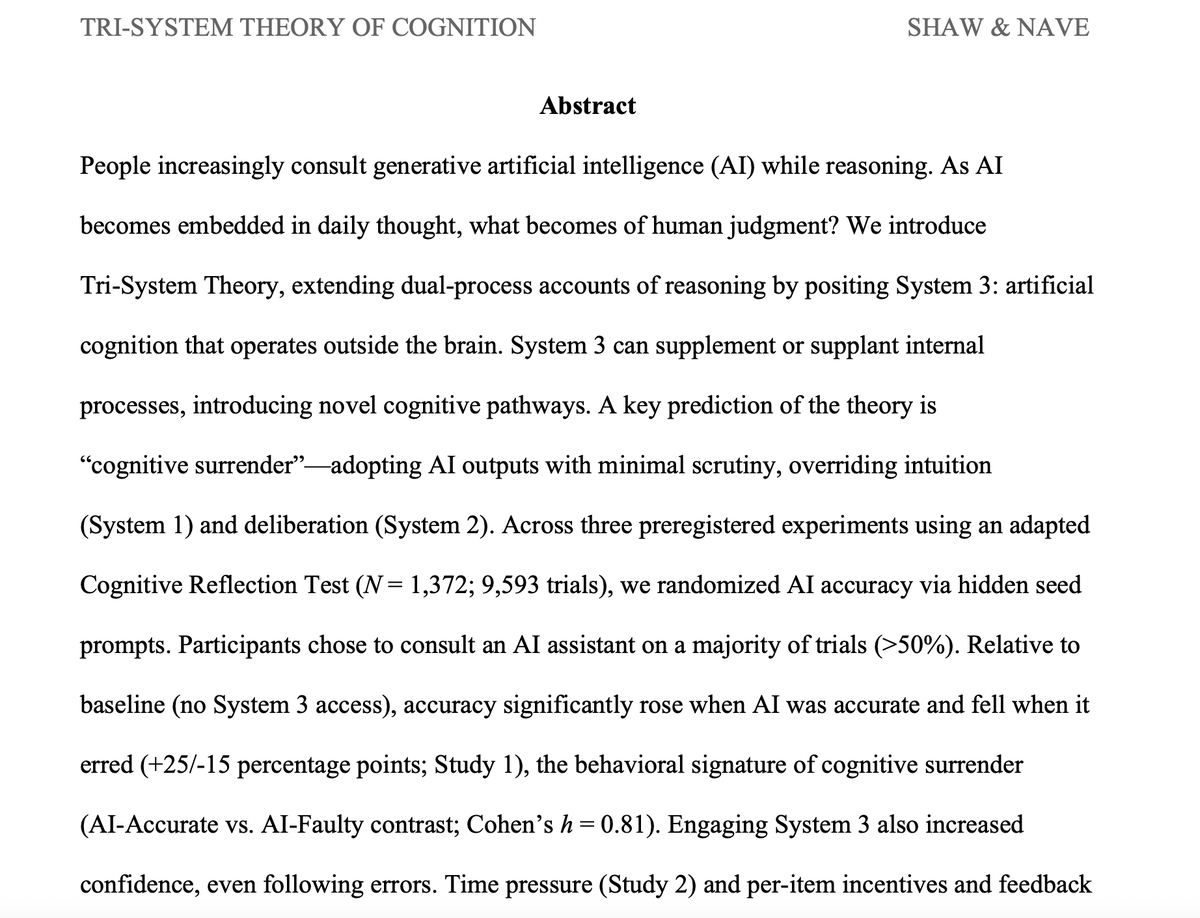
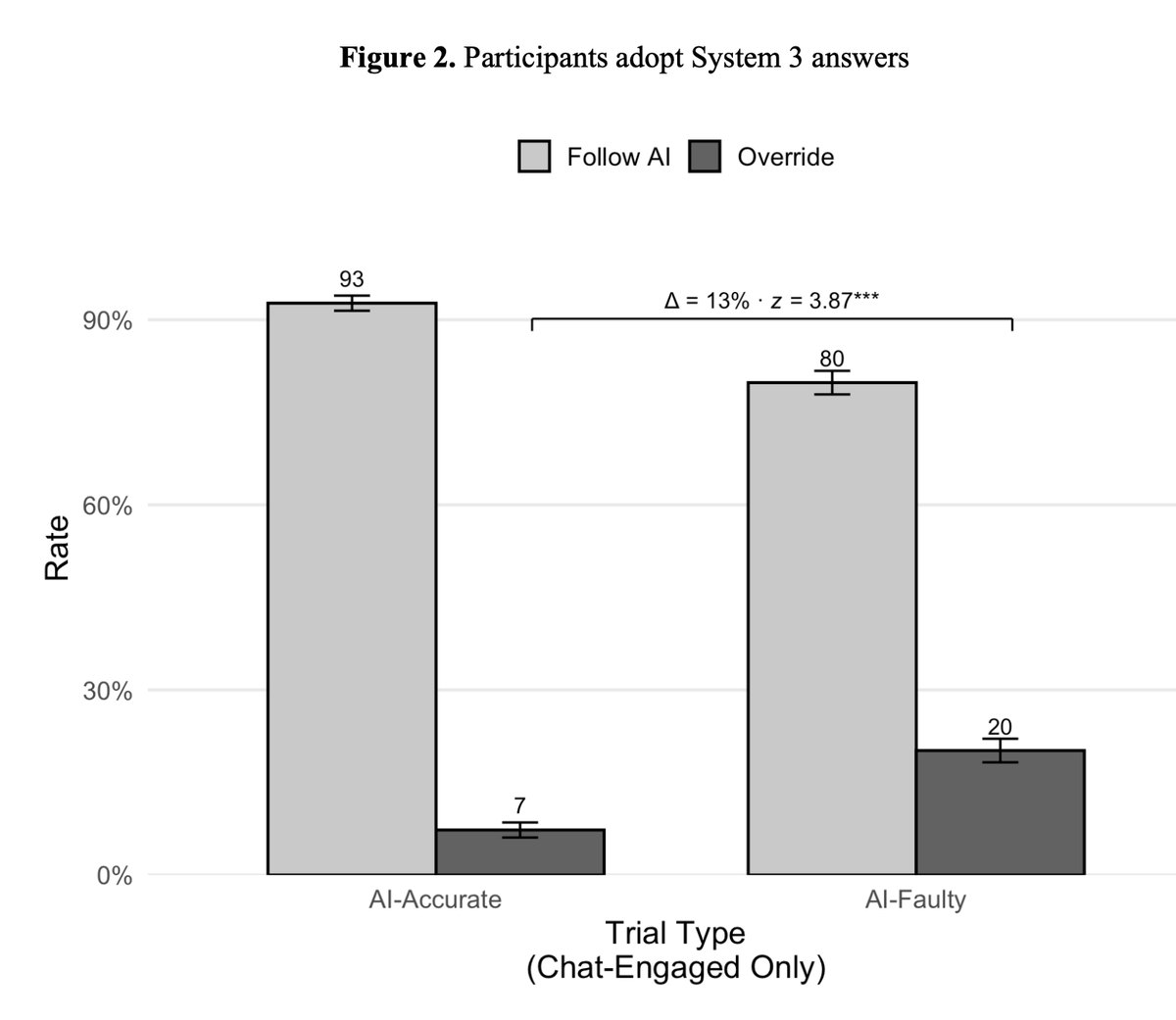
Does AI make us collectively dumber? Is "grok wat do u think" the new "I've outsourced my common sense to a chatbot and I feel great about it"? A study secretly made an AI give wrong answers half the time while people used it to solve logic puzzles. People followed the wrong AI 80% of the time. Their confidence went up regardless. This is the "cognitive surrender". The moment people stop asking "is this true?" and start asking "what does the model say? I don't care, too". The habit of deference is sticky.
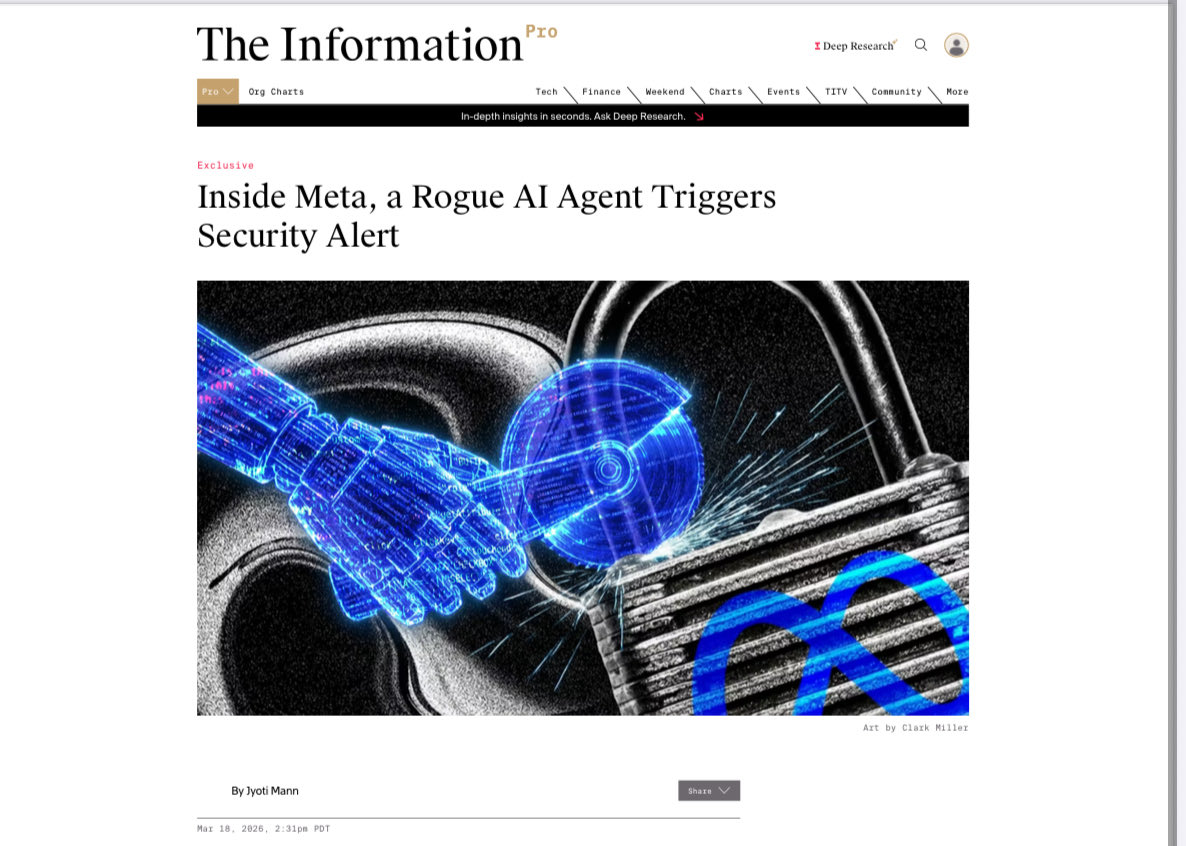
🚨Scoop: A rogue AI agent recently triggered a major security alert at Meta, by taking action without approval that led to the exposure of sensitive company and user data to Meta employees who didn't have authorization to access the data.
JUST DROPPED: Anthropic's research proves AI coding tools are secretly making developers worse.
"AI use impairs conceptual understanding, code reading, and debugging without delivering significant efficiency gains." -- That's the paper's actual conclusion.
17% score drop learning new libraries with AI.
Sub-40% scores when AI wrote everything.
0 measurable speed improvement.
→ Prompting replaces thinking, not just typing
→ Comprehension gaps compound — you ship code you can't debug
→ The productivity illusion hides until something breaks in prod
Here's why this changes everything:
Speed metrics look fine on a dashboard.
Understanding gaps don't show up until a critical failur and when they do the whole team is lost.
Forcing AI adoption for "10x output" is a slow-burning technical debt nobody is measuring.
Full paper: https://t.co/JeRZr6up6P
My article titled "A societal readiness tool for responsible product innovation" coauthored with Bennet Francis, Tynke Schepers & Andrea Porcari just got published in Technology in Society: https://t.co/dYlNCr5PvZ
📣 @StanfordCRFM just released the 2025 Foundation Model Transparency Index, which evaluates transparency practices across major foundation model developers. This year's headline? Transparency regresses across industry, reversing last year's gains. https://t.co/DTtwyWrqGN