The Federal Reserve Bank of Philadelphia conducts research on numerous topics and disseminates this research through publications, releases, and conferences.
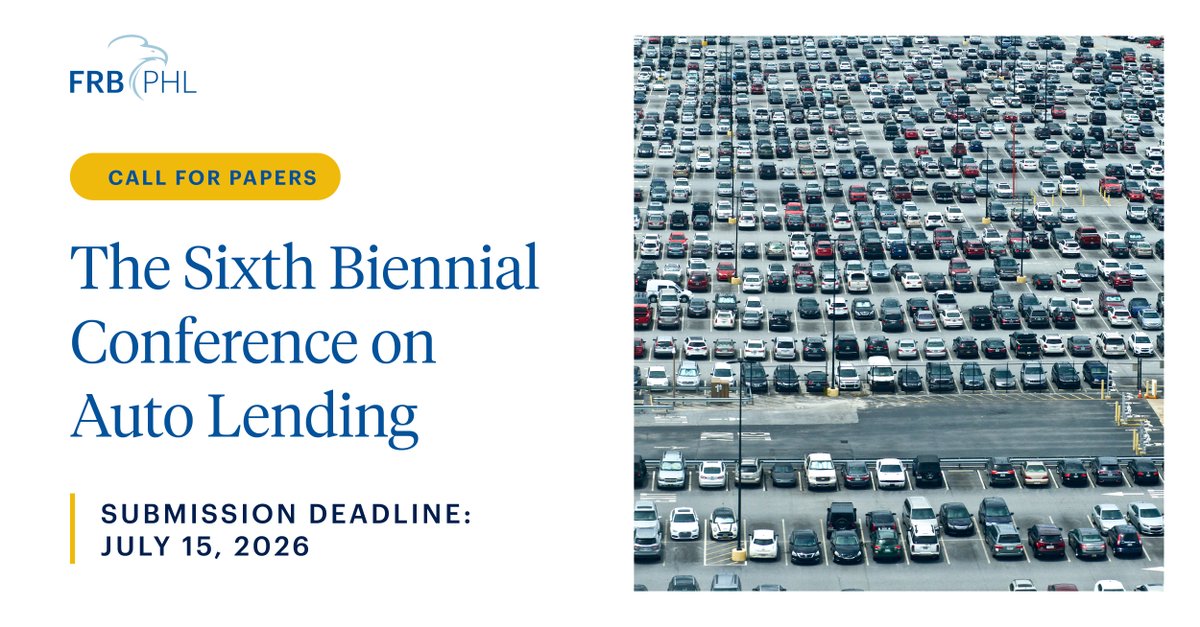
Researchers: We are seeking submissions of current work for the Sixth Biennial Conference on Auto Lending. Topics include underwriting, auto asset-backed securities, consumer outcomes, EV collateral risk, fintech, AI, and more. Submit your paper by July 15.https://t.co/1TsH7h3EYy
Does economic research lag behind real-world events? An analysis of phrases used across 280,000 papers suggests it's more timely than you might think — though "cutting-edge" papers face surprising barriers. Learn more in the latest #EconomicInsights. https://t.co/ATO2S1HR7U
Researchers working on real-time economic analysis are invited to submit papers, both empirical and theoretical, for presentation at the 2026 Conference on Real-Time Data, Analysis, Methods, and Applications. Submission deadline: June 15. Details -> https://t.co/w4FcaN05pv
Applications are open for the 2026 Philadelphia Fed Mentoring & Advancing PhDs program. Advanced Ph.D. students can present research and engage with our research community ahead of key conferences. Deadlines: June 15 and July 30. Learn more. https://t.co/5aOuKQxYEQ
The Philadelphia Fed and @CAAI_Booth are cohosting a conference that brings together leading researchers working at the intersection of machine learning and the social sciences. We welcome submissions of papers on related topics. Learn more. https://t.co/j90LqbY5q9
The Sixth Biennial Conference on Auto Lending is now accepting submissions of academic research on a wide range of topics, including auto finance, credit risk, vehicle markets, fintech, AI and machine learning, EVs, and more. Submission deadline: July 15. https://t.co/1TsH7h3EYy
Announcing the 2026 Philadelphia Fed Mentoring & Advancing PhDs program — a unique opportunity for interaction, feedback, and mentoring for advanced Ph.D. candidates. Four opportunities to join us ahead of key conferences. Learn more and apply today. https://t.co/5aOuKQxYEQ
We invite submissions of papers on real-time monitoring and forecasting, machine learning for real-time macroeconomics, probabilistic forecasts, innovative datasets and methods, and other relevant topics. Submission deadline: June 15. https://t.co/w4FcaN05pv
#CallForPapers
Why didn’t banks lean on their bond portfolios to help absorb risk in 2022–2023? This new #ResearchInFocus explores how rising interest rates pushed securities underwater — and why banks made only limited adjustments despite mounting pressure. https://t.co/DdpJNeo0eT
Quantum computers may one day break today’s encryption — but banks can stay ahead of the risks. New quantum-resistant standards are paving the way for a safer, future-proof public key infrastructure. Fabio Sanches explains what this means for data security.https://t.co/DmwOsMitxE
@PhilFedResearch has posted two positions that experienced PhD economists in academia, central banks, or policy institutes might find interesting: Senior Policy Advisor and Director of the Real Time Data Center. Come join us in Philly! Links below
Philadelphia Fed economists study how the transition to remote schooling during the COVID-19 pandemic affected parental labor supply, with a focus on the role played by telework and nonparental childcare. Read more in the latest #ResearchInFocus. https://t.co/7bCDzgUDLO
Nonbank financial institutions have grown rapidly over the past two decades. Banks lending to these institutions has grown along the way. Andrew Conroy and Pablo D'Erasmo explore what this means for banks and the economy in a two-part series. https://t.co/WyWARtI7CG
Explore how different policy rules could shape the U.S. economy. Use our new Monetary Policy Benchmarks tool to compare projections for key economic indicators like GDP growth, inflation, unemployment, and interest rates. https://t.co/kVv9XkeohJ
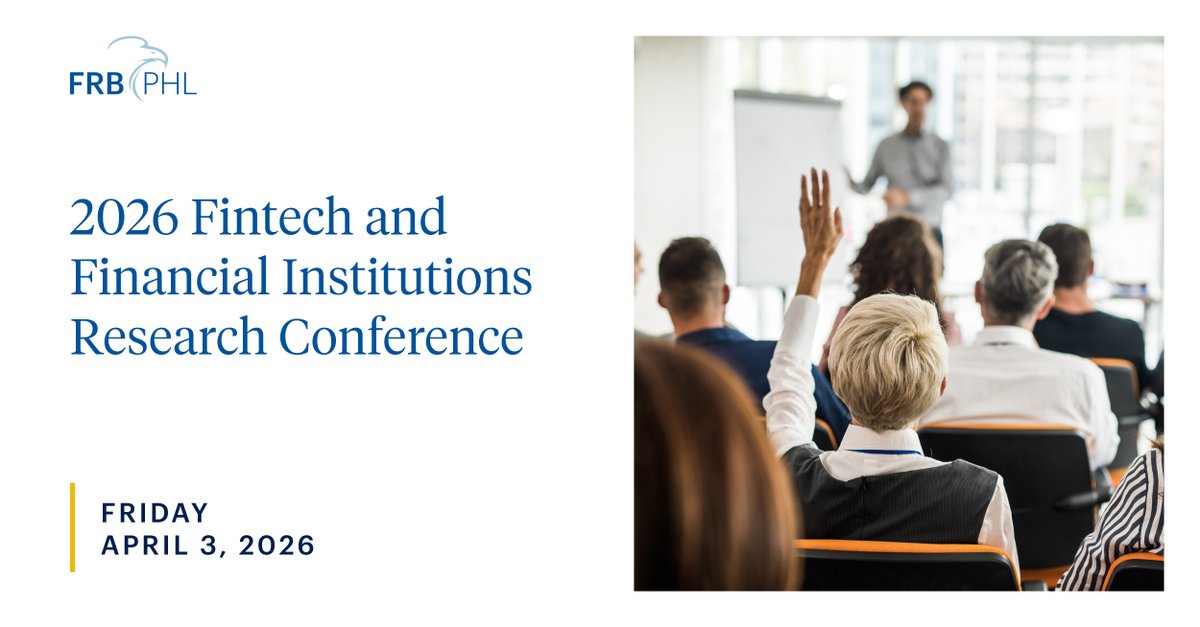
The Philadelphia Fed and @UDLernerCollege invite you to join us on April 3 to hear about current research exploring the connectivity between the fintech and financial systems. Event details -> https://t.co/WWuo4qF3Ij
Through an analysis of trading activity across derivatives markets, three economists explain how risk levels can remain elevated, even after regulatory reforms. Learn more in the latest #ResearchInFocus. https://t.co/PxR3J4xn9R
Two Fed economists and their coauthor design a new method for producing a digitized historical panel data set. Their test case is the adoption of vehicles in 20th century America. Read the latest #ResearchInFocus to learn more: https://t.co/d5WSYirxAG
#EconTwitter