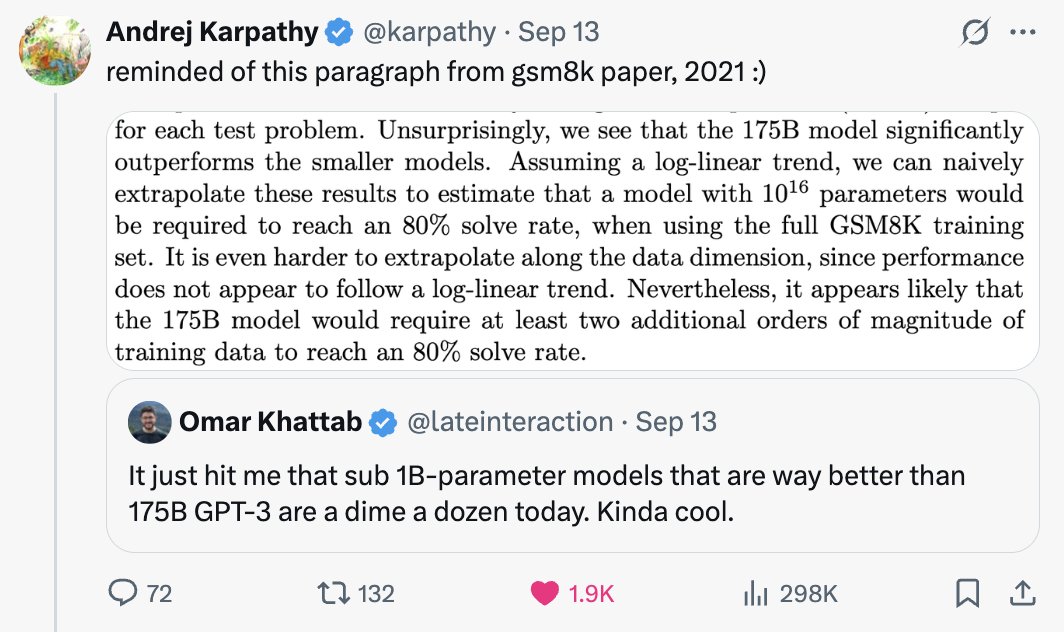
…all compounded to break the “log-linear” scaling assumption the GSM8K paper was based on.
🙃 The impossible-sounding scaling requirement from 2021 has already been outpaced.
❌ Distinguishing “𝐂𝐚𝐧’𝐭 𝐀𝐧𝐬𝐰𝐞𝐫” from “𝐖𝐨𝐧’𝐭 𝐀𝐧𝐬𝐰𝐞𝐫” in LLM Evaluation
In production LLM systems, hallucinations are only one failure mode. Another one that we find very often is avoidance: when the model 𝐜𝐡𝐨𝐨𝐬𝐞𝐬 𝐧𝐨𝐭 𝐭𝐨 𝐚𝐧𝐬𝐰𝐞𝐫 𝐚 𝐫𝐞𝐪𝐮𝐞𝐬𝐭 even though it could.🚦
A "can’t answer" case means the model lacks the knowledge, reasoning ability, or context to respond, while a "won’t answer" case means it’s capable but refuses due to safety tuning, policy constraints, or routing errors. 😬
𝐒𝐨, 𝐰𝐡𝐲 𝐝𝐨𝐞𝐬 𝐭𝐡𝐢𝐬 𝐡𝐚𝐩𝐩𝐞𝐧?
𝐎𝐯𝐞𝐫-𝐭𝐮𝐧𝐞𝐝 𝐒𝐚𝐟𝐞𝐭𝐲 𝐋𝐚𝐲𝐞𝐫𝐬 -> Many LLM providers use safety fine-tuning (via RLHF, RLAIF, or supervised refusal data) to prevent harmful outputs. These models have refusal triggers, when activated, the model enters refusal mode.
𝐔𝐧𝐜𝐞𝐫𝐭𝐚𝐢𝐧𝐭𝐲 𝐌𝐚𝐬𝐤𝐢𝐧𝐠 -> Some instruction-tuned models are optimized for “confident correctness,” and when uncertain, they refuse rather than admit partial knowledge
𝐀𝐥𝐢𝐠𝐧𝐦𝐞𝐧𝐭-𝐏𝐨𝐥𝐢𝐜𝐲 𝐂𝐨𝐧𝐟𝐥𝐢𝐜𝐭𝐬 -> Policies can be embedded in both the system prompt and fine-tuning layers. When these conflict (e.g., “always comply” vs. “never discuss X”), models default to avoidance.
When it comes to LLM Evaluation, we at Deepchecks have an "𝐀𝐯𝐨𝐢𝐝𝐞𝐝 𝐀𝐧𝐬𝐰𝐞𝐫" property, which calculates a probability score (0–1) representing the likelihood that the model explicitly and deliberately avoided the request.
🧠 With Deepchecks ORION, our hallucination detection engine, we can calculate a score for "Avoided Answer". ✳️ Beyond that, 𝐰𝐞 𝐚𝐥𝐬𝐨 𝐝𝐢𝐬𝐭𝐢𝐧𝐠𝐮𝐢𝐬𝐡 between cases where the model genuinely "can’t answer" and cases where it "won’t answer".
✅ To separate the two, Deepchecks uses a Mixture-of-Experts (MoE) approach, which we call the 𝐒𝐰𝐚𝐫𝐦-𝐨𝐟-𝐄𝐯𝐚𝐥𝐮𝐚𝐭𝐨𝐫 𝐀𝐠𝐞𝐧𝐭𝐬. Multiple independent evaluators with different safety tuning, alignment profiles, and reasoning capabilities are tasked with answering the same prompt.
Link to the ORION paper: https://t.co/J2SqTsoNXZ
Link to the Deepchecks platform: https://t.co/yjZFWWYgfK
🤔 In general, how do you handle cases where your LLM refuses to answer?
Would love to hear!
#LLMs #LLMOps #Evals #GenAI #AI
See the disappointment in GPT-5 through gamblers eyes!
Looks like they don't like Anthropic, and are big fans of Google.
🙃 But the most interesting graph is definitely the sudden drop in OpenAI's rating after releasing GPT-5 (and Google gets most of the gain).
🚨OpenAI just open-sourced their powerful models, gpt-oss-120B & gpt-oss-20B!
These models are specifically designed for powerful reasoning, agentic tasks, and versatile developer use cases. This is their first open-weight language model release since GPT-2, and unlike some earlier symbolic gestures toward openness. 🙃
* gpt-oss-120B performs on par with o4-mini (their closed-source model) on reasoning, tool use, and even outperforms it on HealthBench and math (AIME 2025).
* gpt-oss-20B matches o3-mini in benchmarks, and runs on just 16GB of memory. Ideal for edge devices and local inference.
Both models support up to 128k context length, structured outputs, chain-of-thought reasoning, and few-shot function calling.🧠 These models are released with weights released under a permissive Apache 2.0 license, and with serious attention given to deployment, safety, and real-world use.
Also worth noting is the attention to safety. The team didn’t just “filter” bad data, they adversarially fine-tuned the models to simulate misuse and tested them using their Preparedness Framework.
Interestingly, these models also support agentic capabilities. You can use the models' native capabilities for function calling, web browsing, Python code execution, and Structured Outputs.
🤓 I am going to spend more time reading about this model and running it locally to see how good this actually is.
Link to HuggingFace: https://t.co/vxmMAJoIwQ
Link to GitHub: https://t.co/2qxJZ7Haf4
BTW, Anthropic also released their new model today, Opus 4.1, which outperforms Opus 4! 😀
#LLMs #LLMOps #OpenAI #OpenSource #GenAI #OSS
🤯 Someone just reverse-engineered the safety filters inside Apple Intelligence, and they open-sourced it!
🧵1/
This is a big deal, not because it’s a jailbreak, but because it makes something visible that’s usually hidden.
6/
But in practice, many production systems rely on much simpler mechanisms like blocklists, regex-style triggers, category classifiers, and structured content policies that act as safety nets.
Someone tried to transcribe a 40-minute YC talk by @karpathy. The file was too long for OpenAI’s whisper model (it has a 25-minute limit), so they tried speeding it up to reduce the length.
🙃 But when they looked at the cost breakdown, they realized it actually made things cheaper too.
The technical reason
⏰This works because it seems to come down to token usage, in short:
OpenAI charges transcription input at $6 per million audio tokens and output at $10 per million text tokens.
Faster audio → fewer seconds → fewer audio tokens.
Transcription models use frame-wise attention + decoding, so inference cost scales linearly with the number of frames. 🤓
Fewer frames = fewer compute cycles = fewer input tokens = lower cost.
I can’t tell if this is an intentional feature on OpenAI’s part… or just an accidental hack someone discovered. It’s not a huge revelation, but it’s one of those “obvious in hindsight” things.
Either way, neat little hack.
https://t.co/IeqTRHuy3u
❎ Btw, this hack does not work properly when you 4x the speed.