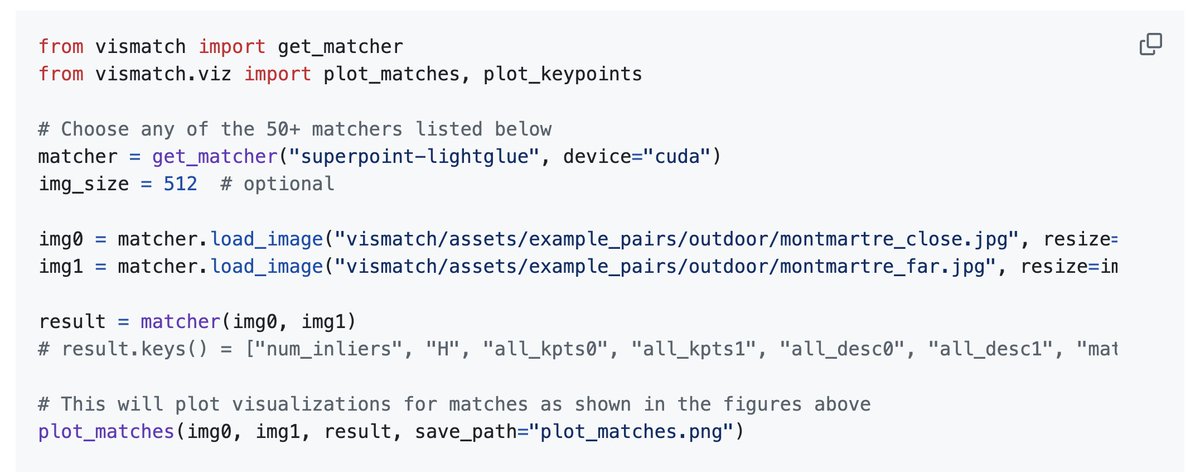
VisMatch v1.5.0 is out!
Added FlexGlue, SANDesc, CLIDD and DaD
Congrats to the authors @PhilippCSE@pesarlin@mapo1@Parskatt@mattiadurso98 and all coauthors!
5 lines of code to try 80+ image matchers
@isaaccorley_@gabriberton I agree, this would be interesting! I tried visual disambiguation on the EarthMatch benchmark of @gabriberton. It does a decent job there in detecting covisible pairs. However, the scores are miscalibrated (negatives are ~0.5), likely because it was never trained on such data.
To match or not to match?
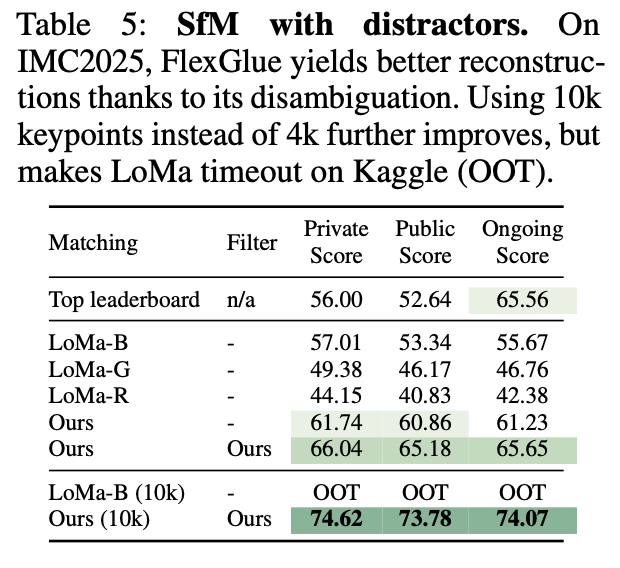
FlexGlue 🐙, our new image-matching model, can match every pixel AND reject doppelganger pairs, tackling a common failure case in SfM.
➡️State-of-the-art SfM and matching, blazing fast
➡️Code: https://t.co/A8ZXe7rxy5
➡️Paper: https://t.co/bIMHmLtSVp
1/
@RodneyLabNotes@gabriberton I agree that with noisy GPS, one needs to be careful when labelling images as non-covisible, especially when they are close by. However, I think this approach works at scale: labelling two images as non-covisible when they are multiple km apart is fairly safe.
FlexGlue: Sparse-to-Dense Feature Matching and Visual Disambiguation
@PhilippCSE@pesarlin Ondrej Miksik @mapo1
tl;dr: transformer for dinov3 token matching, then query with anything (grid, keypoints) and image overlap clf.
Trained with negatives!
https://t.co/6tK0ff9g3G
@aussetg Interesting question! I don't know whether we should consider such pairs covisible, but the HardMatch benchmark by @davnords includes pairs between images and old drawings, matched by FlexGlue:
➡️Through data augmentation, FlexGlue is also robust to in-plane rotations, especially when paired with the RaCo keypoint detector by @shenbuoy.
https://t.co/5q0TfCr3l6
7/