Working at @Architect_Fi.
Web and mobile app developer.
Previous work; lead mobile dev @ FTX, software egineer @ Ixor, dev of OneMusic, Cal on Windows Phone.
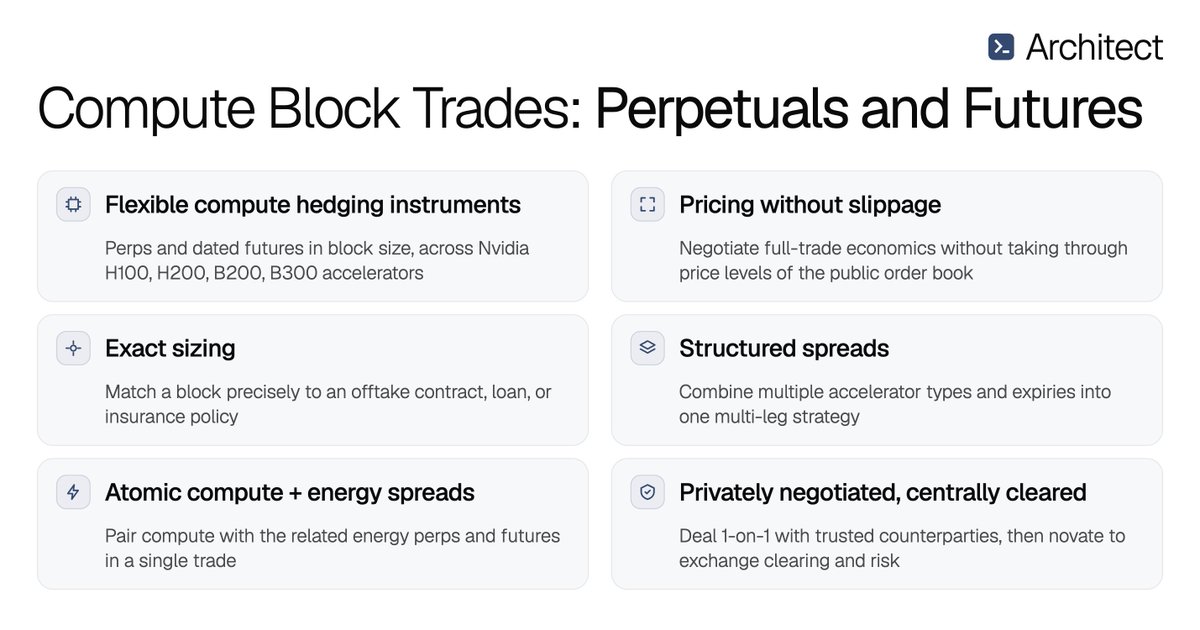
Architect’s AX Exchange supports OTC block trading in compute futures and perpetuals, tracking Nvidia H100, H200, B200, and B300 rental prices. Key block trade features for institutional hedgers of GPU compute:
• Exact sizing: Match the precise notional quantity tied to particular offtake contracts, loans, or insurance policies
• Pricing without slippage: Negotiate full-trade economics without taking through price levels of the public order book
• Structured spreads: Combine multiple accelerator types and expiries into one multi-leg strategy
• Atomic compute + energy spreads: Pair compute with related energy perps and futures in a single trade
Privately negotiated, centrally cleared: Deal 1-on-1 with trusted counterparties, then novate to exchange clearing and risk
If you or your company has a particular OTC compute futures trade to put on, talk to me or our team.
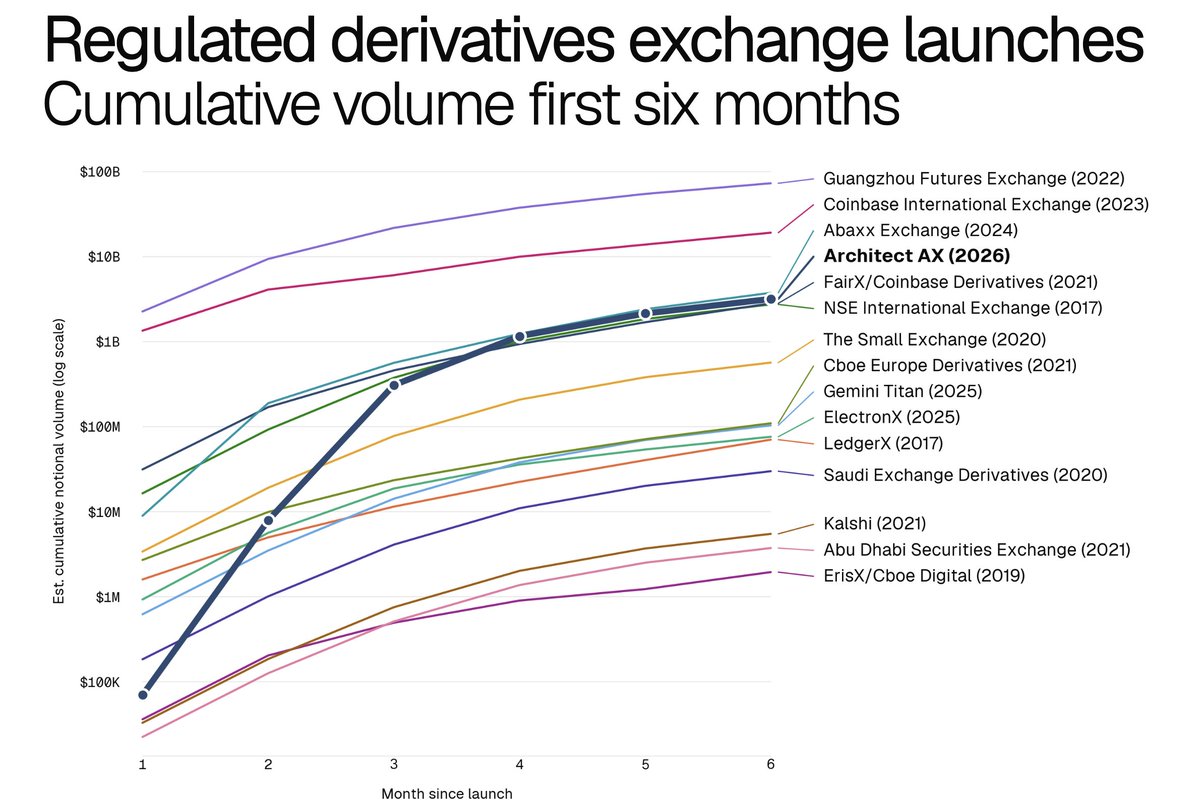
Architect AX traditional asset perpetuals exchange at six months: $3.3B total notional, $1.1B one-sided notional/month,15M orders/day, 80 minutes downtime. A comparison of first six months’ volume on regulated derivatives exchanges (US and intl) launched in the last ten years
Optimizing Exchange Latency
At HFTs I built low-latency trading systems for traditional and cloud-native exchanges including Nasdaq, NYSE Arca, CME, ICE, SGX, JPX, Coinbase/GDAX, and others. A summary/discussion of the current split in low-latency network infrastructure
Colocation: Traditional exchanges are hosted in physical datacenters. Colocation involves renting rack space with cross-connects to the exchange matching engine. While it is expensive and time-consuming to set up, physical colocation guarantees an equalized path to the exchange. By contrast, it is fast and inexpensive to set up cloud servers but difficult to guarantee the lowest latency. To be colocated with an exchange running in AWS, firms first need to understand not only what region the exchange is deployed in (e.g. us-east-1) but also the availability zone (e.g. use1-az4). Even within a single availability zone, there is variance in how close a randomly placed EC2 instance lands to the matching engine.
Non-determinism: Networking setups for traditional exchanges offer deterministic access to matching engines by running the same cable lengths to all client boxes. Public clouds have a significant degree of non-determinism due to routing within a cloud region. Two different EC2 instances in us-east-1/use1-az4 could have different latencies to the same matching engine in the same zone. Firms mitigate this issue by spinning up multiple instances and choosing the one with lowest ping times, as well as using cluster placement groups and AWS technology such as ENA Express.
Unicast instead of multicast: Traditional exchanges disseminate market data over UDP multicast, which puts a single copy of the book on the wire and delivers it to every participant simultaneously. Public clouds don't offer multicast in any form usable for market data: VPCs have no native support, and Transit Gateway multicast is built for enterprise applications rather than microsecond-sensitive feeds. Cloud-native exchanges therefore publish over TCP unicast, which involves a separate copy for every subscriber and a fan-out order that no longer treats them equally. HFTs recover what they can by bypassing the kernel for their networking stack. They use a poll-mode driver such as DPDK over ENA that lets the NIC DMA frames directly into userspace ring buffers, with a userspace TCP stack handling the protocol above it.
Inter-region latency: Expensive microwave, millimeter-wave, and subsea fiber links carry the lowest-latency paths between physical datacenters, and none of them terminate inside a cloud region. To move data between cloud regions and traditional venues, firms combine the long-haul routes of established market data vendors with specialized cloud on- and off-ramps, paying a penalty at each transition. Since price discovery still originates largely from traditionally colocated exchanges, trading on public cloud venues adds to a firm's market data infrastructure footprint rather than replacing it.
Partnerships between CME and Google and between Nasdaq and Amazon aim to deliver infrastructure that combines the flexibility and global reach of public clouds with the deterministic latency of purpose-built exchange datacenters. If that convergence arrives, most of the practices above stop paying. The advantage in trading on cloud-native exchanges may shift back toward the firms with decades of colocated experience rather than those who have built expertise in cloud-latency engineering.
Intercommodity spreads, from crack to compute
As US derivatives exchanges list futures on GPU rental prices, spreads between compute and related commodities will become tradeable for the first time. Intercommodity spreads and compute:
An intercommodity spread expresses the relationship between two related commodities rather than either one outright. The classic examples encode a specific production process:
• Crack spread: crude in, gasoline and distillate out
• Crush spread: soybeans in, meal and oil out
• Spark spread: gas in, power out
Each spread lets you trade the conversion step instead of the inputs. Refiners hedge cracks while gas plants hedge sparks.
Compute is the obvious next link in that chain. A datacenter converts megawatt-hours into GPU-hours, and GPU-hours into tokens. Neither of these two conversion steps has a direct hedging instrument, but the pieces are coming together.
The natural constructs:
• Compute spark spread: power in, GPU-hours out
• Inference spread: GPU-hours in, tokens out
In addition to providing precise hedging for datacenter operators and inference providers, compute intercommodity spreads will create new opportunities for trading firms acting as arbitrageurs. In the early days of compute futures trading, these firms will profit from moving information from existing commodities to the compute curve. As liquidity in GPU price derivatives increases, compute will act as a leading indicator and intercommodity spreads will become a valuable source of price discovery.
PRE-ONBOARDING FOR THE AMERICAN INNOVATION EXCHANGE IS LIVE. Sign up to trade Architect’s Nvidia GPU compute futures and options. Access the first US derivatives market for compute. Competitive margin, low fees, desktop/mobile/API access, block trades supported 🇺🇸
Architect operates two US brokerages, an international perpetuals exchange, and soon a US commodities futures/options exchange with an engineering team of 12. We do this with a tailored fleet of agents we built from scratch. Here's a partial list:
• An agent with permissioned access to our exchange databases that can be asked from Slack or Claude to generate charts, tables, and other business-intelligence reports. Built heavily on ClickHouse and Matplotlib.
• An agent that reads the past week of X and media coverage, our internal Slack, and our exchange-transactions DB to write a weekly internal newsletter on the exchange landscape and what we should focus on next.
• An agent that uses the X API and HeyGen's HyperFrames to post a daily summary of GPU compute prices with an accompanying motion-graphic video. Compute is the core commodity of the AI economy we're building an exchange for.
• An agent that acts as the team's project manager, using Linear to summarize key milestones, track development velocity, and triage lagging or deprecated tickets.
• An agent that scans for new waitlist entries and posts a breakdown to Slack, grouped by firm and individual, with their stated interest.
• An agent that scans our Rust and TypeScript dependencies for vulnerabilities and automatically opens PRs to upgrade or remove affected packages, tuned to our stack rather than off-the-shelf tooling.
• An agent that shepherds GitHub pull requests that have gone more than a day with unaddressed comments.
We're scaling this fleet to create the first US derivatives exchange purpose-built for AI and US reindustrialization. If there are agent functions you've found useful in this area, let us know here or in Architect’s compute markets Telegram.
US Compute Futures As Hedges
Compute futures face the argument that if a future doesn’t track the exact costs hedgers incur, it will carry too much basis risk to form a viable market. This fundamentally misrepresents how hedges actually function in many major US markets.
A hedge does not need to be perfect in order to be useful, let alone transformative, to its underlying commodity market. To be viable as a multi-billion dollar market, a hedging instrument needs to remove enough risk at scale to be worth its initial cost. If the correlation between a hedging instrument and the portfolio is ρ and the optimal hedge ratio is used, the fraction of variance eliminated by the hedge is ρ². A correlation of only 0.7 cuts variance in half.
Cross-hedges built on loose relationships predominate in the real US economy. Airlines hedge jet fuel with crude. Bond desks hedge rate risk in credit with treasuries. Long-short equity portfolios hedge market beta with S&P 500 futures. At my former firms Jane Street and Citadel Securities, every trading desk was required to hedge portfolio factors with related instruments intraday and overnight to isolate alpha.
Commodity markets are typically heterogeneous. Compute is not a unique underlying in this respect. An “H100 hour” could represent many different goods: SXM or PCIe, spot or reserved, hyperscaler or neocloud, US or Asia. Weigh this “problem” against the “solution” that compute buyers and sellers have today: nothing. Asset-backed loans on GPUs carry 40-50% haircuts because lenders can’t transfer the associated risks. The institutions financing the >$1T datacenter-linked debt sector regularly transact in other heterogeneous commodity markets.
The success of US compute futures/options markets primarily depends on CFTC-regulated exchanges’ agility and competency at collaborating with index providers native to chip configurations, neocloud procurement, and timeseries interpolation on a continuous basis. Designing a futures contract that minimizes basis risk and maximizes liquidity formation is an antecedent requirement. Fulfilling the US government mandate to “accelerate the maturation of a healthy financial market for compute” is the main goal.
We’re excited to announce Architect’s partnership with @PillarHQ. We’re bringing together Pillar’s automated hedging solutions for commercial consumers of commodities and Architect’s US and international exchange-listed derivatives on AI-industry supply chain inputs.↓
Join Architect's new Telegram group for compute markets. We're bringing together a community of traders/hedgers for futures, options, forwards, and spot compute. DM me or Ishanee for the invite.
We’re publishing a new daily report comparing GPU compute prices, price changes, and volatilities across models, with data from @ComputeDesk, Bloomberg: CIBLKWUS, CIHOPUS
H100s, the oldest model with the largest install base, currently show the highest YTD rental price increase.
The deeper we dig into resource bottlenecks in datacenter-related manufacturing, the more materials we find with non-existent markets. This isn’t limited to AI; of the metals that make a Tesla battery (lithium, nickel, cobalt, manganese, aluminum, iron), how many have liquid US futures?
Worth 99 seconds of anyone's time. Compute futures stopped being a thought experiment and turned into a live product faster than almost anyone expected. Good to see it explained plainly.
AI datacenters are driving unprecedented demand for electricity consumption and current power futures markets no longer offer an effective hedge. Existing power contracts are inadequate for two reasons:
A month ago I wrote that two layers were missing under the procurement paradigm: a way to hedge forward compute price without buying more capacity, and a benchmark worth settling it against. Today the first one ships. Architect is listing H100 through B300 futures, settled to our index. The contract was the easy part. The index is the work: broad enough to catch where compute actually clears in private deals, narrow enough that the hedge tracks your cluster and not a market average. Now there is a price to trade around.
The typical neocloud operator we speak to says some version of: “I’ve sold out 12 months of capacity on my H200 cluster, but I don’t know what compute prices will be in months 13-24.” Futures solve this, but the suitability of the hedge depends on the index. More below ↓
Compute futures indexes need to be broad enough to capture private cloud transactions but narrow enough to minimize basis risk for datacenter hedging. Architect’s Nvidia H100, H200, B200, and B300 futures will offer the best of both worlds on the American Innovation Exchange.
Every AI datacenter is a copper story. Power distribution, busbars, transformers, miles of cabling. Datacenter buildouts at this scale are pushing copper demand into new territory. The AI Exchange lets you hedge the metals that build AI alongside the compute that runs on it.
Architect has acquired a DCM and we’re launching the American Innovation Exchange, a new US futures exchange purpose–built for trading compute derivatives.
Onboard directly from desktop or mobile, trade the century’s most consequential commodity. Coming soon.
Introducing the American Innovation Exchange, the first U.S. derivatives exchange designed for trading the AI economy. Trade futures and options on compute, metals, energy, and other critical instruments in the AI supply chain. Coming soon from Architect.