Hey #TempGen2021Tweets! Planning to do enzymatic reduced representation using museum specimens? You might need up to 24% more historical DNA 🐟🧬to get sequence results comparable to contemporary samples. Follow this thread to find out more 1/7
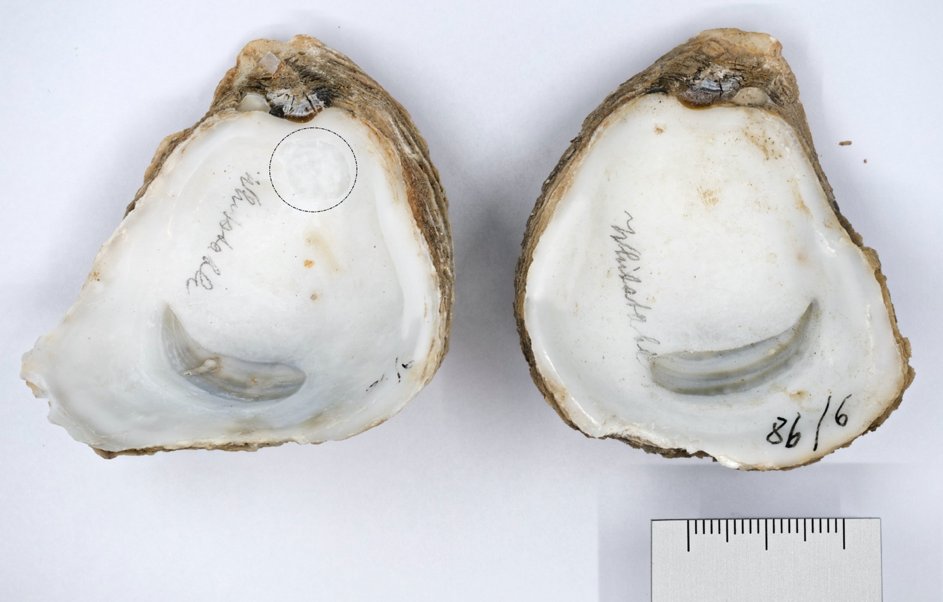
Excited to share my ongoing work at #TempGen2021Tweets! Here we go: The ghost of oysters past - genomic insights into extinct oyster diversity 🦪 Thanks to RA @zoepithel for data wrangling 🙏
It is time for some sharky business at #TempGen2021Tweets!🦈for this talk titled (it gives a bit of the surprise away) “Temporal genomics suggests the disappearance of a tiger shark population off south-eastern Australia”. 1/7
1/ I will now present our project 'Resolving mechanisms maintaining distinct Atlantic cod ecotypes in a hybrid zone using a multi-generational experiment' for #TempGen2021Tweets! Follow along for the next 15 min about this "closest examination of hybridity & generation"(-Darwin).
Allele frequency divergence reveals ubiquitous influence of positive selection in Drosophila.
#TempGen2021Tweets
Temporal genomic data let us directly see evolution unfolding but hard to analyze. Today I’ll talk about detecting selection using allele frequencies (AF) 1/7
The West Philippine Sea (WPS) and the Kalayaan Island Group (Spratly Islands) are an important fishing grounds in the Philippines, contributing to the country's social and economic well-being. The richness of the WPS should not be underestimated or undervalued.
The next speaker for the Temporal Genomics Lecture Series is @Evie_Jensen. She will be discussing her temporal genomics research on the Galapagos giant tortoises today from 11-12 EST. Sign up below to attend.
https://t.co/I86SS7A21Q
The Tank Goby (Glossogobius giuris) is a common aquarium species. Whole-genome sequencing from @PacBio would allow us to assemble a reference genome to identify changes in genetic diversity of this species over 100 years of habitat degradation and overfishing! #hifiexhibit
The Temporal Genomics working group funded by @evolvingseas is hosting a seminar series this spring-summer. Talks will be biweekly on Thursdays from 11-12 EST. First talk is next Thursday, March 25. Check out the schedule and register here: https://t.co/zhQkJ4FIa3
Dr. Eric Garcia, a postdoc in the Carpenter Lab, will give this week's departmental seminar. "Genomic analysis of disjunct marine fish populations of the northeastern Pacific and Sea of Cortez". Please DM us for the Zoom details if you are interested in attending.
Dr. Kent Carpenter talks with @goodreasonradio about his @NSF@PhilippinesPIRE study and how his research group is using many of the 100,000 specimens collected during the 1908 voyage of the USS Albatross to study biodiversity. https://t.co/Nzcv7Aq07O
A recent article by Klein et al. (2020) identified a new ichthyosaur, Cymbospondylus duelferi sp. nov., which was found with 3 fetuses. This is the 2nd oldest evidence for viviparity in ichthyosaurs. Check out the skull and teeth of this 4.3 m monster!
Our lab is working through the python portion of Practical Computing for Biologists by Haddock & Dunn. What are some other good books or resources for beginning to intermediate bioinformaticists?
@PhilippinesPIRE postdoc, Eric Garcia, recently published a paper about patterns of divergence and signals of selection in sympatric and allopatric populations of Sargo and Longjaw Mudsucker across the Baja California peninsula.
Only a few days left to register for @VIMS_News' online #MarineScienceDay this Sat, May 30! The virtual event will feature videos & resources to #explore at your leisure as well as live-streamed talks, demos, & Q&A sessions with #scientists. Register:https://t.co/kYKQWT60RP
It's Monday! Greeting you all from the comfort of my own home. It's a day of beginnings--1st day of summer classes here at @ODU & I'm teaching Gen Bio I over Zoom. I'm also doing a twitter take over for @evolvingseas this week! What are you starting on this week?