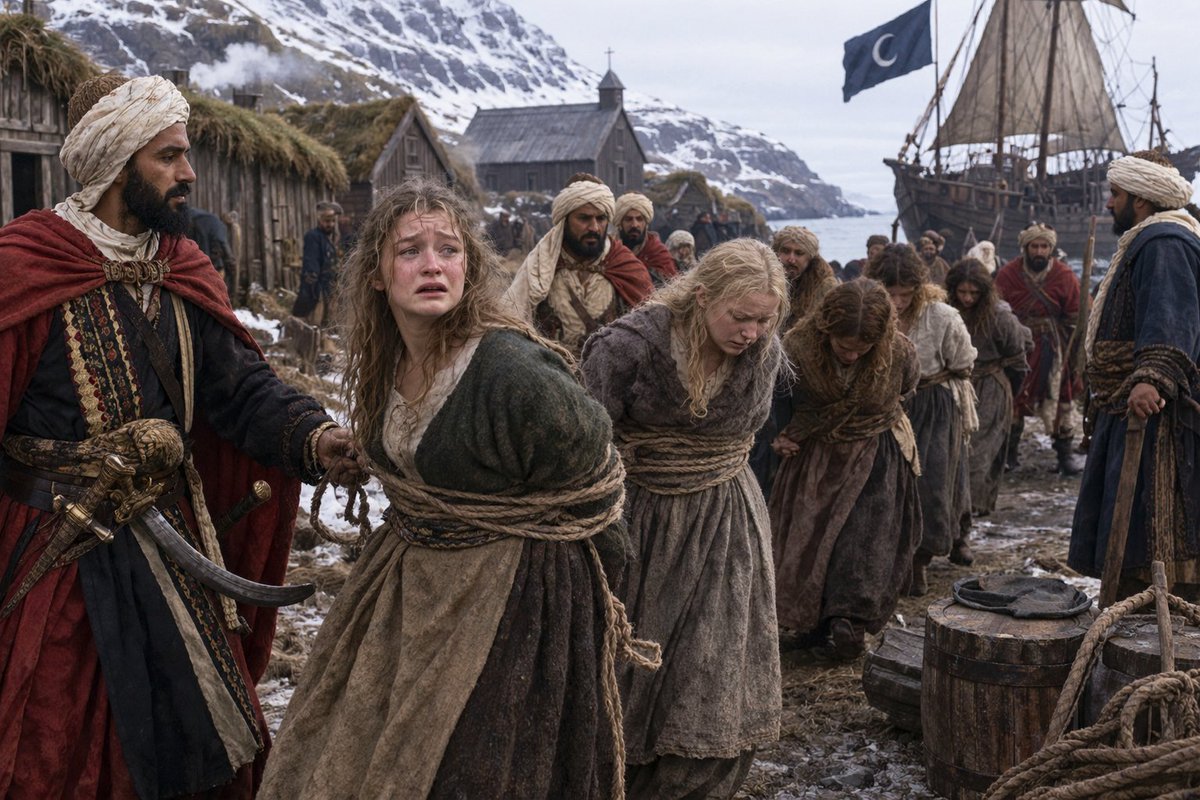
Algiers corsairs and other Barbary pirates raided Iceland in July 1627—an event known in Icelandic as the Tyrkjaránið (Turkish Abductions)—killing 51 people and capturing approximately 400 men, women, and children to sell in North African slave markets. Women and girls, alongside men and children, were loaded onto ships and transported across the Atlantic and Mediterranean to Algiers. Upon arrival, captives were displayed and sold into slavery in public markets. Many female captives faced forced labor, harsh living conditions, or forced conversions to Islam. Over the following years, European monarchies (such as Denmark) and families negotiated and paid ransoms for a fraction of the survivors—including notable figures like Guðríður Símonardóttir—allowing around 40 to 50 individuals to eventually return home over a span of 9 to 18 years...
At dawn on July 16, 1627, three ships appeared off Heimaey, an island south of Iceland. The people on shore had little time to understand what they were seeing. The ships carried corsairs from Algiers. Armed men came ashore, swept through the settlement, killed anyone who resisted, and seized whoever could not escape.
The island’s pastor, Ólafur Egilsson, was taken with his wife and children. So were hundreds of his neighbors. By the time the ships left, 242 people from Heimaey had been carried away to the thriving Islamic slave markets of North Africa.
Ólafur’s wife was pregnant. She would give birth during the voyage.
In Algiers, the captives were marched through the streets and sold. Families were separated in the marketplace. Ólafur watched as his eleven-year-old son was taken from him. He urged the boy not to abandon his Christian faith. His son answered, “They can treat my body as they will, but my soul I shall keep for my good God.”
Then they led the boy away.
Ólafur, his wife, and their two youngest children were held together for a time. But then his captors thought of a lucrative plan. They would send him across Europe to ask Denmark’s king—whose kingdom then included Iceland—for ransom money.
Ólafur traveled from Algiers through Italy, France, and the Netherlands to Denmark. The record is unclear about any ransom payment, but he did return to Iceland in 1628, without his family. His wife did not return until 1637. Their sons, however, never came home.
The Iceland raid was only one small episode in a much wider campaign by Muslim corsairs, whose raids carried millions of Christians into the slave markets of the Islamic world. Boys could be taken to serve in Muslim armies, girls sold into harems, and adults condemned to back-breaking labor. Ólafur’s surviving journal gives one family a human voice amid countless others whose names and stories were lost.
Ólafur was one of the lucky ones. He came home. But his children did not. His memoir preserved the moment a father watched his son disappear into slavery—and the words the boy left behind.
“They can treat my body as they will, but my soul I shall keep for my good God.”
#archaeohistories
Roman concrete could repair its own cracks.
Some Roman buildings have stood for 2,000 years, while modern concrete can start to crumble within decades. For a long time, scientists did not fully understand why.
The Romans made their concrete from lime, water and volcanic ash from the area around Pozzuoli, near Naples. The ash reacted with the lime and created a material that grew stronger over time instead of weaker.
In 2023, a team from MIT led by Admir Masic found another piece of the puzzle, small white lumps of lime scattered through the concrete.
Scientists had always thought these lumps were a sign of careless mixing. In fact, they were the repair kit. When a crack forms and rainwater gets in, the lime dissolves and refills the crack with new mineral, sealing it from the inside.
The secret was “hot mixing.” Instead of using slaked lime, the Romans added quicklime directly to the mix. It heated up as it reacted with water and left these lumps behind on purpose.
To test the idea, the team cracked samples of concrete made with the Roman method and let water run through them. Within two weeks, the cracks had sealed completely. In concrete made without the lime lumps, the water kept flowing.
Roman harbour concrete went even further. Pliny the Elder wrote that once it touched the waves, it became a single block of stone that grew stronger every day. In 2017, geologist Marie Jackson showed he was right, seawater slowly grows rare crystals inside the concrete that hold it together.