Following the brutal killings of #Bengali students, teachers, and civilians on the night of March 25, 1971, by the Pakistani Army, Major Ziaur Rahman - a courageous Bengali officer in the Pakistani military - revolted and announced ‘the declaration of independence of Bangladesh’ on behalf of Bangabandhu Sheikh Mujibur Rahman on March 26, 1971. This marked the beginning of #Bangladesh’s nine-month-long Liberation War.
In response, the Pakistani army launched a systematic crackdown, unleashing widespread #genocide that claimed millions of lives. This brutality galvanized the formation of the #Mukti Bahini, a determined and ferocious guerrilla resistance force.
Under the leadership of Prime Minister Indira Gandhi, #India played a critical role in the struggle, providing refuge to millions of Bangladeshi civilians and offering military training to Mukti Bahini fighters.
While humanitarian concerns may have shaped India’s response, strategic interests were the primary driving force. Weakening #Pakistan by severing its eastern wing aligned with India’s broader geopolitical goals, including securing its western borders and reducing Pakistan’s influence in the region.
India’s direct military intervention began on December 3, 1971, after Pakistan launched preemptive airstrikes on Indian targets. By this time, Mukti Bahini’s months of guerrilla warfare had already exhausted the Pakistani military. Within two weeks, the combined forces of India and the Mukti Bahini achieved a decisive victory. Pakistan surrendered on December 16, 1971, paving the way for the birth of #Bangladesh as an independent nation. However, this hard-fought victory came at a steep cost: an estimated 3 million Bangladeshis were killed, and India lost around 3,000 soldiers.
In the aftermath of the war, controversies arose regarding India’s role in post-independence Bangladesh. Reports by the Bangladeshi authorities, as well as by The Guardian (January 22, 1972) and The Washington Post (January 26, 1972) accused Indian forces of widespread looting, alleging the seizure of factory machinery, weapons, and other resources valued at approximately $2.2 billion at the time. These allegations complicate the narrative of India’s intervention, suggesting that strategic and economic benefits may have outweighed its altruistic motives.
The 1971 war remains a defining chapter for both nations. While it is celebrated as a shared triumph for freedom, it is also marked by complexities and criticisms that continue to shape perceptions of this historic conflict.
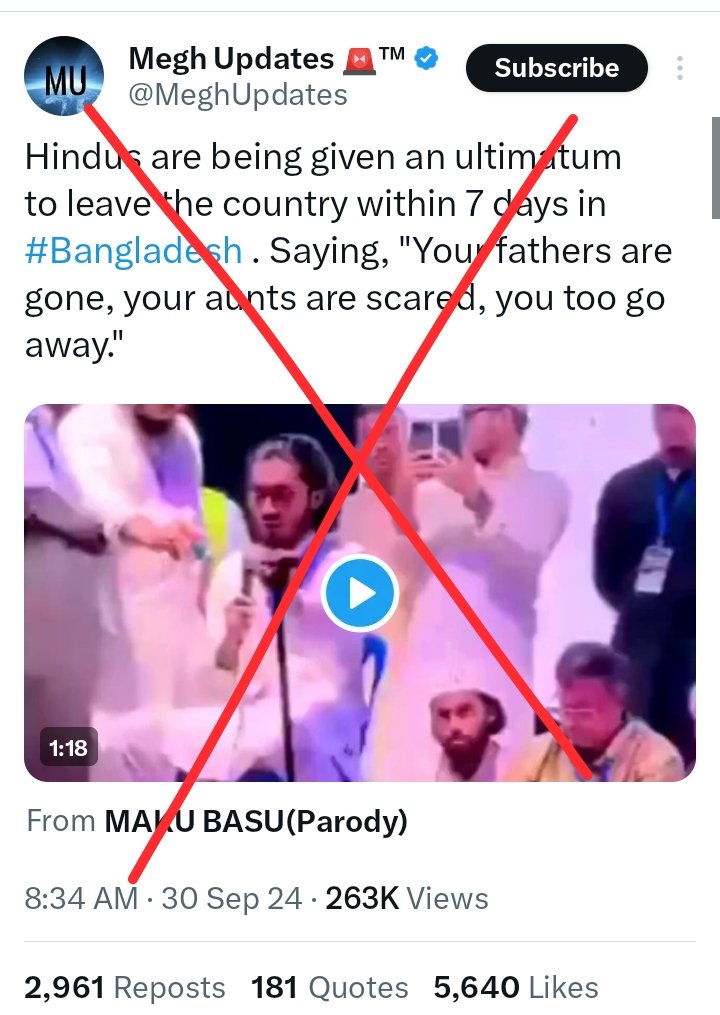
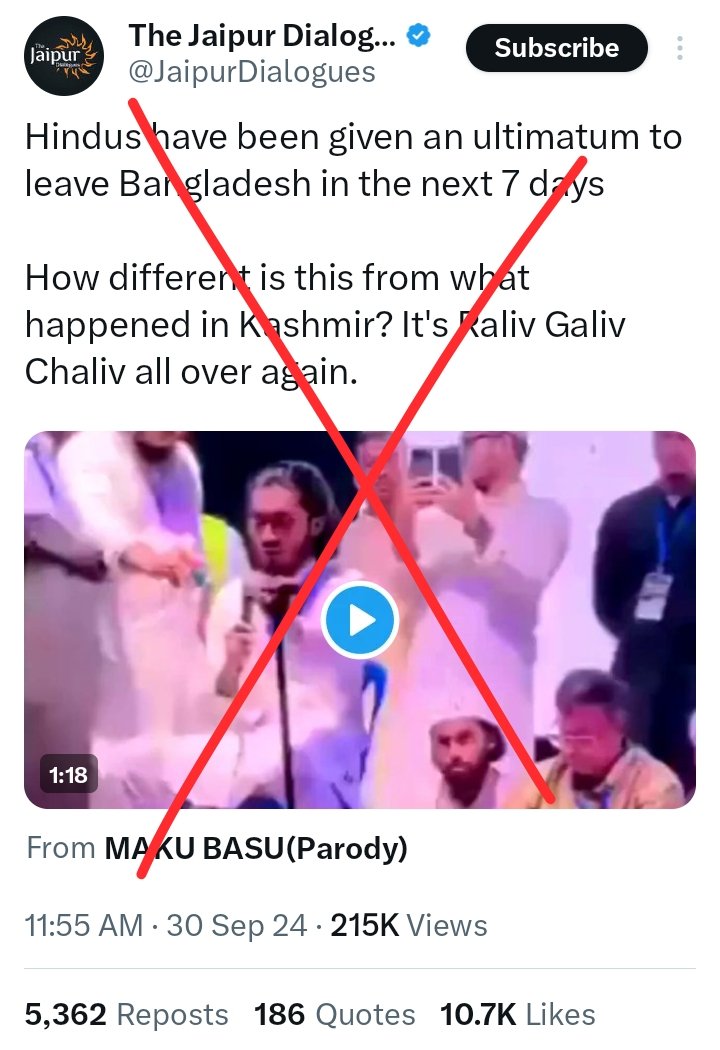
Many RW Indians handles, and Indian media shared a video claiming that "Hindus are being given an ultimatum to leave the country within 7 days in Bangladesh," which is FALSE.
The statement was not against Hindus; it was against the previous regime/government and its associates who attacked on protesters.
The man speaking in the video is Saifuddin Mohammad Emdad, aka Emdad Babu, who actively participated in the anti-discrimination movement in July and lost vision in one of his eyes due to a police bullet.
He delivered this speech at a program titled "July Remembrance and Cultural Evening," organized by a social organization named 'Bikiron' in Chittagong.
Emdad made his statements about the one-week ultimatum while addressing those who attacked students during the movement.
If you listen to his entire speech, it's clear that he was targeting the previous Awami League government and its associates, not Hindus. (Listen his full speech here : https://t.co/1OycWfMHdc)
For example, at one point in his speech, he says, "Until now, the henchmen of the autocracy have been roaming the streets of Chittagong. I want to know why they are still walking free. How do they have so much courage? They, armed, have shot at the student community of Chittagong at Bahaddarhat and New Market. Why are they still openly walking around?"
This clearly indicates that his speech was against those associated with the Awami League who attacked rotestors.
Why did he mention the word 'Hindu'? Bangladeshi can easily understand the context of this clipped part. Initially, after the interim government took office, there was a protest by Anser, a paramilitary auxiliary force, in front of the interim government head office. Instead of helping the government restore law and order during the massive floods in Bangladesh, they came to protest. As a result, people termed them 'Anser League,' saying that Awami League came in the form of Anser. Then, the very next day, there was a protest by rickshaw pullers, and they were also termed the same because they were creating tension. It became a phenomenon—whoever protested was termed the same. Because, they hadn't protested in the last 15 years, but during that time of law collapse, they came to protest.
There was also a 'Hindu protest,' and in reference to this phenomenon, Emdad mentioned that the Awami League came in the form of 'Hindus' which may created communal tensions . If you notice, he also talked about journalists and others who appeared in the form of AL; it is a figurative term.
@SSunilkumarm15@MumbaichaDon Focus on your country dear. It's 2024 but still such disgusting things are happening in your country. Instead of pointing fingers at others, work on creating real change, because progress starts at home.
https://t.co/OeXThCMSdm
An organization called the 'Anti-Fascist Coalition' has issued a condemnation of your report. I am sharing the exact text of their statement below. ⤵️
"We are writing to express profound concern regarding Kai Schultz's article "Chaos in Bangladesh Opens Doors to Islamic Extremists," published on September 27, 2024. The article contains several factual inaccuracies and unverified claims that misrepresent the current situation in Bangladesh.
Firstly, the article heavily relies on the account of Ms. Tureen Afroz, who alleges an attack by an Islamist mob at her residence. There is no official report, eyewitness account, or verifiable evidence to substantiate these serious allegations. Such a lack of corroboration raises questions about the claims' credibility. Responsible journalism necessitates thorough fact-checking, especially when reporting sensitive incidents that could inflame tensions.
Secondly, the depiction of Bangladesh as descending into chaos and becoming a haven for Islamic extremists is not supported by factual evidence. The recent political changes in Bangladesh resulted from a peaceful movement advocating for democracy, transparency, and the rule of law. The interim government, led by Nobel laureate Muhammad Yunus, is actively working to maintain stability and promote democratic values. Portraying the nation as lawless undermines these efforts and presents a distorted view to international readers.
Furthermore, the assertion that thousands of Hindus are fleeing to India due to sectarian violence lacks substantiation. Official records and reports from credible organizations do not support this claim. Such statements misinform and can potentially harm communal harmony and incite unnecessary fear. Additionally, Ms. Tureen Afroz is one of the beneficiaries of the previous regime and has a track record of engaging in unethical activities, including secret conspiracies. She was heavily invested in a judicial system condemned by rights groups such as Human Rights Watch, Amnesty International, and the British Supreme Court for its lack of due process. Her statements, therefore, cannot be taken at face value without thorough scrutiny.
Given these concerns, we respectfully request Bloomberg Business to issue a Correction or Retraction. We urge you to reassess the article's content and consider correcting or retracting to address the factual inaccuracies and unverified claims presented."
— Anti Fascist Coalition
🚨🚨🚨 BREAKING: Bangladeshi fan admitted to hospital after being attacked by Indian supporters in Stadium during Kanpur Test [DhakaPost] 🇧🇩🇮🇳
SHAME, SHAME, SHAME
And you'll see the rubbish organisation named @ICC will do nothing because it's "INDIA"
@TomolotoC@PREMIUMERZA@joydas1844417 Cared to verify if all of those videos were authentic? I saw most of the videos were fabricated and proven wrong by the fact checkers..
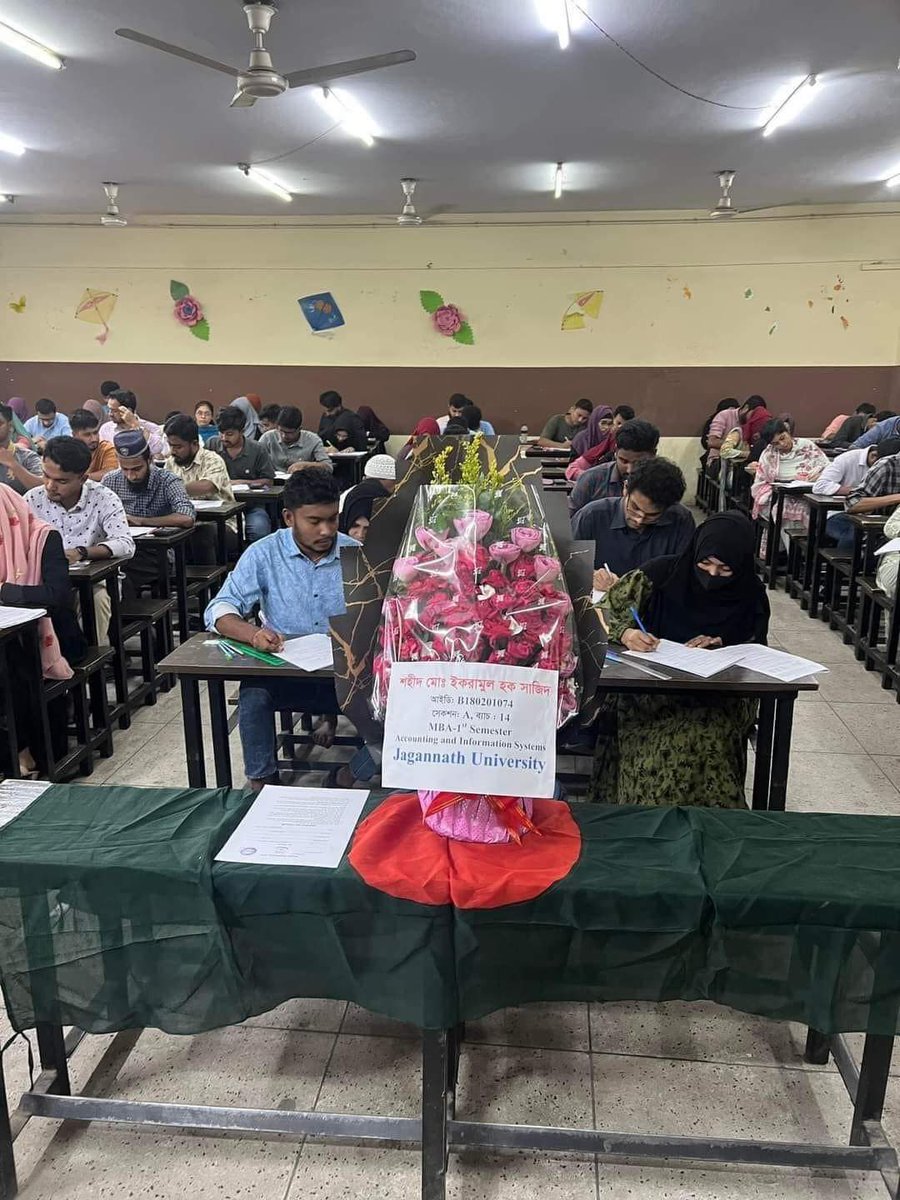
বৈষম্যবিরোধী ছাত্র আন্দোলনে" শহীদ ইকরামুল হক সাজিদ ভাইয়ের স্মরণে MBA 1st Semester পরীক্ষায় তার স্থানে ফুল এবং জাতীয় পতাকা দিয়ে তাকে স্মরণ এবং সম্মান জানিয়েছে তার সহপাঠীরা।
🎋শহীদ ইকরামুল হক সাজিদ ❤️
MBA 1'st semester
Department of Accounting and Information Systems, JU
@satyanneshii @Sohan_RSB আপনার দেয়া খবরেই স্পষ্ট লেখা আছে গণপিটুনিতে নিহত হয়েছে। চুরির শাস্তি কিন্তু মৃত্যু নয়। এটাকে প্রশ্রয় দিলে কিন্তু নির্দোষ মানুষও পরবর্তীতে শুধু সন্দেহের জের ধরে মারা পড়বে দুর্বৃত্তদের হাতে.....
This incident occurred in Bangladesh, where there was a heated argument at an expressway toll plaza in Dhaka.
The argument wasn't about tolls or free passes. They were denied access to the expressway due to security concerns, but they forcefully attempted to proceed, leading to the incident.
The manager of Operations and Maintenance of the Dhaka Elevated Expressway, retired Captain Hasib Hasan Khan, told Prothom Alo, at night that generally, people are not allowed to enter the elevated expressway if there are more people standing on the truck than its capacity or if the goods and materials loaded on the truck are not tightly secured. In this incident, 10-15 people were standing on the back of a small truck and trying to enter the elevated expressway.
At that time, they were denied a pass to go, with the explanation that they could not proceed this way. Angered by this, a few people got off the truck.... and this incident occurred.







![PREMIUMERZA's tweet photo. 🚨🚨🚨 BREAKING: Bangladeshi fan admitted to hospital after being attacked by Indian supporters in Stadium during Kanpur Test [DhakaPost] 🇧🇩🇮🇳
SHAME, SHAME, SHAME
And you'll see the rubbish organisation named @ICC will do nothing because it's "INDIA" https://t.co/AI1l24veoT](https://pbs.twimg.com/media/GYeTFb9bgAA8KdS.jpg)