try this next “use /create-formal-verification-skill to model these state machines, one skill per subsystem. and use /statechart to visualize my most important user flows”
both skills are in pstack
https://t.co/SxilBe4Diu
@ID_AA_Carmack I've found that hiring former college athletes is a direct proxy for strong work ethic and teamwork. These are the best athletes from their high schools, who had to compete against the largest pool of talent, all while maintaining good grades or getting kicked off their team.
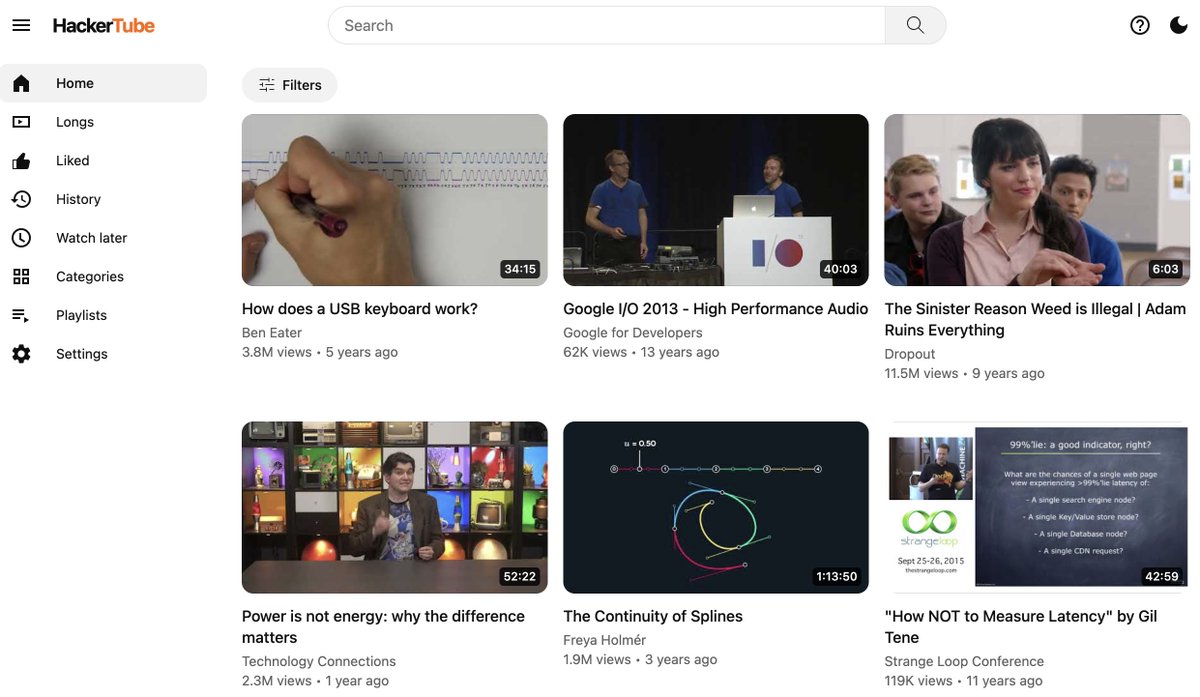
Weekend hack: HackerTube. I was annoyed with YouTube's recommendations so I had Claude filter down 43M comments over 20 years of HN to 6,454 videos that keep being recommended. *Significantly* better viewing experience, ~2 hours with Opus 5.5:
https://t.co/JIhXN7OSh1
- Excellent recs without any logins (state is kept in local browser session)
- Thumbnail is a representative frame from middle of the video instead of the super duper A/B test hyper-optimized user uploads
- Underlying data from the comment analysis as one zip file, point your Claude at it and ask for your own version
- HackerTube Longs ✊
A bit more on the process:
I use Claude Code (desktop app for Mac), Opus 5.5 on Medium effort as my default. I only talk to Claude and have it do everything, the only "manual work" I helped with in tandem was in the browser (reminiscent of MenuGen): 1) I had to create some kind of API key from Google Cloud UI to query YouTube for video metadata, 2) I booted up a VPS box for serving and 3) I bought the domain name. Once the box was up I gave Claude the IP and told it update, secure, harden, deploy and optimize the code, and it did the whole thing.
Many awesome projects that would have normally taken weeks/months even can now be few-shotted for breakfast. What else are we not thinking of.
When I was writing Unreal Engine 1, my time was divided as follows:
- Around 30% went to seriously deep coding on hard problems: assembly language texture mappers, C++ BSP trees, data persistence, object oriented systems design, and networking.
- Around 70% was just typing and refactoring large bodies of code needed for a complete engine feature set. This was not hard, and while I was doing it my mind was mostly on the deeper coding topics, thinking and planning for what's next. It didn't feel much different from vibe coding today, except that it was just me typing code on an IBM Model M keyboard rather than prompting it and reviewing the results.
So, it has always seemed perfectly logical that we would rely on AI for that 70%, once the AI could do it with a similar quality standard as we could, which has never been perfection. It came as no surprise that, after a few years of AI model evolution, it was able to take the reigns on that 70% and free up programmers' time for more valuable tasks.
What's more of a surprise is the emergence of AI as a sort of insta-Carmack able to solve hard technical problems quite cleverly and often cleanly, and that it's able to reason about and work in complex 3D scenes both by operating the tools and by directly understanding the raw data files.
I abandoned assembly language in 1998 when out-of-order CPUs made much simpler C/C++ code faster, and never I missed it. If prompting through architectural documents, concept art, and design plans can transcend typing code and tweaking vertices, that will enable developers to spend their time on higher-level, higher value technical and creative tasks.
What matters is the end product, whether it's a game or an engine. Anything developers can do to try out more ideas and make better software and games faster is a win for everyone.
This Fall at CMU we're teaching a new course on AI Agents!
The goal is that you learn how to create a scaffold, build evals, and train an agentic LLM using RL.
We'll try to balance theory and practice, and introduce modern frameworks and best practices.
A CS undergrad asked me where he could have most effect in the AI age. I said probably at either extreme: either close to the technology, actually making LLMs, or close to the customer, using AI to give them exactly what they want. Or maybe both if you can stretch that far.
here's how i shipped 2,500 PRs last month to production
this was originally supposed to be for Cursor Compile in London. i couldn't make it since i was livestreaming for Grok @Bot Galaxy so i'm making it available for free here on X! watch it on 2x speed, i talk slowly
If I could pick "grown up" concepts I'd like kids to learn about earlier, counter-intuitiveness would be high on the list. One of the problems with teaching things by rote is that you also implicitly teach that the truth is obvious, when in fact it's often surprising.
@airesearch12 💯 @ Spec-driven development
It's the limit of imperative -> declarative transition, basically being declarative entirely.
Relatedly my mind was recently blown by https://t.co/pTfOfWwcW1 , extreme and early but inspiring example.
A few random notes from claude coding quite a bit last few weeks.
Coding workflow. Given the latest lift in LLM coding capability, like many others I rapidly went from about 80% manual+autocomplete coding and 20% agents in November to 80% agent coding and 20% edits+touchups in December. i.e. I really am mostly programming in English now, a bit sheepishly telling the LLM what code to write... in words. It hurts the ego a bit but the power to operate over software in large "code actions" is just too net useful, especially once you adapt to it, configure it, learn to use it, and wrap your head around what it can and cannot do. This is easily the biggest change to my basic coding workflow in ~2 decades of programming and it happened over the course of a few weeks. I'd expect something similar to be happening to well into double digit percent of engineers out there, while the awareness of it in the general population feels well into low single digit percent.
IDEs/agent swarms/fallability. Both the "no need for IDE anymore" hype and the "agent swarm" hype is imo too much for right now. The models definitely still make mistakes and if you have any code you actually care about I would watch them like a hawk, in a nice large IDE on the side. The mistakes have changed a lot - they are not simple syntax errors anymore, they are subtle conceptual errors that a slightly sloppy, hasty junior dev might do. The most common category is that the models make wrong assumptions on your behalf and just run along with them without checking. They also don't manage their confusion, they don't seek clarifications, they don't surface inconsistencies, they don't present tradeoffs, they don't push back when they should, and they are still a little too sycophantic. Things get better in plan mode, but there is some need for a lightweight inline plan mode. They also really like to overcomplicate code and APIs, they bloat abstractions, they don't clean up dead code after themselves, etc. They will implement an inefficient, bloated, brittle construction over 1000 lines of code and it's up to you to be like "umm couldn't you just do this instead?" and they will be like "of course!" and immediately cut it down to 100 lines. They still sometimes change/remove comments and code they don't like or don't sufficiently understand as side effects, even if it is orthogonal to the task at hand. All of this happens despite a few simple attempts to fix it via instructions in CLAUDE . md. Despite all these issues, it is still a net huge improvement and it's very difficult to imagine going back to manual coding. TLDR everyone has their developing flow, my current is a small few CC sessions on the left in ghostty windows/tabs and an IDE on the right for viewing the code + manual edits.
Tenacity. It's so interesting to watch an agent relentlessly work at something. They never get tired, they never get demoralized, they just keep going and trying things where a person would have given up long ago to fight another day. It's a "feel the AGI" moment to watch it struggle with something for a long time just to come out victorious 30 minutes later. You realize that stamina is a core bottleneck to work and that with LLMs in hand it has been dramatically increased.
Speedups. It's not clear how to measure the "speedup" of LLM assistance. Certainly I feel net way faster at what I was going to do, but the main effect is that I do a lot more than I was going to do because 1) I can code up all kinds of things that just wouldn't have been worth coding before and 2) I can approach code that I couldn't work on before because of knowledge/skill issue. So certainly it's speedup, but it's possibly a lot more an expansion.
Leverage. LLMs are exceptionally good at looping until they meet specific goals and this is where most of the "feel the AGI" magic is to be found. Don't tell it what to do, give it success criteria and watch it go. Get it to write tests first and then pass them. Put it in the loop with a browser MCP. Write the naive algorithm that is very likely correct first, then ask it to optimize it while preserving correctness. Change your approach from imperative to declarative to get the agents looping longer and gain leverage.
Fun. I didn't anticipate that with agents programming feels *more* fun because a lot of the fill in the blanks drudgery is removed and what remains is the creative part. I also feel less blocked/stuck (which is not fun) and I experience a lot more courage because there's almost always a way to work hand in hand with it to make some positive progress. I have seen the opposite sentiment from other people too; LLM coding will split up engineers based on those who primarily liked coding and those who primarily liked building.
Atrophy. I've already noticed that I am slowly starting to atrophy my ability to write code manually. Generation (writing code) and discrimination (reading code) are different capabilities in the brain. Largely due to all the little mostly syntactic details involved in programming, you can review code just fine even if you struggle to write it.
Slopacolypse. I am bracing for 2026 as the year of the slopacolypse across all of github, substack, arxiv, X/instagram, and generally all digital media. We're also going to see a lot more AI hype productivity theater (is that even possible?), on the side of actual, real improvements.
Questions. A few of the questions on my mind:
- What happens to the "10X engineer" - the ratio of productivity between the mean and the max engineer? It's quite possible that this grows *a lot*.
- Armed with LLMs, do generalists increasingly outperform specialists? LLMs are a lot better at fill in the blanks (the micro) than grand strategy (the macro).
- What does LLM coding feel like in the future? Is it like playing StarCraft? Playing Factorio? Playing music?
- How much of society is bottlenecked by digital knowledge work?
TLDR Where does this leave us? LLM agent capabilities (Claude & Codex especially) have crossed some kind of threshold of coherence around December 2025 and caused a phase shift in software engineering and closely related. The intelligence part suddenly feels quite a bit ahead of all the rest of it - integrations (tools, knowledge), the necessity for new organizational workflows, processes, diffusion more generally. 2026 is going to be a high energy year as the industry metabolizes the new capability.
When Meta trains it models on 80+ TB of pirated books from LibGen and other platforms, it's called 'fair use', without them having to pay penalties and / or receive some form of legal punishment, as proceedings are ongoing.
When Aaron Swartz downloaded 70 GB of articles from JSTOR in 2010 he was facing a $1M fine and 35 years in prison, before taking his life in 2013.
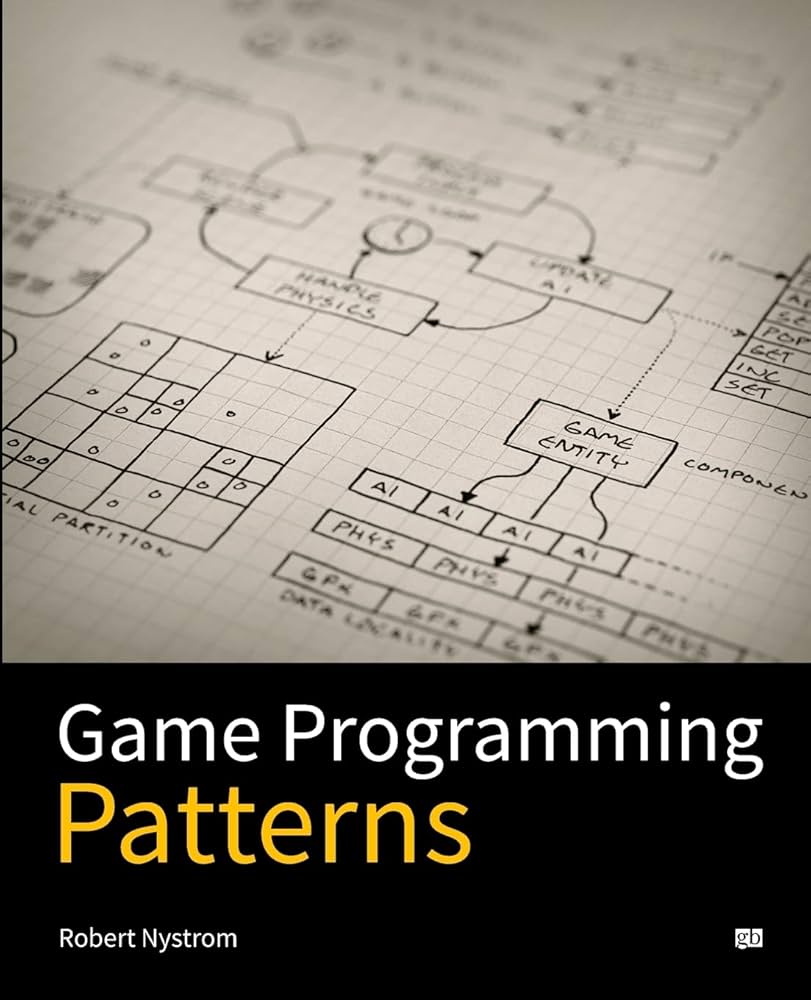
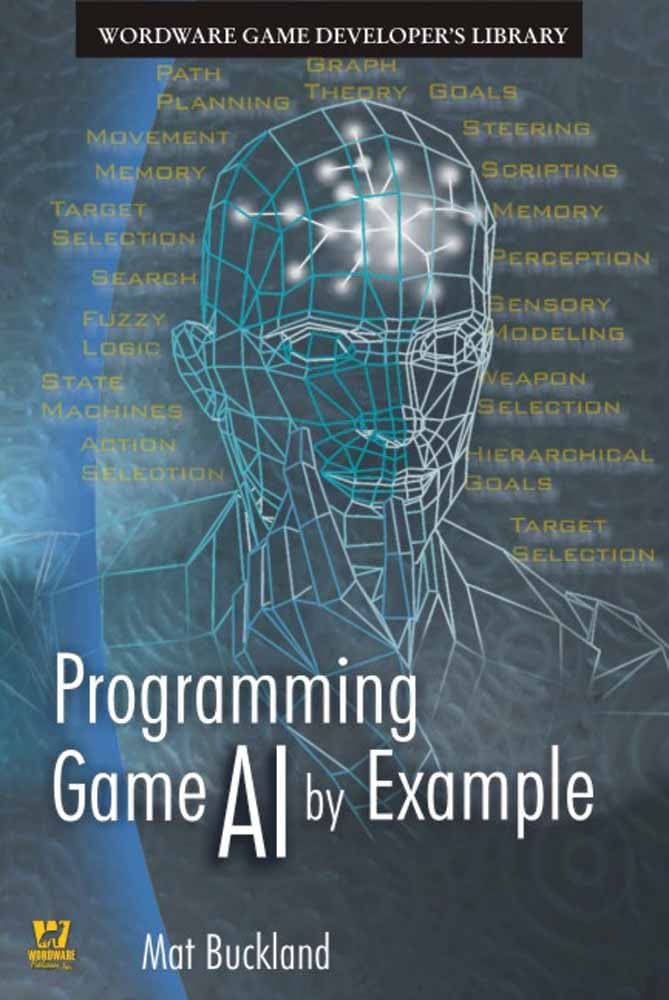
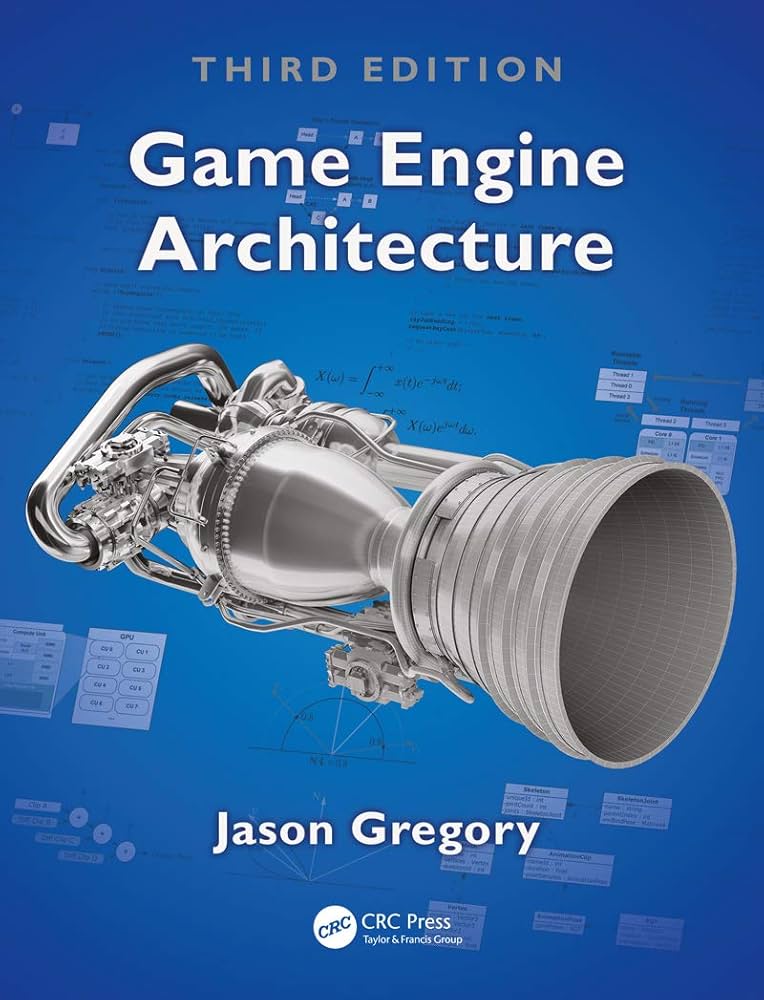
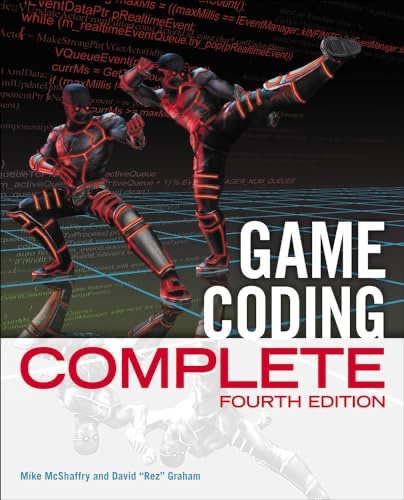
From the hundreds of books in game programming I read, these are still *the* best.
“Game Coding Complete” especially. It’s incredibly practical and has taught me so much, I still use many concepts/patterns from it to this day.
3.5 years ago I transitioned from being a software engineer to running a mobile gaming company
This is what I wish I knew at the beginning
1. Your players will call you greedy or your company will go out of business.
2. Ads work. As a software engineer, I thought no one clicked on them. I was wrong.
3. Organic content is not king. It’s spray and pray. Social media ads are like a sniper for finding customers. Both are good.
4. You need to earn the right to make a big game. Start with a game that you can make in less than 6 months.
5. You can’t MVP a game. Wait until you have a tight polished core loop to launch.
6. You can’t “fix” a bad game. Make a new one.
7. To make a great game you need someone that is 10x at: game design, coding, and visual design. This is usually 3 people. Partner/hire what you are missing.