We had a really mean python at work and I gave him back to his owner and was like “he was trying to kill me” and his owner said “well, he only has so many ways to interact with the world. All he has is a face” and it Moved Me
Women can tell how attractive a man is just by watching their gait. They can even predict it better from his lower legs than from his entire body.
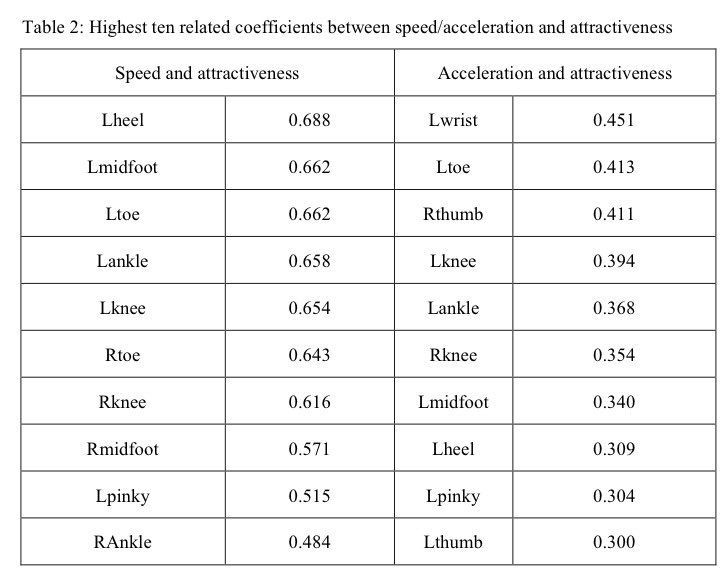
The speed of a single point, the left heel, correlated at r = 0.688 with the attractiveness ratings. Overall walking speed mattered a lot (r = 0.724), yet the specific, fluid kinematics of the lower legs still added their own independent punch.
Velocity matters far more than acceleration for perceived attractiveness. Women appear to prefer gaits with fluid, consistent limb velocities over those with lots of jerk or sudden acceleration changes. “Smooth and purposeful” seems to beat “bouncy or erratic.”
For figuring out who someone is by their gait, the left lower arm dominated the main patterns, likely because most people naturally swing their left arm more prominently as the leading arm.
The women who rated the men’s walks largely agreed with each other on how attractive they found them (Cronbach’s α = 0.78).
Time Dilation kind of makes the whole “datacenters in space” idea more fun.
Technically…something like a GPS Block III CPU runs an extra ~7,000 clock cycles per day compared to the same machine on earth.
Extend this to the extreme, and you get the whole subfield of CS+physics called relativistic hypercompuation.
There’s some (fun?) papers that allow you to solve the halting problem by placing yourself dangerously close to a black hole…while your computer safely computes for ~infinite-ish amounts of time.
One of the better papers on this field appears to be:
"Relativistic computers and the Turing barrier" (Németi & Dávid 2006)
(sadly, the maximum speedup just escaping earths gravity well is something like 1 x 10 ^ (-10), so yeah the blackhole thing is kinda necessary)