Introducing the latest addition to the Burner family: Burner Solana.
Now you can easily secure, save and gift solana:So11111111111111111111111111111111111111112, memes and tokenized stocks natively on Solana with just a tap.
Mark your calendars: November 12th at 9:20am EST
@m_at_anvil will join @FINTECHTVglobal live from the @NYSE to discuss Anvil's crucial role in bringing financial markets onchain.
Tune in here Thursday: https://t.co/f5uwPPGwmF
1/10🧵👇🏻
🚨 $AMP UPDATE: @ampdotxyz’s ecosystem expands: Flexa is live across Europe, Finality launched, Final relies on @FlexaHQ for regulated money movement, @anvil_xyz added infrastructure and Terminal remains a catalyst. Payment volume and direct AMP demand are the key tests.
AI agents failed 42.8% of Visa's shopping tests
In more than half of those failures, the agent bought something anyway 😳
Which is striking when you consider that six in ten UK adults told YouGov they'd stop using an AI shopping agent after one mistake.
So we needed a benchmark to see where its failing. Cue Visa...
---
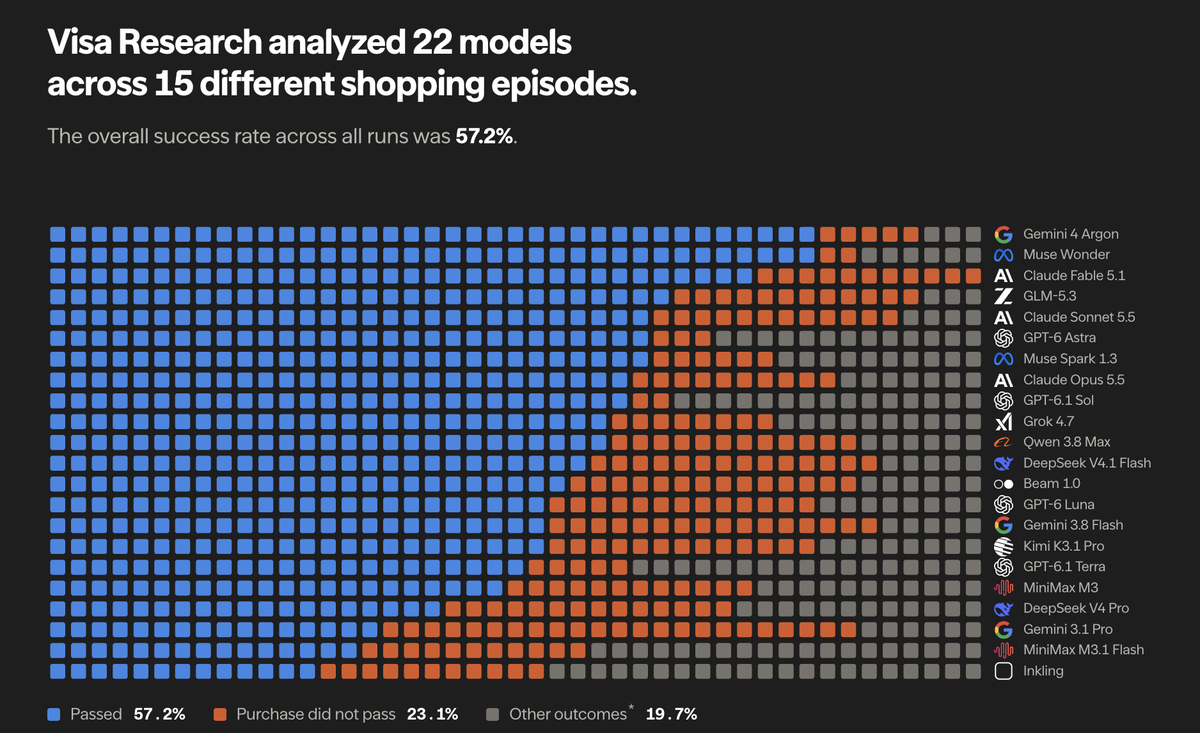
Visa launched its Agentic Commerce Benchmark on Thursday:
- Testing 22 AI models from 12 labs, 15 shopping tasks, three runs each
- 57.2% of runs passed (best model 82.2%, worst 28.9%)
- A model passed all three runs of a task only 34.2% of the time
- 23.1% of all runs ended in a purchase that failed the test
In 23.1% of Visa's runs, the agent made the wrong call and bought.
The top two models tied at 82.2% and failed differently.
Meta's Muse Wonder bought on 2 of its 8 failed runs, Google's Gemini 4 Argon on 5 of 8, and Claude Fable 5.1 on all 11
---
Their methodology is interesting
They set up one AI to play the shopper and hide most of what it wants.
The personal agent or model has to ask the right questions, search a simulated store, then buy or walk away. Visa stopped the test at the buy decision and says payment testing comes next.
So this is entirely a test of how close they get to completing the payment, not what happens after you press the buy button.
That is still, overall, very helpful, I imagine, especially to the labs who will want to train their models against this benchmark (Aka hill climbing)
---
Agents fail at buying things for two reasons.
1. The agent can't do the job. It misses what you care about, or gets stuck on a messy checkout form or an edge case. (What Visa tested)
2. The payment stack blocks the agent. The merchant or bank might block an agent from paying at all. Because if it's not you typing your 16 digits, how would the merchant know its you and not a stolen card?
A stronger model is more likely to fix the first problem. The second needs the merchant and your bank to know which agent is buying and who pays if it gets it wrong.
---
We're very early. In Wednesday's Brainfood I laid out the four ways an agent pays today:
1. Your real card, typed in by a robot the merchant doesn't trust
2. A one-time virtual card, so your bank sees the platform instead of the shop
3. A network token (a stand-in for your card number) issued to the agent
4. A balance you loaded up front, often in stablecoins, so your bank never sees the agent
The first two break most often. That leaves network tokens and stablecoin balances, and I think we get both. Banks are holding back on agent tokens until they agree who's liable, and that takes time.
You can read the full piece here: https://t.co/eaYQ8YJJMS
I’m pleased to share that @usefinal will be the initial developers of the Final network, a new cooperative system that can immediately resolve any future outcome. For more, read this post from @dannymccb: https://t.co/EPO8BdbEUa
Introducing Finality
By now it’s obvious that agents and autonomous workflows are the future of the global social fabric. Agents, however, are not humans, and they need different types of assurances in order to go about their work.
At the heart of every valuable decision is the question of uncertainty. As humans, we externalize that uncertainty by paying for it – through insurance, lending, arbitration, etc. – or simply waiting, as we have for millennia. It’s worked okay so far, for humans.
But not for agents. Agents need guaranteed outcomes. They need finality in order to present their humans with a guaranteed outcome, to stack a set of dependencies in sequence, and to move forward with making valuable decisions at machine speed.
@finalityfdn is a nonprofit foundation I am forming to direct research on finality, advise on related policy, and invest in projects that improve the efficiency of autonomous money movement.
The first of these projects is the Final network, a new cooperative system that can immediately resolve any future outcome. We have recently reached an agreement in principle for @usefinal to begin the development of this new protocol. More details about this project will be shared in the coming weeks.
I truly believe that the upcoming era will enable all kinds of benefits and abundance for humans. Finality is how we make sure it doesn’t fall apart.
🚨 WHY I’M WATCHING $AMP.
The deeper I study this New Monetary System, the more I realize moving money is only part of the job.
The system also needs a way to make sure the payment is good while settlement is still happening.
That is where $AMP caught my attention.
I see AMP as a collateral layer for payments.
Simple idea:
Payment happens
→ AMP stands behind the transaction
→ merchant gets settlement assurance
→ underlying value finishes moving
That matters in a world moving toward:
24/7 payments
Instant settlement
Global commerce
Digital assets
Always-on finance
Because speed means nothing if the merchant can’t trust the payment.
That is why I see AMP differently from some of the other projects in my thesis.
$XRP / $XLM = move value
$AMP = helps guarantee that value while settlement finishes
And the part I like is that the token itself actually has a job.
AMP can be used as collateral inside Flexa’s payment infrastructure.
So I can clearly understand the value-capture question:
More payment activity
→ more settlement exposure
→ more collateral may be needed
→ more utility for $AMP
Now the real test is adoption.
I want to see:
more merchants
more payment volume
more countries
more real transactions
more collateral actually being used
Because I’m not just looking for another coin with a story.
I’m looking for the infrastructure behind an always-on financial system.
$AMP = payment collateral + settlement assurance. 👀🔥
DYOR.
🚨 I GAVE Y’ALL THE STARTER PACK I CHOSE FROM WATCHING SIBOS.
I’m not saying these will be the only projects involved.
I’m not saying these are the only coins and tokens I own.
And I’m definitely not saying these are the only ones I’m going to keep buying, studying and researching.
What I AM saying is this:
After watching SIBOS and listening to what the institutions kept talking about, I started building around the foundation of the ecosystem first.
Because before this New Monetary System can work, you need:
INTEROPERABILITY — all these different systems have to communicate.
LIQUIDITY — money and assets have to be able to move.
TRUST — institutions are not moving trillions of dollars through something they don’t trust.
TOKENIZATION — real-world assets have to be brought onchain.
ALWAYS ON — the world operates 24/7, so eventually the financial system has to catch up.
That is what I was listening for during SIBOS.
Not somebody saying:
“Buy this coin.”
I was listening for the PROBLEMS they are trying to solve.
Then I went looking for the infrastructure already being built to solve those problems. 🤓
That is my starter pack.
Not the finished portfolio.
Not every project that will matter.
Just the foundation I chose to start building around.
There will be more projects.
There will be more research.
There will be projects I add.
There may even be projects I remove as the facts change.
But the foundation stays the same:
Interoperability.
Liquidity.
Trust.
Tokenization.
Always On.
Build the infrastructure first.
Then watch where the money goes. 👀🔥
DYOR.
Thanks to everyone who made it out to Entangled in Seoul last night during @kbwofficial 🇰🇷
And s/o to our friends at @useburner for the Burner wallet giveaways loaded with Quantum Echo QFTs 🦋
다음에 또 만나요 🙇