The French hate air conditioning.
So Paris built a 120-kilometre machine under its streets for producing cold.
It’s called Fraîcheur de Paris, and it does for summer heat what district heating did for winter: centralise the problem.
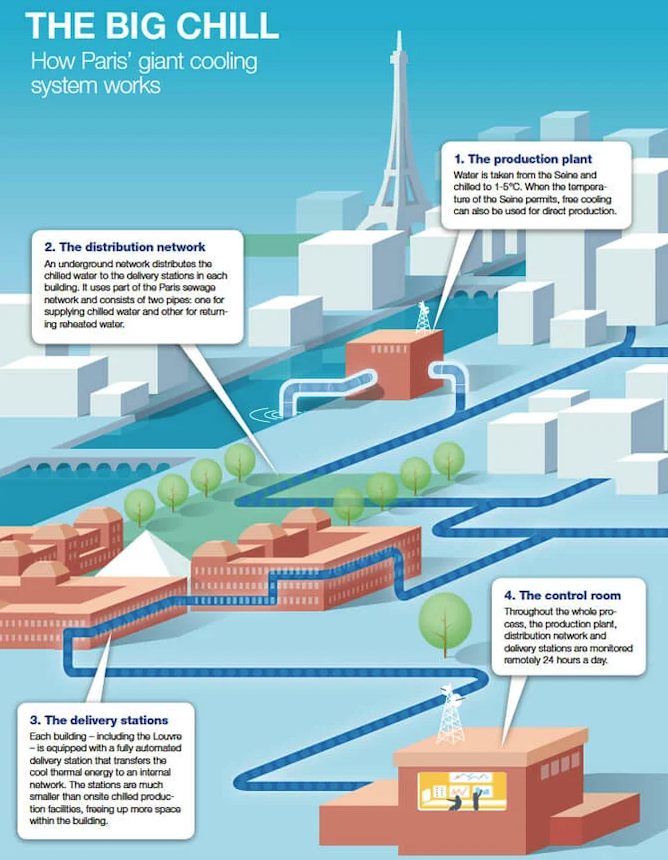
Instead of every museum, office, hotel, hospital and shop bolting its own cooling plant onto the building, Paris moves cold through pipes.
The network sends water chilled to 2 to 4°C through buried supply lines. The water enters a connected building, absorbs heat through an exchange station, then returns at 12 to 14°C to be cooled again.
It essentially functions with two pipes. One carries the cold out, the other carries heat back.
The production plants cool the circuit from 12°C to 4°C. Some sites use the Seine as a heat sink. In colder periods, the system can use the river’s own temperature for free cooling, which means the machines work less and the electricity demand drops. The Seine water doesn’t become the building water. It stays separate, passing temperature across heat exchangers.
The scale is pretty strange when you see it written down though.
It's got 15 production sites, 4 storage sites, 120 km of underground network with 924 subscribers. This has resulted in 7 million square metres cooled, and 493 GWh of cooling sold.
A cold utility running beneath one of the densest cities in Europe.
The Forum des Halles has been cooled this way since 1979. The Louvre since 1986. Galeries Lafayette, Opéra Garnier, Hôtel de Ville, Station F, La Samaritaine and the National Assembly all sit on the same idea. Tourists stand in the Louvre looking at paintings while a municipal cold loop does part of the dull work below ground.
The boring part is the breakthrough.
Cold can be stored at night in chilled water or ice, then used during daytime peaks. The network is monitored from a control room with more than 125,000 control points. A delivery station inside a building takes 5 to 7 times less space than a standalone cooling installation and avoids the roof and façade clutter that turns cities into compressor farms.
That matters because conventional air conditioning solves heat by moving it somewhere nearby. In a dense city, thousands of private machines mean thousands of outdoor units rejecting heat into streets, courtyards and roofs, plus refrigerants, noise, vibration and maintenance spread across every building.
Paris’s public cooling network has a stated coefficient of performance of 4, against 3 for a wet standalone system and 2 for a dry standalone system. Against an equivalent set of autonomous installations, Fraîcheur de Paris says the network gives 100% higher energy efficiency, 35% less electricity use, 90% fewer refrigerant-fluid emissions and 50% lower CO2 emissions.
The climate backdrop is the real reason this exists.
Paris ran a full crisis exercise called “Paris at 50°C” in 2023. Météo-France’s 2050 reference trajectory for France points to heatwave days becoming five times more frequent, hot nights rising sharply in urban centres, and some local extremes around 48°C becoming possible.
The city signed a 20-year concession in 2022 with Fraîcheur de Paris, owned 85% by ENGIE and 15% by RATP. The contract is worth a projected €2.4 billion. The plan is to extend the network by 158 km by 2042, add 20 production plants and 10 storage sites, and reach more than 3,000 subscribers, including hospitals, nurseries, schools and care homes.
This is basically the infrastructure version of admitting that summer is becoming a public systems problem...
"Le meilleur pour les turbulences de l'esprit, c'est apprendre. C'est la seule chose qui n'échoue jamais. Vous pouvez vieillir et trembler, vous pouvez veiller la nuit en écoutant le désordre de vos veines, vous pouvez manquer votre seul amour et vous pouvez perdre votre argent à cause d'un monstre ; vous pouvez voir le monde qui vous entoure dévasté par des fous dangereux, ou savoir que votre honneur est piétiné dans les égouts des esprits les plus vils, il n'y a qu'une seule chose à faire dans de telles conditions : apprendre."
Marguerite Yourcenar, Sources II (Gallimard)
The best pitch test: can you tell this at a bar to a friend?
Not the market size, not the TAM, not the deck. Just the story. Why you built it. What you saw that nobody else saw. What happened.
If you can't tell it naturally over drinks (or it would feel weird to your friend and they would think "this isn't you"), your idea or pitch or endeavor needs to bake some more.
The 9pm-at-a-bar test for your startup idea is a defining authenticity test. And without that, nobody will buy your product, let alone come work for you or invest.
The data science revolution is here now.
TabPFN-3 is live, taking tabular foundation models to enterprise scale 🤩
1M training rows on a single H100. No training. No tuning. Load and predict.
🧵 1/5
#tabpfn#tabularfoundationmodels#priorlabs
A European startup that built a foundational model with only $9m has just been acquired for $1bn+.
The company - @prior_labs, has built a state-of-the-art foundation model for tabular data.
It was founded by @FrankRHutter, @noahholl and Sauraj Gambhir, and only announced a $9m pre-seed led by @balderton (@Jameswise) last year.
Tabular data, i.e. structured data in tables, spreadsheets, and databases, plays an essential role is many critical industries, but was neglected in the early advances in AI that focused on text and images.
Today SAP has announced that it is acquiring the company for $1bn+.
To date Prior Labs has only raised $9m which means it will likely be a great result for its founders, employee and early investors who include Balderton, @guypod, @Thom_Wolf, @petersarlin.
It's great to see a good exit for the German tech ecosystem and even better to see it staying in Europe!
It also shows how much there is to play for in AI. The team have built an insanely high quality, hyper-focused model and have got a unicorn outcome on just under a year.
Amazing news!
We're incredibly proud to congratulate our co-founder and CTO, @matei_zaharia, on receiving the ACM Prize in Computing for his development of distributed data systems that have enabled large-scale machine learning, analytics, and AI.
Matei's open-source contributions have fundamentally changed how organizations work with data and AI — including Apache Spark™, Delta Lake, and MLflow. Researchers, nonprofits, startups, and enterprises across every industry have built on the foundation he helped create.
Now he's pushing the frontier further, focusing on building and scaling reliable AI agents through open-source research like DSPy and GEPA.
Matei, this recognition is so well deserved. We're honored to build alongside you every day. https://t.co/mgBvBc3QnP
@BetterCallMedhi 100% mais ça permet à Mistral d'exister à eux d'utiliser le marché français pour s'imposer à l'international. De toute façon sans cette stratégie on n'aurait rien...