Everyone assumes GPTs and LLMs are the future of AI, but what if they're not?
What if they are just the beginning of it?
Betamax was better technology. Kodak dominated photography. Cisco briefly became the most valuable company in the world because it powered the internet boom.
None ended up owning the future they helped create.
In my latest newsletter, I explore a question most people in AI are not asking loudly enough:
Are OpenAI and Anthropic building the final architecture of intelligence… or simply the first commercially useful interface to it?
The first dominant technology is rarely the final one.
AI may prove no different.
Read now: https://t.co/7fXetJRi2X
@elonmusk@Space_Station@sen - and founder @charlesblack - is going to document mankind’s journey from orbit to the Moon and then Mars. It’s great to be onboard!
Give yourself an assistant, or give your EA an EA!
Get more done with Command.
Coming soon.
Learn more: https://t.co/zLKBQlbten
@goimplementai@Aalokyshukla
Every so often you build or invest in something that permanently changes how you live or work.
Most products don’t. This one has.
AIOS Command has changed how I operate day to day.
Not because it’s another AI tool.
Because it gives me continuous operational awareness.
I now talk to my business instead of digging through systems.
Emails. Calls. CRM. Finance. Meetings. Tasks. AI agents.
Command sees across all of them at once and tells me:
• what matters
• what’s stalled
• what needs action
• what I’m missing
Then it helps do the work.
It has made me at least 2x more productive.
The strange reality is that I can’t imagine working without it now.
Most software stores information.
This changes awareness.
My own Jarvis.
Command is coming soon.
Learn more: https://t.co/C1DnyY7HoN
𝐁𝐞𝐟𝐨𝐫𝐞 𝐀𝐆𝐈 𝐚𝐫𝐫𝐢𝐯𝐞𝐬 𝐢𝐧 𝐚 𝐦𝐚𝐜𝐡𝐢𝐧𝐞, 𝐢𝐭 𝐦𝐚𝐲 𝐟𝐢𝐫𝐬𝐭 𝐚𝐫𝐫𝐢𝐯𝐞 𝐢𝐧 𝐭𝐡𝐞 𝐰𝐚𝐲 𝐲𝐨𝐮𝐫 𝐛𝐮𝐬𝐢𝐧𝐞𝐬𝐬 𝐢𝐬 𝐨𝐫𝐠𝐚𝐧𝐢𝐬𝐞𝐝.
Most businesses are not short of data, or human intelligence. What they are short of is connected intelligence.
The information is already there: emails, meetings, calls, CRM records, SOPs, finance systems, support tickets, documents, dashboards and people’s heads.
But it is fragmented. So people spend large parts of their day pulling reports, checking systems, preparing summaries, explaining what happened to colleagues and chasing what happens next.
That looks like work. But often, it’s just information retrieval, repairing and sharing.
Worse, when people leave, much of the real know-how leaves with them: the context, the exceptions, the relationships and the “this is how things actually work here” knowledge.
That is the old operating model. Humans acting as the glue between disconnected systems.
AIOS is built for a different one.
AIOS Command: the leadership, insight and action layer. It reads across connected systems, retains memory, answers questions in plain English, drafts in the user’s voice and helps leaders take action. It does work.
AIOS Workforce: the digital worker platform. It lets organisations deploy and manage digital workers across all functions to do work using all communications channels, including voice.
Together, they form AIOS: one system for coordinating leaders, human resource and digital workers.
That is the transformation. Not AI as another tool, but AI as an operating layer for the organisation.
AIOS abstracts work from underlying software complexity, so leaders and teams do not have to navigate it. The systems stay. But the business gains an intelligence and action layer above them.
Users do not need to know how every platform works as the intelligence layer understands your objectives and can access the APIs. They can focus on asking better questions, making better decisions and triggering the right action.
This is not about replacing people. It is about changing the division of labour. Humans should focus on judgement, creativity, trust, relationships, exceptions, edge cases, and decisions under uncertainty.
Digital workers should handle scale, repetition, monitoring, analysis, follow-through and execution.
For a SME leader, AIOS creates leverage. For a corporate leadership team, it creates shared visibility. For a growing company, it adds capacity without scaling headcount in the old linear way.
Productivity and efficiency gains are first-order effects. The strategic effect is competitive advantage.
The companies that win with AI will not be the ones with the most tools. They will be the ones that organise intelligence best.
That is what AIOS makes possible. It is not about buying AI.
It's about organising intelligence.
Learn more: https://t.co/qNEEgKQMou
@goimplementai@Aalokyshukla
@goimplementai Podcast #81 with @MattDummy, former President Google EMEA and incoming Director-General of BBC.
Why AI Adoption Lags Behind Capability
https://t.co/490gHXZJh3
𝐁𝐞𝐟𝐨𝐫𝐞 𝐀𝐆𝐈 𝐚𝐫𝐫𝐢𝐯𝐞𝐬 𝐢𝐧 𝐚 𝐦𝐚𝐜𝐡𝐢𝐧𝐞, 𝐢𝐭 𝐦𝐚𝐲 𝐟𝐢𝐫𝐬𝐭 𝐚𝐫𝐫𝐢𝐯𝐞 𝐢𝐧 𝐭𝐡𝐞 𝐰𝐚𝐲 𝐲𝐨𝐮𝐫 𝐛𝐮𝐬𝐢𝐧𝐞𝐬𝐬 𝐢𝐬 𝐨𝐫𝐠𝐚𝐧𝐢𝐬𝐞𝐝.
Most businesses are not short of data, or human intelligence. What they are short of is connected intelligence.
The information is already there: emails, meetings, calls, CRM records, SOPs, finance systems, support tickets, documents, dashboards and people’s heads.
But it is fragmented. So people spend large parts of their day pulling reports, checking systems, preparing summaries, explaining what happened to colleagues and chasing what happens next.
That looks like work. But often, it’s just information retrieval, repairing and sharing.
Worse, when people leave, much of the real know-how leaves with them: the context, the exceptions, the relationships and the “this is how things actually work here” knowledge.
That is the old operating model. Humans acting as the glue between disconnected systems.
AIOS is built for a different one.
AIOS Command: the leadership, insight and action layer. It reads across connected systems, retains memory, answers questions in plain English, drafts in the user’s voice and helps leaders take action. It does work.
AIOS Workforce: the digital worker platform. It lets organisations deploy and manage digital workers across all functions to do work using all communications channels, including voice.
Together, they form AIOS: one system for coordinating leaders, human resource and digital workers.
That is the transformation. Not AI as another tool, but AI as an operating layer for the organisation.
AIOS abstracts work from underlying software complexity, so leaders and teams do not have to navigate it. The systems stay. But the business gains an intelligence and action layer above them.
Users do not need to know how every platform works as the intelligence layer understands your objectives and can access the APIs. They can focus on asking better questions, making better decisions and triggering the right action.
This is not about replacing people. It is about changing the division of labour. Humans should focus on judgement, creativity, trust, relationships, exceptions, edge cases, and decisions under uncertainty.
Digital workers should handle scale, repetition, monitoring, analysis, follow-through and execution.
For a SME leader, AIOS creates leverage. For a corporate leadership team, it creates shared visibility. For a growing company, it adds capacity without scaling headcount in the old linear way.
Productivity and efficiency gains are first-order effects. The strategic effect is competitive advantage.
The companies that win with AI will not be the ones with the most tools. They will be the ones that organise intelligence best.
That is what AIOS makes possible. It is not about buying AI.
It's about organising intelligence.
Learn more: https://t.co/qNEEgKQMou
@goimplementai@Aalokyshukla
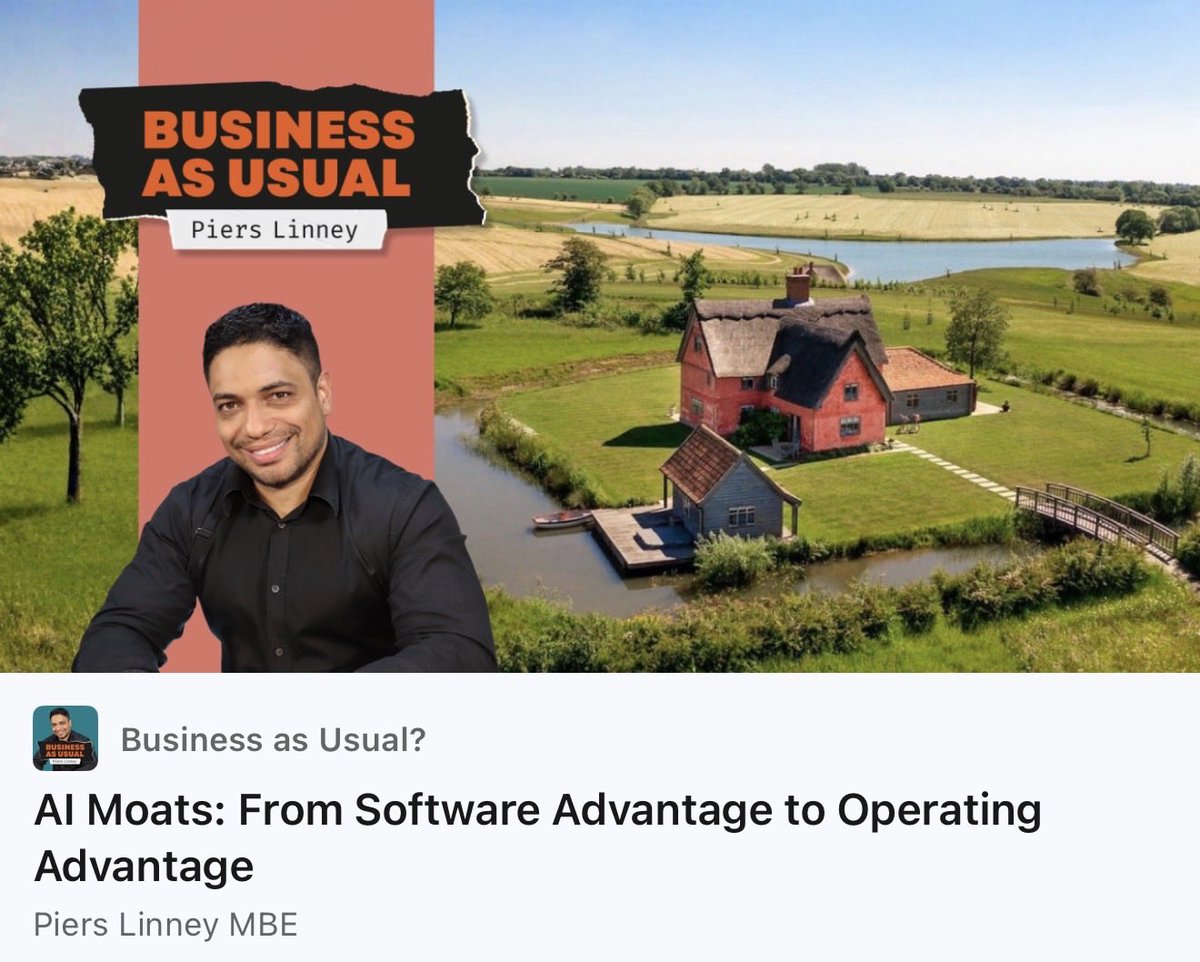
Most software moats are disappearing.
The wrong question: “Which AI tool should we use?”
That’s procurement, not strategy.
The real question: what stays defensible when intelligence is cheap?
It’s no longer features or models.
Read my latest newsletter edition: what moats actually look like in the AI era.
Read it here: https://t.co/7rFK1ks1dQ
@goimplementai@Aalokyshukla
AI is not just changing work. It is changing what work is.
The real shift is not that new tools are appearing.
It is that more and more work is moving from labour to capital.
That has consequences far beyond productivity:
▪️ Who owns the capital, who captures the income, what happens to mass employment?
▪️ What remains distinctively human when machines can do more of the output?
Read my latest newsletter on the deeper economics and human implications of that shift.
If human labour is no longer the default engine of production, what does that do to business models, tax systems, identity and opportunity?
Let me know where you think this goes next.
@goimplementai@Aalokyshukla
LinkedIn: https://t.co/Vf2rpnVaLe
Web: https://t.co/zRhXgelpU3
AI is not just changing work. It is changing what work is.
The real shift is not that new tools are appearing.
It is that more and more work is moving from labour to capital.
That has consequences far beyond productivity:
▪️ Who owns the capital, who captures the income, what happens to mass employment?
▪️ What remains distinctively human when machines can do more of the output?
Read my latest newsletter on the deeper economics and human implications of that shift.
If human labour is no longer the default engine of production, what does that do to business models, tax systems, identity and opportunity?
Let me know where you think this goes next.
@goimplementai@Aalokyshukla
LinkedIn: https://t.co/Vf2rpnVaLe
Web: https://t.co/zRhXgelpU3
When countries talk about AI leadership, the conversation often focuses on infrastructure, unicorn startups, and massive investments.
But what if the real competitive advantage isn’t building the biggest models but ensuring millions of businesses know how to implement AI?
Supporting SMEs with practical AI training and adoption could unlock enormous economic impact - potentially far beyond the value of a few large tech successes. This might cost £500 per business and several billion, but result in a far more material impact on productivity and GDP.
Because economic transformation rarely comes from technology alone.
It comes from widespread adoption.
🎧 Listen to the full episode on The @goimplementai Podcast with @KulveerRanger and my co-host Aalok Yashwant Shukla:
Apple: https://t.co/PB6Nr13MPJ
Spotify: https://t.co/ACItQ6fi19
YouTube: https://t.co/iqJBYOUEf4
#ImplementAIPodcast #AIAdoption #SMEs #FutureOfWork #EconomicGrowth #DigitalTransformation
I joined @mattfrei on @LBC this morning too discuss UK productivity, energy, the impact of AI, and how important it is to diffuse technology and innovation throughout the economy.
@goimplementai@Aalokyshukla
https://t.co/gCAhdCwFef
David Sinclair's lab is using AI to build a pill that reverses aging for $100.
Right now, their gene therapy costs roughly $10 million to manufacture. It requires a direct injection into the target organ.
That's not going to work for 8 billion people.
So Sinclair's team made a breakthrough. They found that the three age-reversal genes aren't the only path to resetting cells.
They discovered CHEMICALS that do the same thing.
In mice, they can now give an animal a liquid — not genes, not injections, a drink — and rejuvenate tissues in 4 weeks.
Sinclair says it's now normal for his students to casually report: "We just rejuvenated the ear. We just rejuvenated the skin. We just cured ALS (motorneuron disease) in these animals."
He calls his lab "Willy Wonka's chocolate factory" because the discoveries blow him away every week.
But he wants one molecule that does everything. So they used AI to screen 8 BILLION candidates. They're now down to three molecules that work. And they're using AI to try to combine all three into one.
The gene therapy could cost over $100,000 per treatment. Sinclair's goal: "What if it could be $100 instead? That's what I'm working for. I want to democratize this technology so anyone even in Kenya can take these medicines."
They should know within a year or two if the molecules work in mice.
The gene therapy is the proof of concept.
The pill is the endgame.
— @davidasinclair