Wie viele Patienten überleben einen Herz-Kreislauf-Stillstand nach Lawinenunfall? Was bringt ECLS? Wo können wir besser werden? Diesen Fragen gingen wir in der größten bisher publizierten Studie aus den Schweizer Alpen nach.
https://t.co/8kCcqAfisf
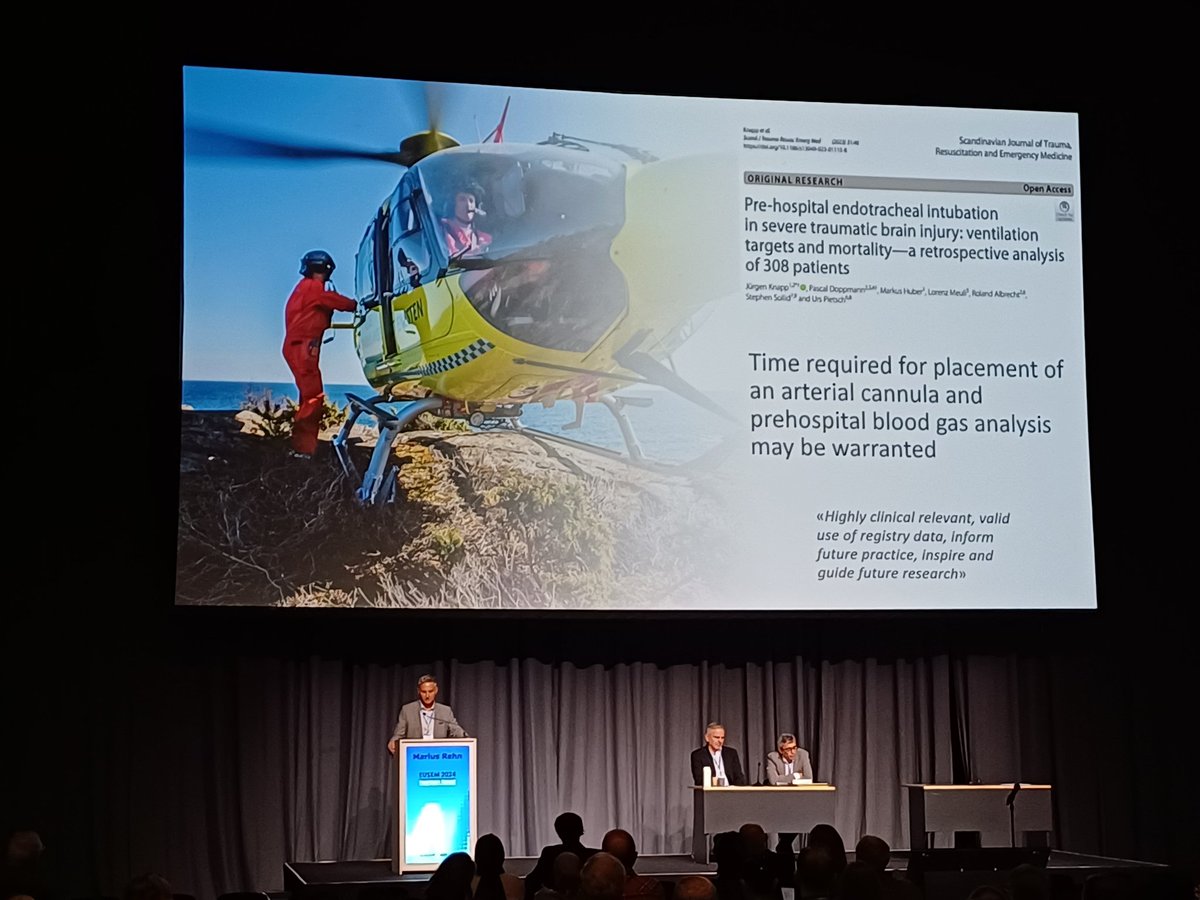
Great Papers 2023, as per @SJTREM Editor: our very own @anaesthemergmed@PietschUrs .
#EUSEM2024
Great Work, guys🎉👏
In case you wonder: here is the paper:
https://t.co/xsyUVx1Gww
Our 40-year study shows improved survival rates and faster rescues. Survival is >90% within 10 minutes but drops sharply after, challenging the old 18-minute window. Fast companion rescue boosts survival rates 3x compared to professional rescue.
Great cooperation ❄️🌨️🚁
Survival rates for critically buried avalanche victims in Switzerland increased from 44% to 53%, 1981-2020, this study finds. Early rescue is likely vital; survival probability drops from >90% in the first 10 mins to 31% within 30 mins. https://t.co/wqtvRG17kN
We know how deleterious hypoxia can be. But what about hyperoxia?
In this 🇨🇭paper we found hyperoxia to be common after trauma and associated with prolonged hospital stay.
RCTs on oxygen dosage after trauma are urgently needed
@PietschUrs@anaesthemergmed@jacob_steinmetz et al
🌡️ Evaluating Wearable device for Temperature Monitoring in ICU!
Surgical ICU pts underwent testing of a non-invasive, wearable sensor against traditional bladder and tympanic thermometers
by U.E Ehlers, @PietschUrs et al. from @KantonsspitalSG 🇨🇭
https://t.co/VVora96cSG
🧵
Looking for simple yet effective educational interventions to increase patient safety in critical care?
Look no further: @PietschUrs @julianekaemmer et al implemented CIRS reported safety issues into a "room of horror" simulation exercise ...1/2
https://t.co/IdmrWNil6A
2/2... and had health care staff identify safety concerns either individually or in teams during routine handovers.
Identification of critical errors 》non critical ones and
Teams learned more from the task.
So simple yet so effective. 🎉