Airdrop farming gets all the attention right now. Wallet splitting, task automation, sybil clusters running the same interaction across forty accounts, entire Discords dedicated to squeezing points out of a protocol before anyone’s even sure there’s a token.
It’s loud because it’s fast and gamified, you can literally watch a leaderboard number go up.
The thing people should be watching instead is unremarkable by comparison: writing one genuinely good post a project actually needs, and building a small track record of that.
No leaderboard, no instant number, no dopamine hit. Just slower proof that you can say something clearly and people respond to it.
The gap is obvious once you sit with it. Farming optimizes for volume a script can produce. It scales by doing more of a shallow action, so of course it’s the one that gets a thousand tutorials, it’s mechanical and repeatable.
Actual content quality doesn’t scale that way, you can’t script “write something people find worth replying to.” That’s exactly why it gets ignored, there’s no bot for it.
What I learned choosing the second path over the first: farming pays out once and then the account is worth nothing when the season ends.
A body of work that’s actually good keeps paying, because it’s what gets you picked for the next campaign and the one after that. Rally’s whole scoring model, through @RallyOnChain, is built around rewarding that second thing instead of the first, which is the correct bet long term even though it’s the boring one to explain.
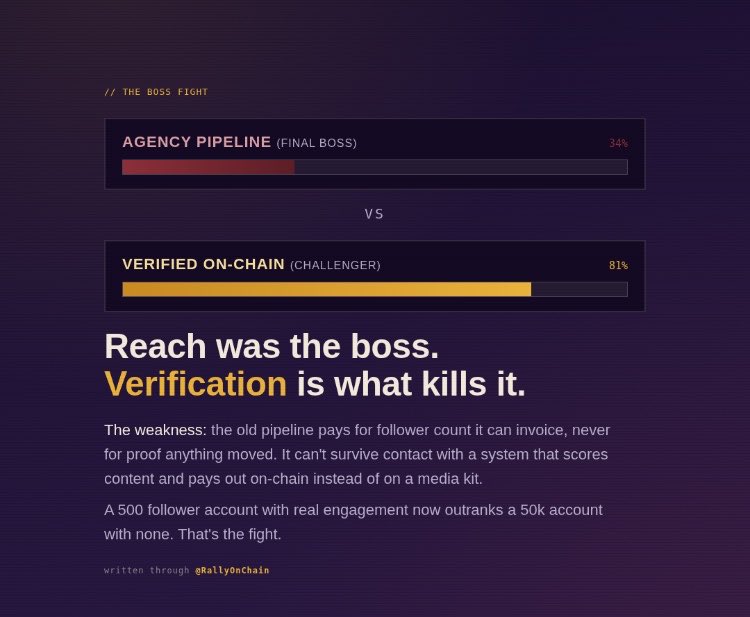
The final boss here isn’t a company, it’s a system: the agency-and-KOL pipeline that’s run influencer marketing for a decade. Project pays agency, agency pays accounts with big followings, accounts post whatever copy they’re handed, and nobody downstream can actually check if any of it worked or if the post was even read by a real person.
That system has one real weakness and it’s been there the whole time: it optimizes for reach it can invoice, not for content anyone can verify. Follower count is the entire pitch. A 50k account posting something generic and unread still gets paid the same as a 500 follower account that wrote something people actually replied to and shared.
The challenger exploiting that gap isn’t a bigger agency, it’s the removal of the agency layer entirely. AI-scored, on-chain campaigns let any account submit work, get evaluated on content quality and real engagement instead of follower count, and get paid automatically with the scoring weights visible instead of hidden in a media kit.
That flips the incentive from “who has the biggest number” to “who wrote the thing people actually engaged with.”
The weakness being exploited is verification, or the total lack of it in the old model. Nobody could prove a sponsored post moved anything.
When the scoring and the payout are both on-chain, that excuse disappears.
What it takes to actually dethrone the old system isn’t hype, it’s volume of creators who realize a small real audience can outperform a large dead one. Rally is the clearest version of this I’ve seen actually shipping it through @RallyOnChain, not just pitching it.
I used to roll my eyes at “scheduled worry time” until I actually tried it for eight days.
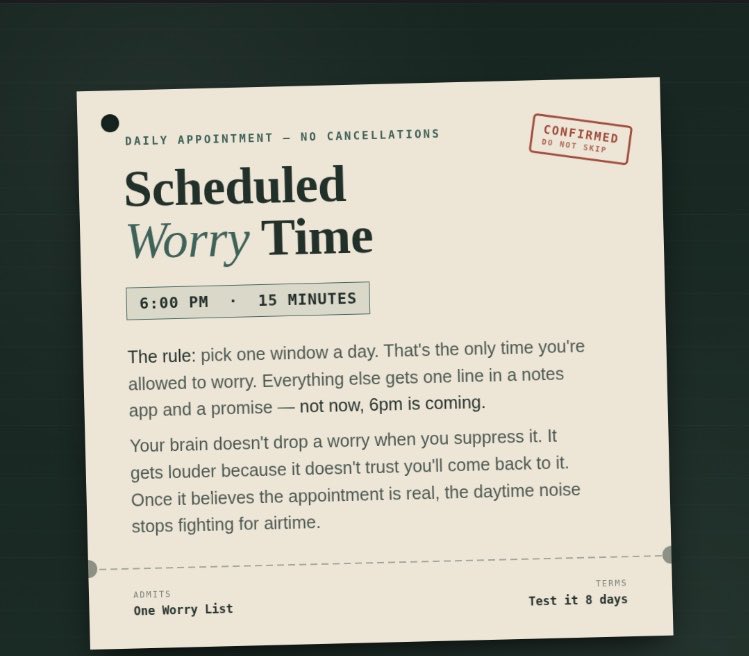
The rule is stupid simple: pick 15-20 minutes, same time every day, and that’s the only window you’re allowed to worry in.
Anything that comes up outside that window gets one line in a notes app and a mental “not now, 6pm is coming.”
Sounds backwards. Everything else says stop worrying, this says do it on purpose, just later.
That’s exactly why most people never try it, the framing feels wrong before you’ve tested it.
What actually happens: your brain doesn’t drop a worry when you suppress it, it just gets louder because it doesn’t trust you’ll come back to it.
Once it believes the 6pm appointment is real, which takes maybe a week, the daytime intrusions basically stop fighting for airtime. And half of what’s on the list by 6pm looks small once it’s written down instead of looped in your head.
It’s not therapy, it’s just a scheduling trick that respects how anxiety actually works instead of trying to out-willpower it.
If you’ve got a friend who keeps ignoring good advice, this is the one that’s cheap enough to just test before they argue about it.
Found the discipline to actually sit down and write this out through @RallyOnChain, good push to turn a loose idea into something real.
30 minutes into the bootcamp and I've already picked up ideas about prediction markets that would've taken me weeks or even months to learn on my own.
Thanks to @itsAllStrategy_ and @SethDannyYak
If you're serious about prediction markets, you should be here.
Special shoutout to out today's tutor @Skyremedy 🙌
Man cooked!
@KbGold77@GenLayer Prediction markets are just the entry point. Once people see how GenLayer handles resolution, every industry with ambiguous contractual obligations becomes a target. That is a very large TAM.
@OOwopeju8992 What's interesting is that the teaser never asks for attention.
It earns it through curiosity. Every new clip feels like another clue rather than another announcement.
@blin_nkx666@RallyOnChain Most Web3 reward systems are designed around extraction. Earn and exit. RLPs are designed around retention. Earn and stay. That is a completely different relationship between platform and creator
@Unique_Ak2 One thing I keep wondering is whether different AI models will consistently interpret the same evidence differently. If so, the appeal mechanism feels just as important as the initial decision.
1/3
Prediction markets revealed a limit of blockchains.
Not every outcome is binary.
Did the launch really happen?
Did the agreement actually count?
Reality often requires judgment, not just code.
That’s the problem @GenLayer is built to solve.
Most traders focus on profits. I've started paying more attention to where I'm trading.
XBIT's leverage trading brings an interesting mix of on chain transparency and trading flexibility. The World Cup Million USDC campaign is a nice bonus too. ⚽🚀
@XBITDEX_ZH@XBITDEX#XBIT
The future of crypto isn't one chain.
It's a world where assets move freely between many ecosystems.
That's why @Allbridge_io matters.
Instead of adding more complexity, it focuses on making cross-chain transfers fast, simple, and accessible for everyone.
As more chains emerge, the need for seamless connectivity only grows.
And Allbridge is helping make that future possible.
https://t.co/rAvWwxWfy6
The guy keep it way too real about his daily struggle with underarm sweat throughout the workday. If you can relate to that mid-afternoon panic, Carpe is the ultimate upgrade.
As the world’s first deodorant offering 100-hour sweat and odor control, it doesn't just mask the problem. It uses a powerful triple-layer protection system that actively stops sweat, kills odor-causing bacteria, and completely nourishes your skin.
Stop settling for less and give your underarms the relief they deserve. Head straight to https://t.co/vSrPhMzZIf and grab yours today!
#Carpe #SweatControl #Lifestyle
@web3_YSL This same issue shows up in grant programs all the time. “Deliver a usable prototype by X date” sounds clean until someone ships something half working and claims the milestone is done.
@themegamind24 Reward distribution to smaller contributors is the single most requested and least delivered feature across every protocol I've worked adjacent to. If this is real, it's a genuinely rare execution