You think adaptive evolution is always driven by natural selection? We beg to disagree. Yes, we need selection. But it can be selection ON the organism, or selection BY the organism. Our experimental sparrow results are just out in Current Biology !
https://t.co/80Zrl4fop7
My book "The Selective Organism - An Expanded Theory of Adaptive Evolution" is out (Oxford). Do you want to know about a second driver of adaptive evolution? Interested in new research ideas? Thanks to outside funding, it can be downloaded for free: https://t.co/40atfYZnYS.
Across 1,211 real shotgun metagenomes, four taxonomic profilers produced different diversity estimates; alpha-diversity conclusions shifted with tool choice, k-mer methods, and database. https://t.co/z3lzFDSYIv
My new piece "Reproducibility: how to strengthen a weak foundation" is out today in @Nature! 🎉How reproducible is research in the social & behavioural sciences? A new study by Miske et al. assessed 600 papers across 62 journals: results are sobering
📄 https://t.co/FVqsAOvvuh
@EvolOdonata Erik, how about CRISPR? Could we not see that as a form of directed mutation? Not saying that is a general phenomenon, but at least an intriguing exception?
What if we could autocomplete DNA based on function?
Today in @Nature, we share semantic design—a strategy for function-guided design with genomic language models that leverages genomic context to create de novo genes with desired functions.🧵
https://t.co/P5qVJB3qIY
BIG ANNOUNCEMENT📣: I haven’t been this excited to be part of something new in 15 years… Thrilled to reveal the passion project I’ve been working on for the past year and a half!🙀🥳 It started from my frustration with the depressing effect that the current publishing system has on the well-being of myself, my team, and pretty much every scientist I know (maybe you’ve noticed from my stupid jokes… :) I was exhausted of dealing with the huge delays, reviewers that can be abusive, and how arbitrary it all is. Unfortunately, the most important factors are often WHO your reviewers are and who YOU are... It’s clear we need alternatives or at least ways to improve the situation. So, together with a really special and talented team we worked to develop this idea into “qed” a platform where you can get CONSTRUCTIVE feedback on your own work or CRITICALLY assess other people’s papers. It can be a real difference maker if many of you join us (thousands have tried it already, but today we release a NEW and much stronger version ;) Let’s harness qed to put the power back in the scientists’ hands, to do, to read & to publish science on our own terms. I’m dying for you to TRY IT, and it’s very simple - just drop a paper (the link to the website is in the replies👇) - it’s completely secure, private, and free, and you get results fast. Please show your support, SHARE, tell your friends, and let’s be the revolution 🫵!
📣📣📣PhD position available in my lab at @mncn_csic in Madrid to study speciation mechanisms in oceanic island birds, using phenotypic and genomic data.
- 💰4-year contract
- 🎓Biol, Genetics, Master's, English.
- 📅Apply by October 15
-👉CV & letter to [email protected]
After 4 years of hard work, I finally submitted the 79 files that will be my book to the publisher (Oxford University Press). You can look forward to an expanded theory of adaptive evolution!
Esta tarde daré una charla dentro del ciclo de martes ornitológicos de la @SEO_BirdLife en Sevilla. Será a las 19:00 en la Biblioteca de la @pablodeolavide. Hablaré sobre el proyecto @BIRDeep y el seguimiento ecoacústico de Doñana para conocer sus aves. ¡Estáis todos invitados!
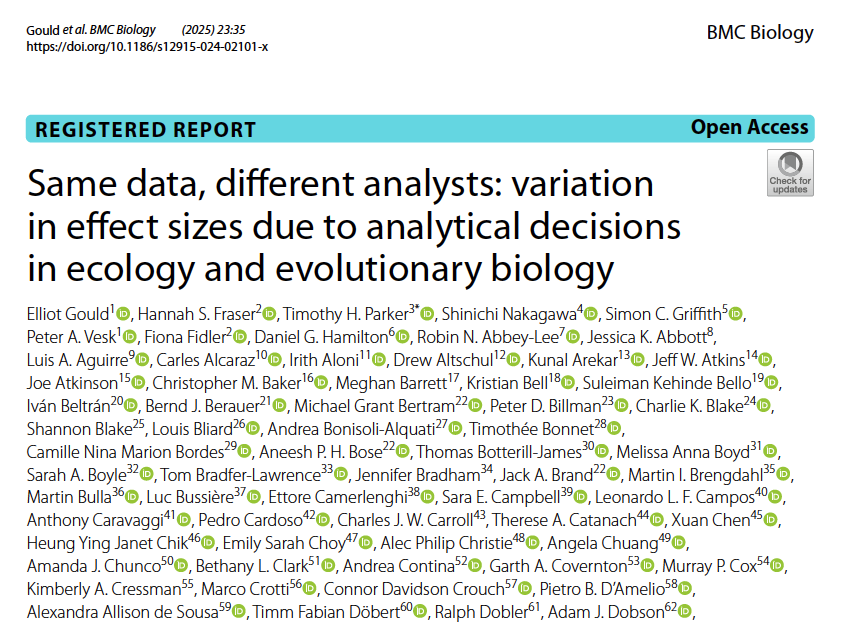
The first many-analysts study in ecology is finally published! 🥳🙌
300+ coauthors and 5+ years, this was a massive effort by @Elliot_Gould_@HannahSFraser@TimParker88 and co.
Open access 👉 https://t.co/aA8QFN3bDs
Using a dataset of 800,000+ observations and decades of breeding records, Dr Satarkar and team employ multi-matrix quantitative genetic ‘animal models’ to show that genes play a minimal role in shaping individual social phenotypes in an avian system 🪽
https://t.co/L0zG1lvoHW
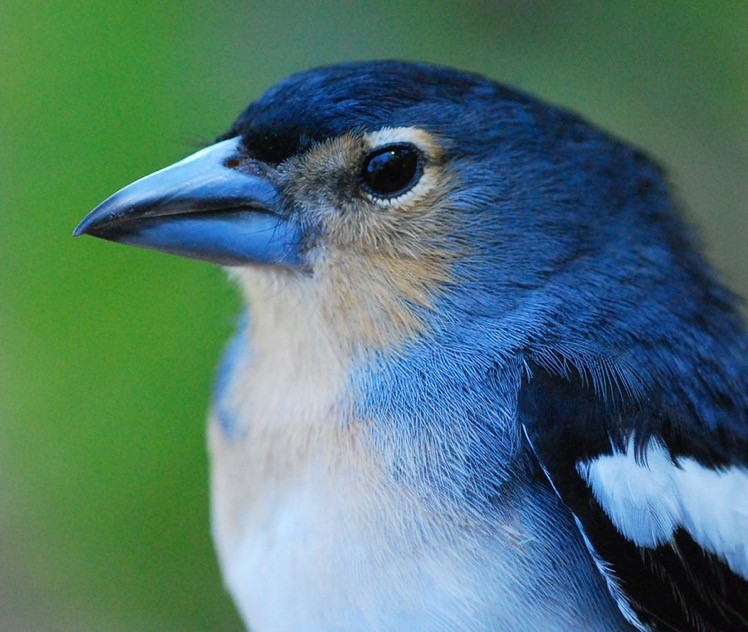
@BMcCloskey_98@BirdGuides No, I don't, sorry. I am just parroting what I read in Van Duivendijk's new book. It, and other observers, also focus on head and bill width, so frontal pictures are also useful. And then of course, LS in Europa might hybridise?
⌛Mañana último día para el cierre de inscripción reducida y entrega de abstracts del XXIV Seminario Genética de Poblaciones y Evo.
❓¿Te lo vas a perder? No lo dejes para el final y regístrate, nos vemos del 15 al 17 de enero en Mazagón
🌐https://t.co/1pkfOMSZTX
⌛Quedan pocos días para el cierre de inscripción reducida y entrega de abstracts del XXIV Seminario Genética de Poblaciones y Evo.
❓¿Te lo vas a perder? No lo dejes para el final y regístrate, nos vemos del 15 al 17 de enero en Mazagón
🌐https://t.co/1pkfOMSZTX
🧬¿Nos vemos en Mazagón del 15 al 17 de enero? El XXIV Seminario Genética de Poblaciones y Evo te espera.
🗓️ Recuerda que tienes hasta el 30 de noviembre para hacer la inscripción a precio reducido y enviar tu abstract.
🌐https://t.co/1pkfOMSZTX
Your help for my upcoming book: can recombination be non-random with respect to allelic identity? Are there mechanisms by which specific alleles from different loci end up in the same gamete at a higher rate than by chance? Can alleles influence with which allele it recombines?
Gabriel explains our experimental results on adaptive evolution without natural selection really nicely! Just out in Current Biology: https://t.co/80Zrl4fop7