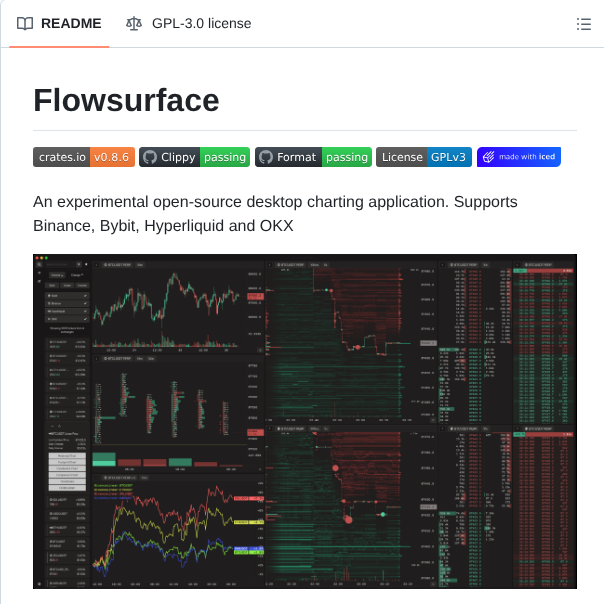
Quit using Excel spreadsheets to trade.
Start using a systematic trading process in Python.
Here's the 4-layer architecture I use for systematic trading:
[Attack of the MM (1): Market Maker Inventory-Based Quoting Systems]
Have you ever experienced the following situation?
You buy a small-cap altcoin, and shortly afterward the price consistently moves against you—as if a “market-making cartel” were deliberately targeting your position.
Is this really manipulation, or some conspiracy by the “whales”?
This article introduces the market maker quoting system and demystifies the so-called “whale conspiracy.”
Conclusion first: prices frequently moving against retail traders is not subjective manipulation. Instead, it is a natural outcome of inventory-based pricing under the Avellaneda–Stoikov framework, specifically quote skewing and toxic order flow protection mechanisms.
Let’s explain this step by step.
Once upon a time…
1. Inventory: the Core Concept
Market makers are not directional traders.
Under proper hedging, spot price movements should, in principle, have minimal impact on total PnL. In this setting, holding inventory is a passive consequence of providing liquidity rather than an intentional bet.
However, inventory matters:
Inventory accumulation expands exposure
The larger the position, the greater the risk to adverse price moves
Retail order flow directly alters the market maker’s inventory
When retail traders submit buy or sell orders, they disturb the market maker’s inventory balance.
The market maker must react to the risk introduced by inventory changes.
In short:
You break the equilibrium → the market maker must protect itself → the protection mechanism is the quoting system.
2. Quote Skewing
Suppose a market maker is aggressively hit by buy orders.
Economically, this means:
The market maker is selling
Inventory becomes short
Downside risk increases if prices rise further
At this point, the market maker’s objectives are:
1,Rebalance inventory as quickly as possible
2,Protect the exposed short position
The market maker will:
Shift quotes downward->Attract selling interest, Discourage further buying, Ensure that the current short exposure does not immediately incur losses, Buy time for hedging or rebalancing
This is quote skew, not manipulation.
3. Spread Widening
If inventory imbalance continues to deteriorate, quote skew alone is insufficient.
The market maker will also:
Widen the bid–ask spread
Reduce execution probability
Lower the rate of inventory accumulation per unit time
The goal is twofold:
Reduce short-term execution risk
Increase spread capture to compensate for inventory risk
4. Reservation Price and the Mathematics Behind Quotes
Each trade between retail traders and market makers occurs at the Reservation Price, which arises from inventory-based pricing models.
In simplified form:
Reservation Price=Mid Price−γ⋅q
Where:
q: current inventory
γ: risk aversion coefficient
(Yes, the full expression is uglier—but we’ll spare you.)
When retail traders trade aggressively, inventory ( q ) changes rapidly, causing the reservation price to shift accordingly.
Under the Avellaneda–Stoikov model:
Optimal quotes are symmetrically placed around the reservation price
Inventory is forced toward mean reversion to zero, Optimal spreads increase with risk
If this part is unclear, that’s fine.
The takeaway is simple:
When retail traders buy aggressively and prices move against them, it is because their own order flow has altered the market’s risk pricing.
5. Why Retail Traders Are Especially Vulnerable
Retail traders typically exhibit the following characteristics:
Almost always submit market orders
Trade in concentrated size
Poor timing concealment
No hedging
No order slicing or time-weighted execution
These issues are magnified in illiquid small-cap altcoins, where:
Liquidity is thin
Your order may be one of the few aggressive trades within minutes
There is little natural offsetting flow
In large-cap markets, opposing flows may naturally neutralize inventory.
In small-cap coins, you are effectively the market maker’s entire counterparty.
6. The Market Maker’s True Objective
Professional market makers are not trying to “liquidate” retail traders.
Their objective function is closer to:
maxE[Spread Capture]−Inventory Risk−Adverse Selection
Inventory risk is penalized exponentially, making protection mechanisms essential.
7. A Practical Trick: Exploiting the Quoting Mechanism
If you’ve read this far, you probably harbor dreams of becoming a “whale” yourself.
Retail traders suffer because they trade: Too fast&Too visibly In concentrated size
So let’s reverse that.
Example:
Suppose Dave wants to build a $1,000 long position.
Instead of going all-in, Buy $100->The market maker skews quotes downward->Buy another $100 at a lower price
Quotes skew further downward
Continue incrementally
Result:
Lower average entry price
Reduced adverse quote impact
You partially use the market maker’s inventory mechanism instead of fighting it
This is only half of the story.
Beyond inventory-based pricing, order book dynamics and toxic order flow detection are another major source of price divergence from retail expectations.
In the next installment, I will:
Explain how market makers process order flow
Analyze order book microstructure
Speculate (imaginatively) on the microstructural causes of the infamous “10/11 incident”
To be continued.
Attack on MM 2: Market Makers' Order Book and Order Flow
Why do things always go wrong shortly after buying altcoins? Why can't seemingly massive market makers hold up against the selling pressure during the 10/11 event? Why did every market maker (MM) I chatted with after 10/11 calmly say they didn't lose much that day—or even profited? This article will introduce market makers' order books and order flow for everyone.
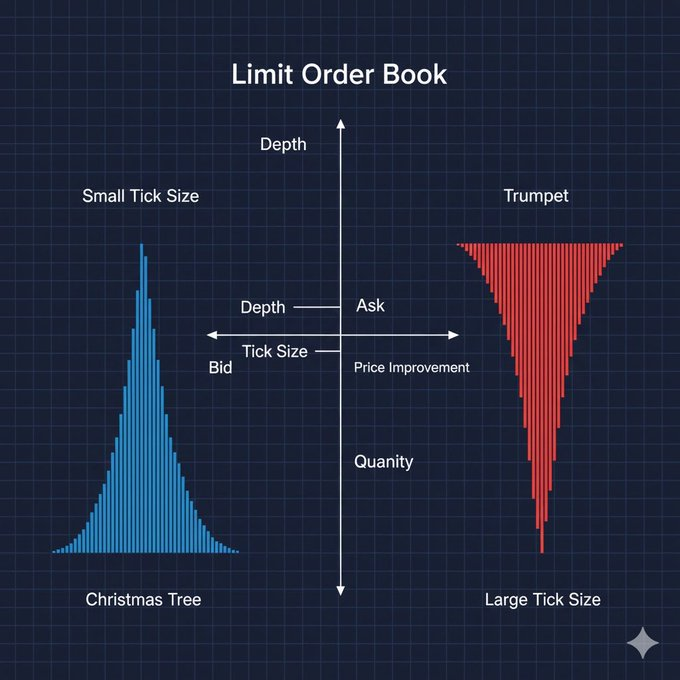
1. Limit Order Book (LOB)
The battlefield for market makers isn't the K-line chart—it's the LOB.Core concepts:
Depth: The amount of hanging orders at each price level.
Tick Size: The minimum unit of price change. In high-frequency environments, tick size is crucial for queuing strategies.
Price Improvement: When you offer a price better than the current national best bid and offer (NBBO), you create value for the market.
For example, if BTC's current bid is $100,000 and ask is $110,000, if you bid at $101,000, you've narrowed the spread and created value for the market.When I was writing this article, I thought about how to explain this section to everyone. In the end, I figured nothing beats showing a real order book directly. Let me give a shoutout to my good friend at BG—using BGB as an example.
The image on bottom is BGB's order book at the minimum tick size. We can see the smallest tick is 0.001, the current market depth is only over $1,000, the spread is tightly controlled down to the minimum tick size. At the same time, the depth is distributed in a "Christmas tree" shape—larger orders farther from the mid-price. But when we zoom out the tick size a bit, we'll find that depth should actually be trumpet-shaped: larger orders closer to the mid-price for better liquidity, and fewer orders farther away (one reason for the liquidity vacuum during the 10/11 event).
2. Market Makers' Profit Source: The Spread
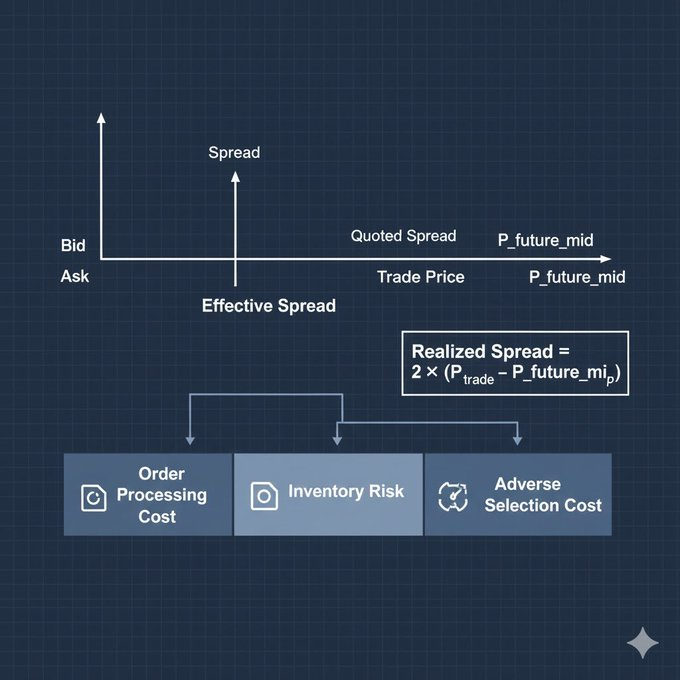
The spread isn't just profit—it's mainly composed of three costs:
Order Processing Cost: Exchange fees, hardware latency, manpower.
Inventory Risk: The risk of adverse price moves while holding positions (covered in the previous episode).
Adverse Selection Cost: This is the core—when you trade, the counterparty might have information you don't. In other words, you might get sniped by an insider.
There are also three types of spreads: Quoted Spread, Effective Spread, and Realized Spread.The quoted spread is the easiest to understand: the ask-bid difference. The realized spread measures the market maker's actual profit after price adjustments:
2 × (P_trade – P_future_mid)
This incorporates the future mid-price, somewhat like an opportunity cost.
3. Order Flow
Order flow is the incoming orders that market makers receive. This is a deep topic—market makers perform various operations on order flow, such as hedging, matching, adjusting hanging orders, etc., in order to manage their book.
There are many professional concepts and techniques here, even involving legal issues—like agency trades can't be matched against principal trades due to conflict of interest (but crypto doesn't care about this).This article will only introduce two concepts: Order Flow Toxicity and VPIN.
If any MM boss wants to hire me, I'll update more professional order flow management for fans (open to jobs !
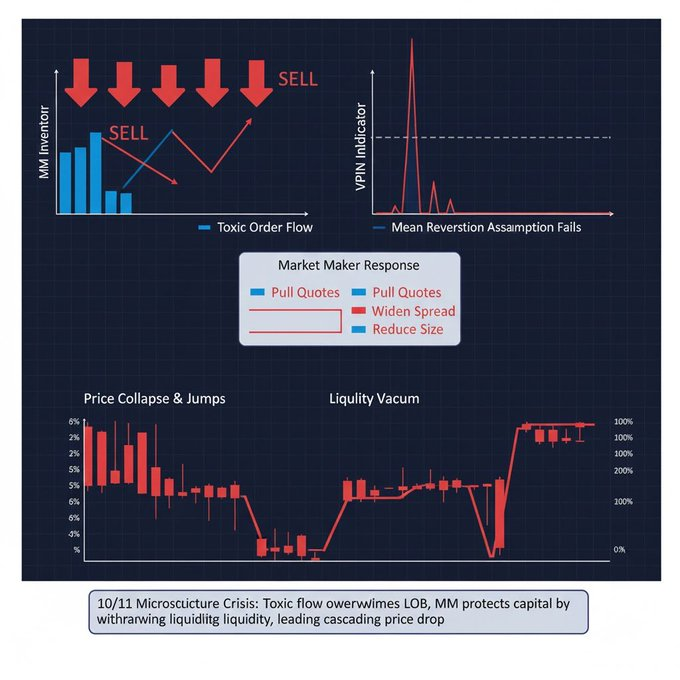
Toxic Flow refers to orders from informed traders who know prices are about to move, causing losses in realized spread because they trade on insider info about P_future_mid. So as market makers, we have to watch out for getting sniped by toxic insiders.
Non-Toxic Flow (Noise/Retail Flow) comes from retail traders or passive rebalancing funds. This is market makers' favorite "food."
To protect themselves, market makers have anti-toxicity mechanisms that adjust quotes. A simple way to prevent toxicity is to assume all aggressive orders are toxic—say, aggressive buys—so the MM immediately lowers their reservation price and shifts quotes downward overall. This also answers the question from the last episode: why do we always buy at the high? Because market makers adjust quotes for risk control.
But a smart reader might ask: what if an insider aggressively buys in bulk, stubbornly eating through the book with their info advantage? Yes, that might be what happened during 10/11—and why even billion-dollar asset MMs couldn't hold the sell-off. Here comes the core metric:
VPIN (Volume-Weighted Probability of Informed Trading)
VPIN ≈ the probability in the current market that market makers are being continuously hit by one-sided flow. When there's massive unidirectional pressure, MM inventory accumulates on one side, mean reversion assumptions fail, and at that point, MMs pull quotes—withdraw liquidity temporarily to wait for order flow to symmetrize. But what if symmetrization doesn't come? Or if the flow imbalance is so extreme it blows up the MM? That's the 10/11 disaster. I kinda want to do an episode on how exchanges profited from 10/11—let me know if you're interested.
Back to the topic: After VPIN spikes abnormally, MMs pull quotes, widen spreads (to earn more "service fees" compensating for positional losses), or shrink sizes to control inventory buildup speed.
This episode wraps up the first part of our market maker story. From a retail perspective, the truth behind the legendary "dog banker" manipulation has been revealed. Next, from the MM angle, I'll introduce more "institutional" topics—hold on tight.
Like anime episode previews at the end: Preview for Attack on Market Makers Episode 3: If we enter the Jujutsu Kaisen world, where order flow is "cursed energy" and quoting is "technique," then in the next episode, we'll explore "domain expansion" in market making.
devs are making $10k-200k monthly on polymarket
no they're not lol
here's what those threads don't tell you
zero fees = zero friction for HFT shops to eat your lunch.
In an efficient market, these simple arbitrage opportunities are fleeting at best. High-frequency trading bots and sophisticated arbitrage algorithms continuously scan for such discrepancies, capturing profits within milliseconds.
You're not competing with other python hobbyists
You're competing with rust bots running on dedicated polygon nodes with sub-millisecond execution.
That "simple python script" from twitter?
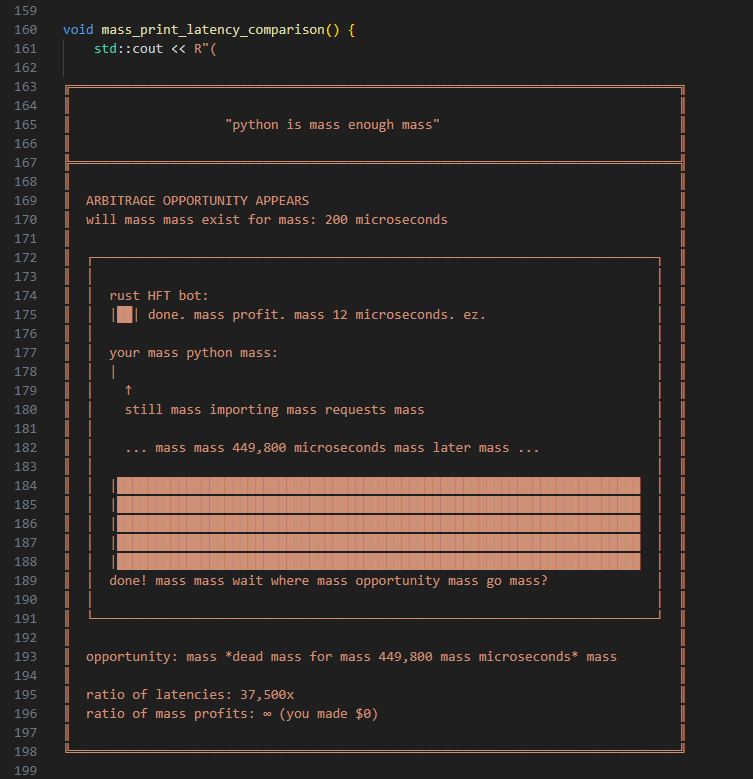
For Python systems, these numbers were more in the 250-500 microsecond range per message, meanwhile actual HFT systems in rust/c++?
Processing time per quote message is about 12 microseconds.
that's 20-40x slower before you even place an order.
what you actually need:
- dedicated polygon RPC nodes (public ones rate-limit you into irrelevance). 99.99% uptime, 100% healthy nodes in production, and average latency max 86.5 ms for premium infrastructure
- VPS colocated near polymarket servers. Ultra-low latency and physically close to Polymarket's servers
- Code written in rust. There's literally a polymarket-hft crate optimized for trading scenarios requiring fast execution
- Proper quant algorithms you can't vibecode because garbage collection is extremely useful during development but often sub-optimal for certain high frequency trading strategies
so those "$200k/month" traders?
They exist.
They're the top 0.5% and they're running infrastructure that costs more than your yearly salary.
If you want to work at a hedge fund or public markets, these are my 4 recommended books to pick up
Each one is a deep dive into economic and monetary history, how asset classes performed, and how managers added alpha in various cycles
Easily my favorites
icymi we wrote a new agents book: patterns for building ai agents
it has everything you need to take your agents from prototype to production, like agent design patterns, the basics of security, etc
reply to this tweet with BOOK and we'll dm you so you can get a copy


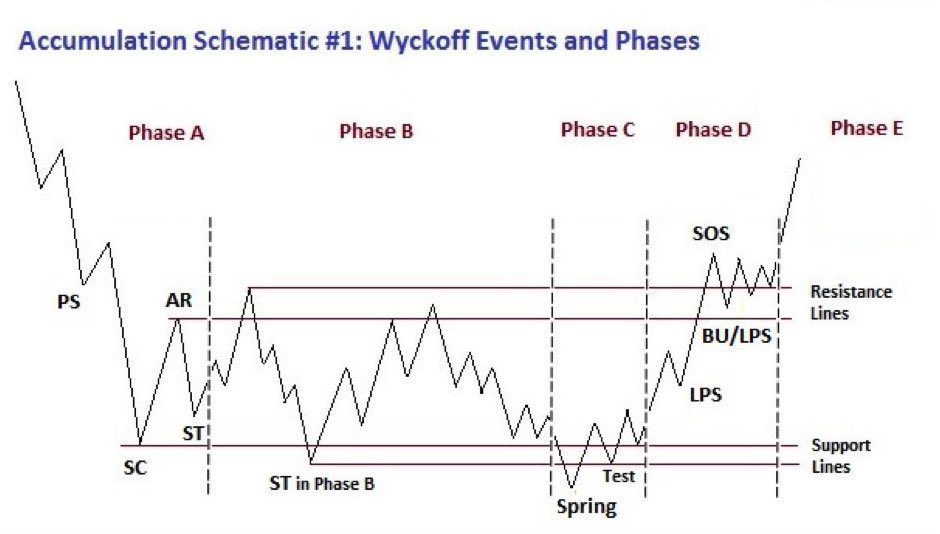
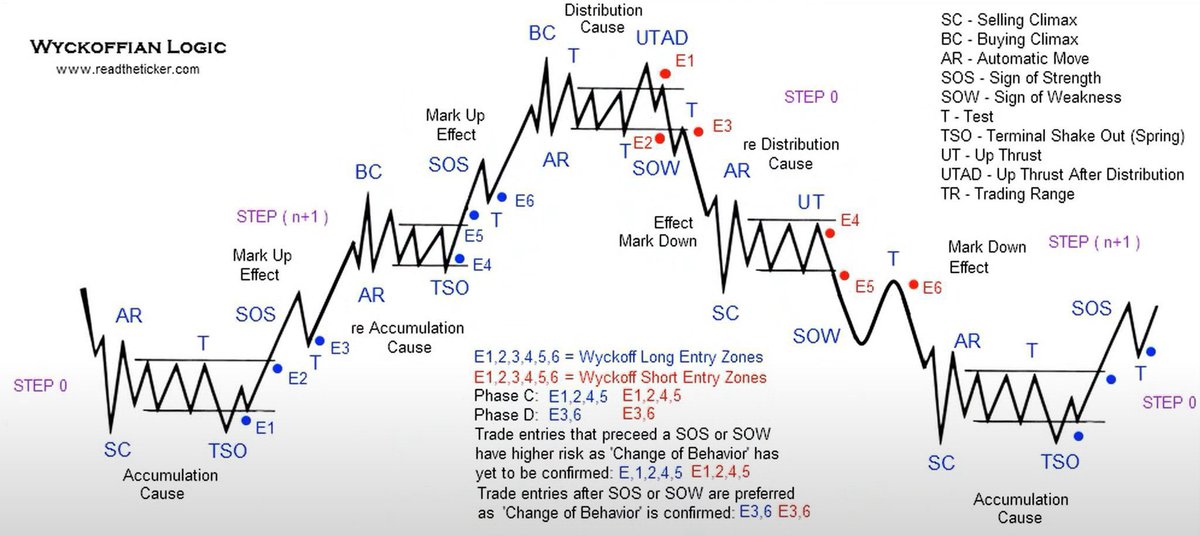


![bc1qDave's tweet photo. [Attack of the MM (1): Market Maker Inventory-Based Quoting Systems]
Have you ever experienced the following situation?
You buy a small-cap altcoin, and shortly afterward the price consistently moves against you—as if a “market-making cartel” were deliberately targeting your position.
Is this really manipulation, or some conspiracy by the “whales”?
This article introduces the market maker quoting system and demystifies the so-called “whale conspiracy.”
Conclusion first: prices frequently moving against retail traders is not subjective manipulation. Instead, it is a natural outcome of inventory-based pricing under the Avellaneda–Stoikov framework, specifically quote skewing and toxic order flow protection mechanisms.
Let’s explain this step by step.
Once upon a time…
1. Inventory: the Core Concept
Market makers are not directional traders.
Under proper hedging, spot price movements should, in principle, have minimal impact on total PnL. In this setting, holding inventory is a passive consequence of providing liquidity rather than an intentional bet.
However, inventory matters:
Inventory accumulation expands exposure
The larger the position, the greater the risk to adverse price moves
Retail order flow directly alters the market maker’s inventory
When retail traders submit buy or sell orders, they disturb the market maker’s inventory balance.
The market maker must react to the risk introduced by inventory changes.
In short:
You break the equilibrium → the market maker must protect itself → the protection mechanism is the quoting system.
2. Quote Skewing
Suppose a market maker is aggressively hit by buy orders.
Economically, this means:
The market maker is selling
Inventory becomes short
Downside risk increases if prices rise further
At this point, the market maker’s objectives are:
1,Rebalance inventory as quickly as possible
2,Protect the exposed short position
The market maker will:
Shift quotes downward->Attract selling interest, Discourage further buying, Ensure that the current short exposure does not immediately incur losses, Buy time for hedging or rebalancing
This is quote skew, not manipulation.
3. Spread Widening
If inventory imbalance continues to deteriorate, quote skew alone is insufficient.
The market maker will also:
Widen the bid–ask spread
Reduce execution probability
Lower the rate of inventory accumulation per unit time
The goal is twofold:
Reduce short-term execution risk
Increase spread capture to compensate for inventory risk
4. Reservation Price and the Mathematics Behind Quotes
Each trade between retail traders and market makers occurs at the Reservation Price, which arises from inventory-based pricing models.
In simplified form:
Reservation Price=Mid Price−γ⋅q
Where:
q: current inventory
γ: risk aversion coefficient
(Yes, the full expression is uglier—but we’ll spare you.)
When retail traders trade aggressively, inventory ( q ) changes rapidly, causing the reservation price to shift accordingly.
Under the Avellaneda–Stoikov model:
Optimal quotes are symmetrically placed around the reservation price
Inventory is forced toward mean reversion to zero, Optimal spreads increase with risk
If this part is unclear, that’s fine.
The takeaway is simple:
When retail traders buy aggressively and prices move against them, it is because their own order flow has altered the market’s risk pricing.
5. Why Retail Traders Are Especially Vulnerable
Retail traders typically exhibit the following characteristics:
Almost always submit market orders
Trade in concentrated size
Poor timing concealment
No hedging
No order slicing or time-weighted execution
These issues are magnified in illiquid small-cap altcoins, where:
Liquidity is thin
Your order may be one of the few aggressive trades within minutes
There is little natural offsetting flow
In large-cap markets, opposing flows may naturally neutralize inventory.
In small-cap coins, you are effectively the market maker’s entire counterparty.
6. The Market Maker’s True Objective
Professional market makers are not trying to “liquidate” retail traders.
Their objective function is closer to:
maxE[Spread Capture]−Inventory Risk−Adverse Selection
Inventory risk is penalized exponentially, making protection mechanisms essential.
7. A Practical Trick: Exploiting the Quoting Mechanism
If you’ve read this far, you probably harbor dreams of becoming a “whale” yourself.
Retail traders suffer because they trade: Too fast&Too visibly In concentrated size
So let’s reverse that.
Example:
Suppose Dave wants to build a $1,000 long position.
Instead of going all-in, Buy $100->The market maker skews quotes downward->Buy another $100 at a lower price
Quotes skew further downward
Continue incrementally
Result:
Lower average entry price
Reduced adverse quote impact
You partially use the market maker’s inventory mechanism instead of fighting it
This is only half of the story.
Beyond inventory-based pricing, order book dynamics and toxic order flow detection are another major source of price divergence from retail expectations.
In the next installment, I will:
Explain how market makers process order flow
Analyze order book microstructure
Speculate (imaginatively) on the microstructural causes of the infamous “10/11 incident”
To be continued.](https://pbs.twimg.com/media/G8-jevhbgAAduLp.jpg)
![bc1qDave's tweet photo. [Attack of the MM (1): Market Maker Inventory-Based Quoting Systems]
Have you ever experienced the following situation?
You buy a small-cap altcoin, and shortly afterward the price consistently moves against you—as if a “market-making cartel” were deliberately targeting your position.
Is this really manipulation, or some conspiracy by the “whales”?
This article introduces the market maker quoting system and demystifies the so-called “whale conspiracy.”
Conclusion first: prices frequently moving against retail traders is not subjective manipulation. Instead, it is a natural outcome of inventory-based pricing under the Avellaneda–Stoikov framework, specifically quote skewing and toxic order flow protection mechanisms.
Let’s explain this step by step.
Once upon a time…
1. Inventory: the Core Concept
Market makers are not directional traders.
Under proper hedging, spot price movements should, in principle, have minimal impact on total PnL. In this setting, holding inventory is a passive consequence of providing liquidity rather than an intentional bet.
However, inventory matters:
Inventory accumulation expands exposure
The larger the position, the greater the risk to adverse price moves
Retail order flow directly alters the market maker’s inventory
When retail traders submit buy or sell orders, they disturb the market maker’s inventory balance.
The market maker must react to the risk introduced by inventory changes.
In short:
You break the equilibrium → the market maker must protect itself → the protection mechanism is the quoting system.
2. Quote Skewing
Suppose a market maker is aggressively hit by buy orders.
Economically, this means:
The market maker is selling
Inventory becomes short
Downside risk increases if prices rise further
At this point, the market maker’s objectives are:
1,Rebalance inventory as quickly as possible
2,Protect the exposed short position
The market maker will:
Shift quotes downward->Attract selling interest, Discourage further buying, Ensure that the current short exposure does not immediately incur losses, Buy time for hedging or rebalancing
This is quote skew, not manipulation.
3. Spread Widening
If inventory imbalance continues to deteriorate, quote skew alone is insufficient.
The market maker will also:
Widen the bid–ask spread
Reduce execution probability
Lower the rate of inventory accumulation per unit time
The goal is twofold:
Reduce short-term execution risk
Increase spread capture to compensate for inventory risk
4. Reservation Price and the Mathematics Behind Quotes
Each trade between retail traders and market makers occurs at the Reservation Price, which arises from inventory-based pricing models.
In simplified form:
Reservation Price=Mid Price−γ⋅q
Where:
q: current inventory
γ: risk aversion coefficient
(Yes, the full expression is uglier—but we’ll spare you.)
When retail traders trade aggressively, inventory ( q ) changes rapidly, causing the reservation price to shift accordingly.
Under the Avellaneda–Stoikov model:
Optimal quotes are symmetrically placed around the reservation price
Inventory is forced toward mean reversion to zero, Optimal spreads increase with risk
If this part is unclear, that’s fine.
The takeaway is simple:
When retail traders buy aggressively and prices move against them, it is because their own order flow has altered the market’s risk pricing.
5. Why Retail Traders Are Especially Vulnerable
Retail traders typically exhibit the following characteristics:
Almost always submit market orders
Trade in concentrated size
Poor timing concealment
No hedging
No order slicing or time-weighted execution
These issues are magnified in illiquid small-cap altcoins, where:
Liquidity is thin
Your order may be one of the few aggressive trades within minutes
There is little natural offsetting flow
In large-cap markets, opposing flows may naturally neutralize inventory.
In small-cap coins, you are effectively the market maker’s entire counterparty.
6. The Market Maker’s True Objective
Professional market makers are not trying to “liquidate” retail traders.
Their objective function is closer to:
maxE[Spread Capture]−Inventory Risk−Adverse Selection
Inventory risk is penalized exponentially, making protection mechanisms essential.
7. A Practical Trick: Exploiting the Quoting Mechanism
If you’ve read this far, you probably harbor dreams of becoming a “whale” yourself.
Retail traders suffer because they trade: Too fast&Too visibly In concentrated size
So let’s reverse that.
Example:
Suppose Dave wants to build a $1,000 long position.
Instead of going all-in, Buy $100->The market maker skews quotes downward->Buy another $100 at a lower price
Quotes skew further downward
Continue incrementally
Result:
Lower average entry price
Reduced adverse quote impact
You partially use the market maker’s inventory mechanism instead of fighting it
This is only half of the story.
Beyond inventory-based pricing, order book dynamics and toxic order flow detection are another major source of price divergence from retail expectations.
In the next installment, I will:
Explain how market makers process order flow
Analyze order book microstructure
Speculate (imaginatively) on the microstructural causes of the infamous “10/11 incident”
To be continued.](https://pbs.twimg.com/media/G8-jevgbMAEeRpW.jpg)





![bc1qDave's tweet photo. [Attack of the MM (1): Market Maker Inventory-Based Quoting Systems]
Have you ever experienced the following situation?
You buy a small-cap altcoin, and shortly afterward the price consistently moves against you—as if a “market-making cartel” were deliberately targeting your position.
Is this really manipulation, or some conspiracy by the “whales”?
This article introduces the market maker quoting system and demystifies the so-called “whale conspiracy.”
Conclusion first: prices frequently moving against retail traders is not subjective manipulation. Instead, it is a natural outcome of inventory-based pricing under the Avellaneda–Stoikov framework, specifically quote skewing and toxic order flow protection mechanisms.
Let’s explain this step by step.
Once upon a time…
1. Inventory: the Core Concept
Market makers are not directional traders.
Under proper hedging, spot price movements should, in principle, have minimal impact on total PnL. In this setting, holding inventory is a passive consequence of providing liquidity rather than an intentional bet.
However, inventory matters:
Inventory accumulation expands exposure
The larger the position, the greater the risk to adverse price moves
Retail order flow directly alters the market maker’s inventory
When retail traders submit buy or sell orders, they disturb the market maker’s inventory balance.
The market maker must react to the risk introduced by inventory changes.
In short:
You break the equilibrium → the market maker must protect itself → the protection mechanism is the quoting system.
2. Quote Skewing
Suppose a market maker is aggressively hit by buy orders.
Economically, this means:
The market maker is selling
Inventory becomes short
Downside risk increases if prices rise further
At this point, the market maker’s objectives are:
1,Rebalance inventory as quickly as possible
2,Protect the exposed short position
The market maker will:
Shift quotes downward->Attract selling interest, Discourage further buying, Ensure that the current short exposure does not immediately incur losses, Buy time for hedging or rebalancing
This is quote skew, not manipulation.
3. Spread Widening
If inventory imbalance continues to deteriorate, quote skew alone is insufficient.
The market maker will also:
Widen the bid–ask spread
Reduce execution probability
Lower the rate of inventory accumulation per unit time
The goal is twofold:
Reduce short-term execution risk
Increase spread capture to compensate for inventory risk
4. Reservation Price and the Mathematics Behind Quotes
Each trade between retail traders and market makers occurs at the Reservation Price, which arises from inventory-based pricing models.
In simplified form:
Reservation Price=Mid Price−γ⋅q
Where:
q: current inventory
γ: risk aversion coefficient
(Yes, the full expression is uglier—but we’ll spare you.)
When retail traders trade aggressively, inventory ( q ) changes rapidly, causing the reservation price to shift accordingly.
Under the Avellaneda–Stoikov model:
Optimal quotes are symmetrically placed around the reservation price
Inventory is forced toward mean reversion to zero, Optimal spreads increase with risk
If this part is unclear, that’s fine.
The takeaway is simple:
When retail traders buy aggressively and prices move against them, it is because their own order flow has altered the market’s risk pricing.
5. Why Retail Traders Are Especially Vulnerable
Retail traders typically exhibit the following characteristics:
Almost always submit market orders
Trade in concentrated size
Poor timing concealment
No hedging
No order slicing or time-weighted execution
These issues are magnified in illiquid small-cap altcoins, where:
Liquidity is thin
Your order may be one of the few aggressive trades within minutes
There is little natural offsetting flow
In large-cap markets, opposing flows may naturally neutralize inventory.
In small-cap coins, you are effectively the market maker’s entire counterparty.
6. The Market Maker’s True Objective
Professional market makers are not trying to “liquidate” retail traders.
Their objective function is closer to:
maxE[Spread Capture]−Inventory Risk−Adverse Selection
Inventory risk is penalized exponentially, making protection mechanisms essential.
7. A Practical Trick: Exploiting the Quoting Mechanism
If you’ve read this far, you probably harbor dreams of becoming a “whale” yourself.
Retail traders suffer because they trade: Too fast&Too visibly In concentrated size
So let’s reverse that.
Example:
Suppose Dave wants to build a $1,000 long position.
Instead of going all-in, Buy $100->The market maker skews quotes downward->Buy another $100 at a lower price
Quotes skew further downward
Continue incrementally
Result:
Lower average entry price
Reduced adverse quote impact
You partially use the market maker’s inventory mechanism instead of fighting it
This is only half of the story.
Beyond inventory-based pricing, order book dynamics and toxic order flow detection are another major source of price divergence from retail expectations.
In the next installment, I will:
Explain how market makers process order flow
Analyze order book microstructure
Speculate (imaginatively) on the microstructural causes of the infamous “10/11 incident”
To be continued.](https://pbs.twimg.com/media/G8-jey0b0AE0mXL.jpg)