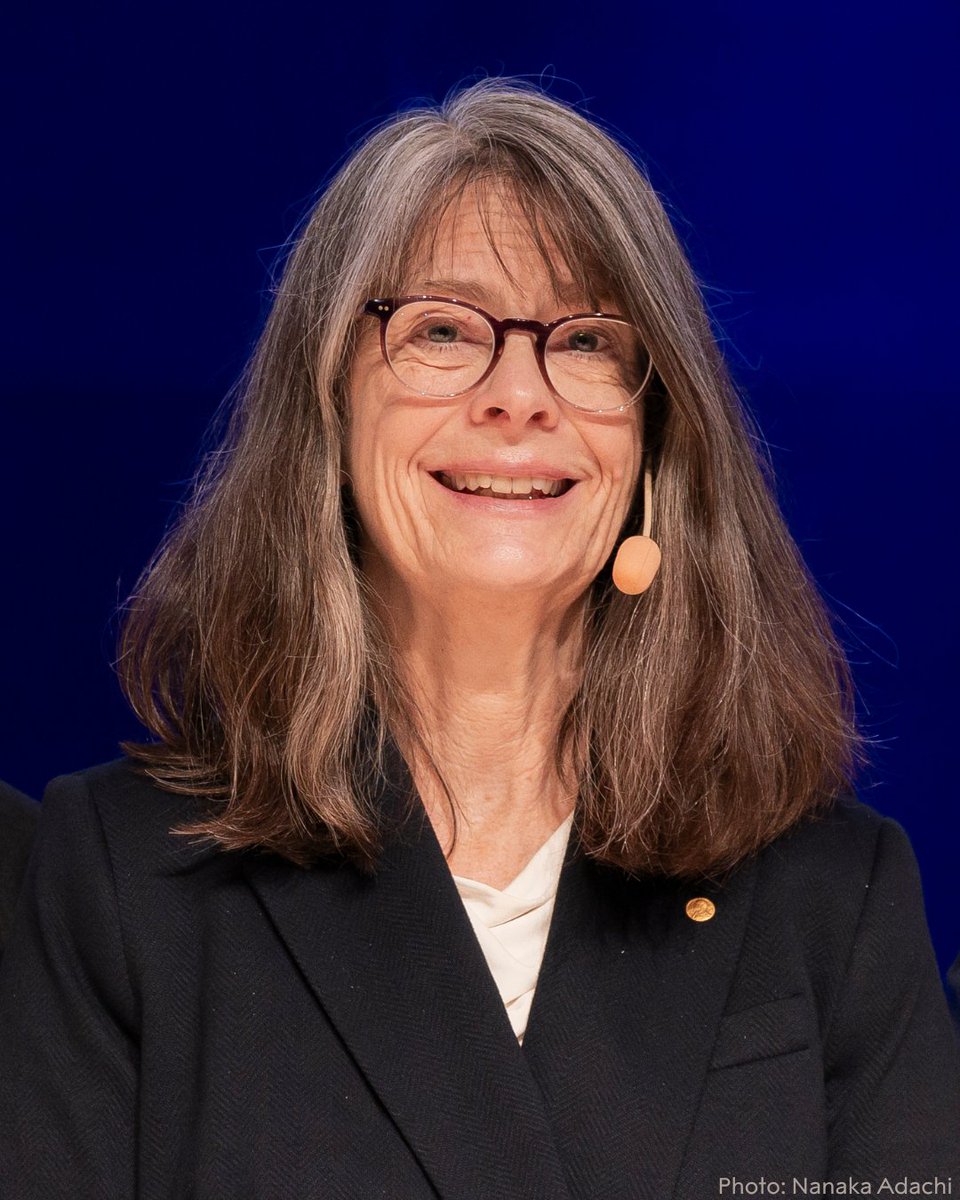
2025 medicine laureate Mary Brunkow: then and now.
In high school, Brunkow enjoyed basketball and ran for the track and cross-country teams, but was, by her own omission, pretty bad at both. She was, however, a good student with a love of maths and science, especially genetics.
Learn how she has embraced the unexpected throughout her career: https://t.co/7zagFxlTBW
👏🏼 Union Berlin coach Marie Louise Eta becomes the first female manager to win a game in Bundesliga.
The first one in top 5 leagues as well, huge achievement. ❤️🤍
Math.
Haruki's Theorem says that given three intersecting circles (which only intersect each other at two points) that the lines connecting the inner intersecting points to the outer satisfy:
s1 ⋅ s3 ⋅ s5 = s2 ⋅ s4 ⋅ s6
where s1, s2, s3, s4, s5, s6 are the measure of segments connecting the inner and outer intersection points. The theorem is named after the Japanese mathematician Hiroshi Haruki, who earned his MSc and PhD from Osaka University and taught there. He was a professor at the University of Waterloo in Canada from 1966 till his retirement in 1986. He died in 1997. Source: https://t.co/ksHRIsk76W
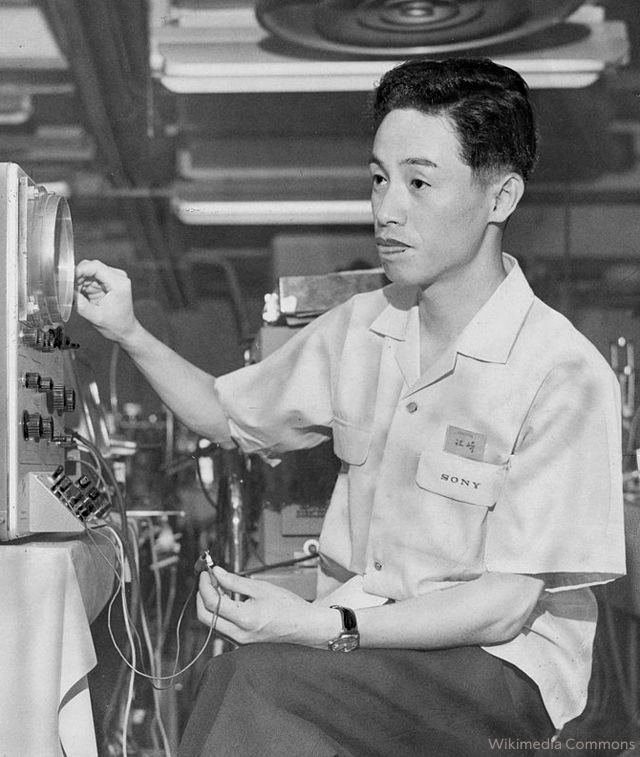
Today we celebrate Leo Esaki, on his 101th birthday. He was born on this day in 1925 in Osaka, Japan.
While working in the Sony Corporation research laboratory in Japan, Esaki used some deceptively simple experiments to prove the existence of a new kind of tunneling phenomenon in a semiconductor. His discovery also showed that this effect could be used technically in so-called tunnel diodes. Esaki’s discovery opened up a new field of research and initiated intensive and successful developments at many international research laboratories.
Esaki was awarded the 1973 Nobel Prize in Physics jointly with Ivar Giaever for their experimental discoveries regarding tunneling phenomena in semiconductors and superconductors, respectively.
Watch our 2004 interview: https://t.co/7osx2SbuLi
@PhysInHistory Every mock theta function he wrote down turned out to be genuine.
This is one of the strongest validations of mathematical intuition in history.
In his “last letter” to G. H. Hardy, dated 12 January 1920, Ramanujan gave 17 examples of what he called “mock theta functions.” He described them as “functions which…mock the theta functions” but offered no proofs, only series definitions and numerical evidence.
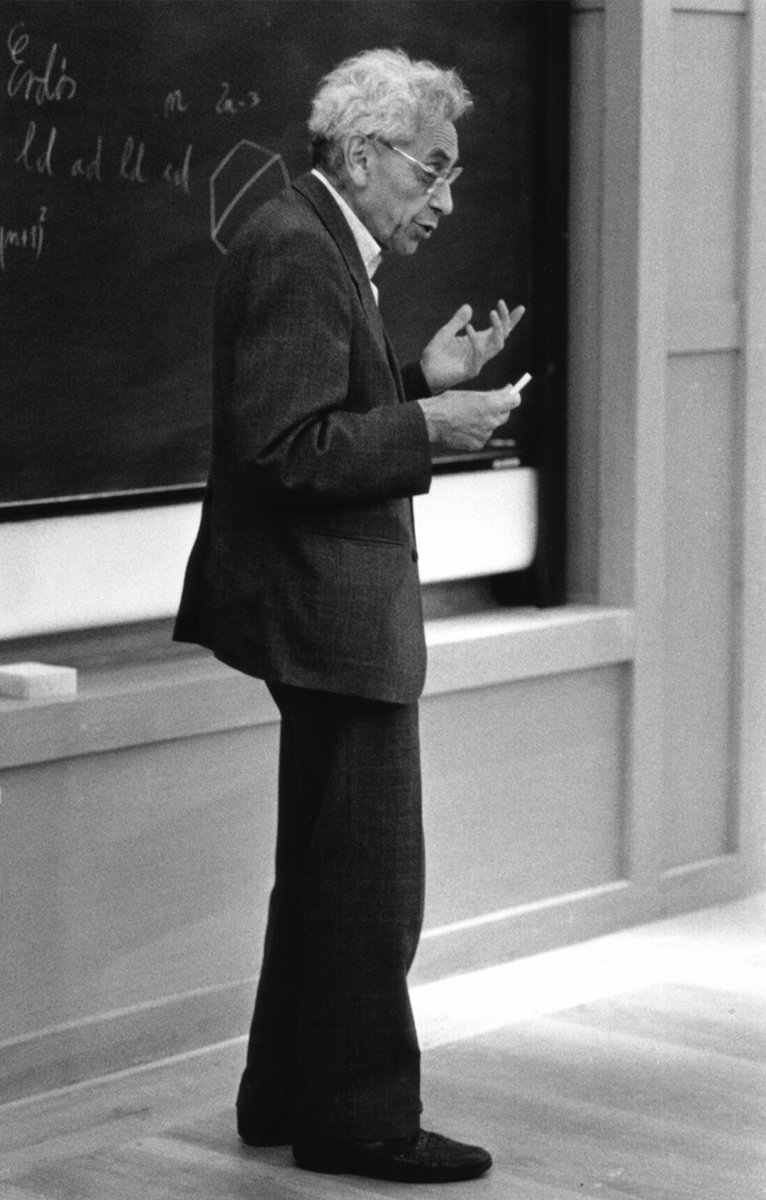
Paul Erdos(1913-1996) born in Budapest, Hungary
- Mathematician
- Contributions to number theory, combinatorics, and graph theory.
- He lived a nomadic lifestyle, traveling the world
- Wrote over 1,500 papers, earning him the title "The Man Who Loved Only Numbers"
#NS_Facts
@pvergadia Such an inspiring journey, Priyanka.
Your GCP Sketchnote repo was one of the reasons I was able to ace the GCP certifications on multiple occasions. These were very effective during exam revision.
A very sweet Canute and Katja c*mmission that I got from @wildzo_ !✨
Reading.📖💕
Also I think Katja tried some of that viking era basic lipstick made with berries here.🥰
Thank you for drawing them! I like how it turned out!💫
#VINLAND_SAGA#vinlandsaga#Ocxcanon
"Vinland Saga’s author says Hild is ripped, though I wonder how you imagine brawny she looks like?" -> YA LA DIBUJE ASI JEJEJEJE https://t.co/kKTcOAyNWe