PhD. in IR | Academic by Profession | HOD of Political Science in Rawalpindi Women University IDecoding geopolitics with a dash of humour & a pinch of politics.
I am honoured to announce that the historic ‘Islamabad Memorandum of Understanding’ has been electronically signed today between the United States of America and the Islamic Republic of Iran. The Memorandum has been signed by honourable Presidents of both the countries and also endorsed by me as the mediator. The signing of this agreement at the highest level of the respective governments demonstrates the commitment of both sides to a diplomatic resolution of the conflict. Islamabad MoU shall enter into force with immediate effect and as a first step, Islamic Republic of Iran will instantly reopen the Strait of Hormuz and the United States of America will immediately lift the naval blockade.
I offer my heartfelt congratulations and sincere appreciation to the President of the United States, Donald J. Trump whose steadfast commitment to diplomacy and preference for peaceful resolution have once again helped end a conflict that could have led to devastating consequences for the region and beyond. I also commend the dedication and tireless efforts of the United States negotiating team, including J.D. Vance, Steve Witkoff and Jared Kushner, for their invaluable contributions to this achievement.
I express my profound respect and appreciation to His Eminence Ayatollah Seyyed Mojtaba Hosseini Khamenei, the Supreme Leader of Islamic Republic of Iran and President Masoud Pezeshkian for their wisdom, foresight and statesmanship in embracing the cause of peace. I also wish to recognize the efforts of the Iranian negotiating team, including Mohammad Bagher Ghalibaf, Abbas Araghchi and Eskandar Momeni, whose patience, perseverance and commitment to constructive engagement were instrumental in bringing this agreement to fruition.
I would especially like to acknowledge the sincere efforts and constructive engagement of the leadership of the State of Qatar in helping reach this point. I also highly commend the leadership of the Kingdom of Saudi Arabia, the Republic of Türkiye and the Arab Republic of Egypt for their indispensable role and invaluable contributions in this regard.
I would also like to make special mention of Field Marshal Syed Asim Munir, whose tireless efforts, selfless dedication and instrumental role were critical in facilitating this breakthrough and advancing the cause of peace and regional stability.
May this Memorandum of Understanding serve as an enduring foundation for greater understanding, mutual respect and shared prosperity for the complete region.
@realDonaldTrump@JDVance@SecRubio@SteveWitkoff@SEPeaceMissions@drpezeshkian@mb_ghalibaf@araghchi
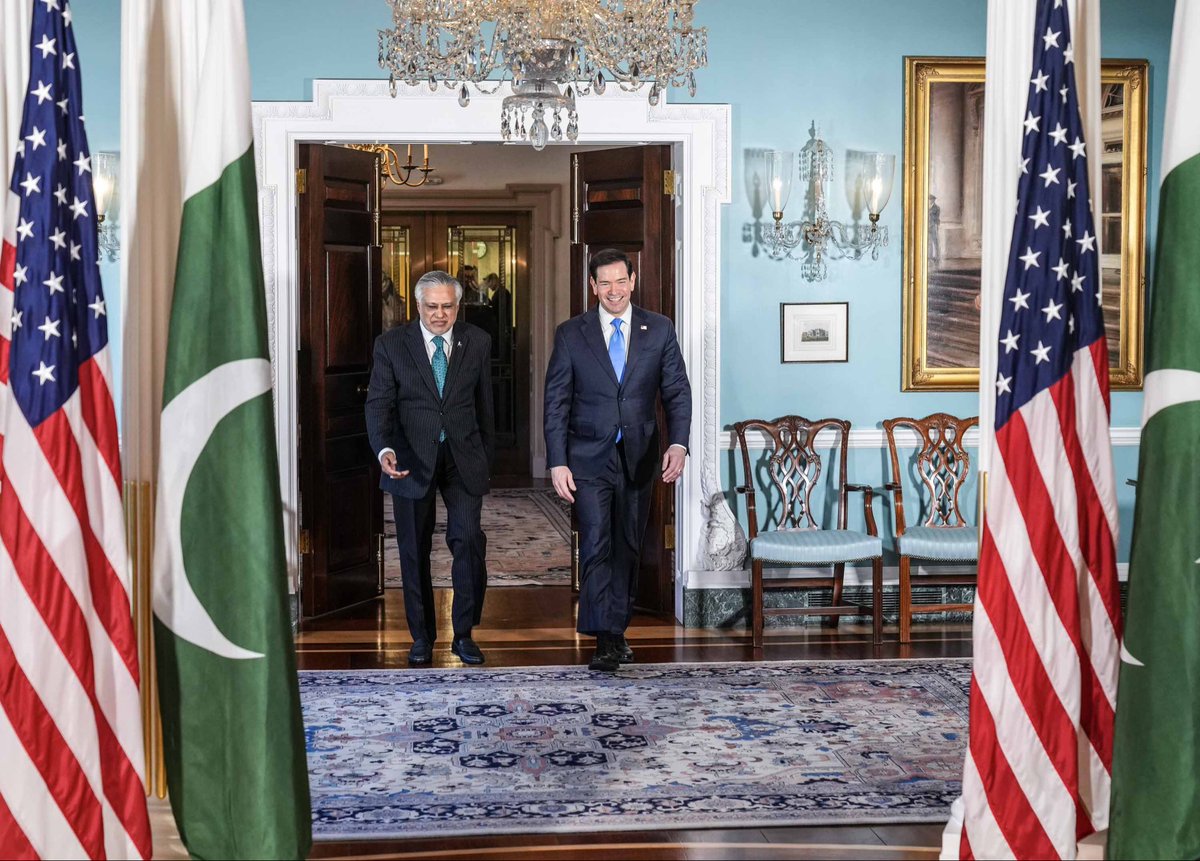
Met with Pakistani Deputy Prime Minister and Foreign Minister @MIshaqDar50 and thanked him for the role Pakistan continues to play in advancing peace in the Middle East. We agreed upon the importance of working together to further strengthen a meaningful partnership for better security and more prosperity for our two nations.
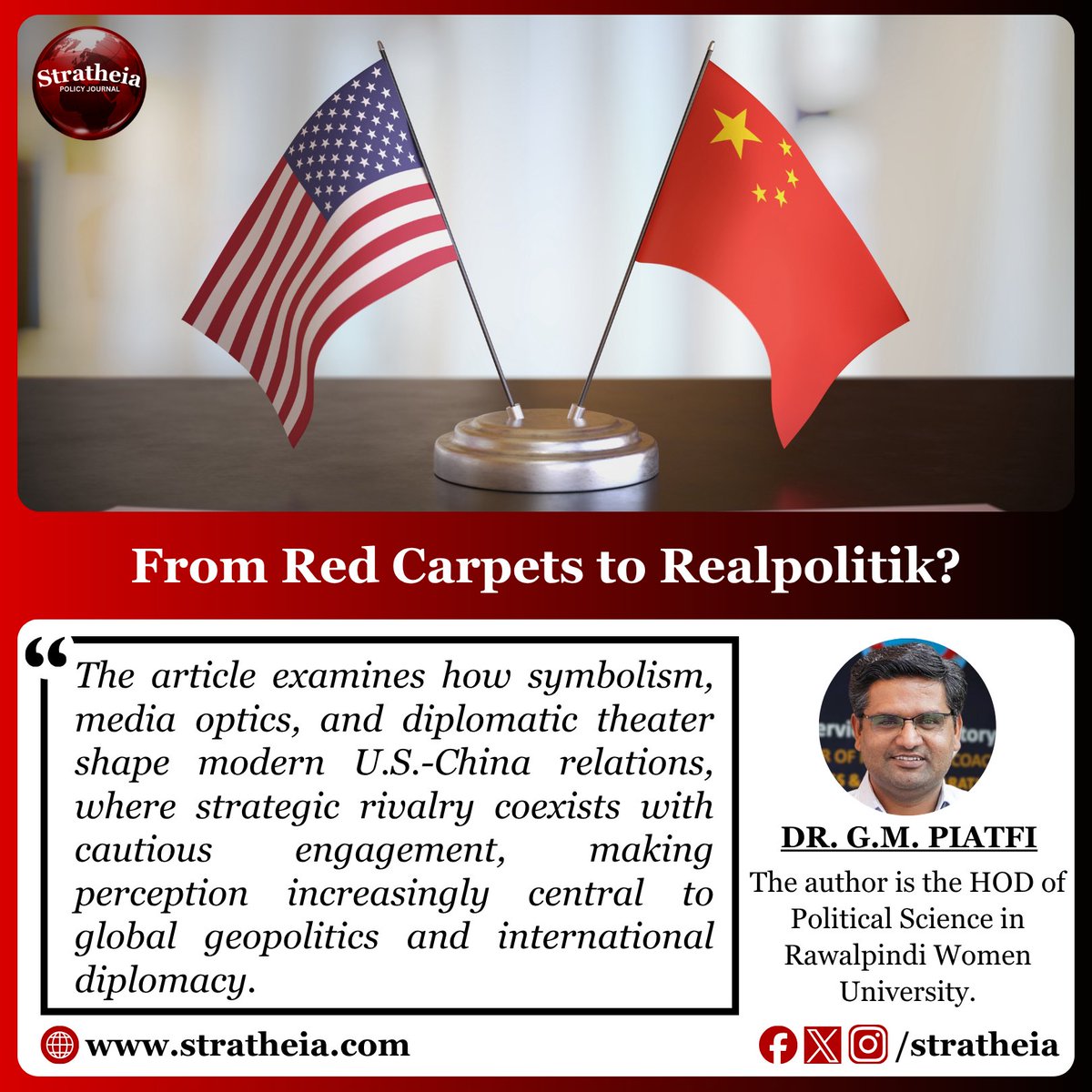
The Trump–Xi encounter demonstrated that modern diplomacy is no longer shaped only by agreements and negotiations. Optics, symbolism, and strategic messaging now play a central role in global politics, I argue in my latest piece for @stratheia
The Trump–Xi encounter demonstrated that modern diplomacy is no longer shaped only by agreements and negotiations. Optics, symbolism, and strategic messaging now play a central role in global politics. @PitafiGM1#USChina#TrumpXi#Diplomacy
Read Full Article: https://t.co/Z9zGf6WiZm
Pakistan's PM Shehbaz Sharif has met with Chinese President Xi Jinping in Beijing. The four-day visit aims to discuss political and economic cooperation between China and Pakistan as the two nations mark 75 years of relations.
Al Jazeera’s @Katmyu has more from Changzhi, China.
#Iran’s announcement of an expanded control envelope in the Strait of Hormuz - coupled with strikes on oil facilities in Fujairah and strikes on oil tankers - points to a deliberate escalation toward the United Arab Emirates’ oil export bypass routes.
The objective is to keep alternative export channels at risk, sustain elevated oil prices, and block any perception of normalization. In other words, the message is that Donald Trump’s mission in the strait will not be cost-free. Instead, it will generate greater complexity and sustained pressure on the energy market.
Pakistan’s diplomatic edge lies in balance—not alignment. Engaging both China and the U.S., it is emerging as a credible mediator in a polarized world. @PitafiGM1#Pakistan#Mediator#US#China
Read Full Article: https://t.co/KZdNzw04Xd
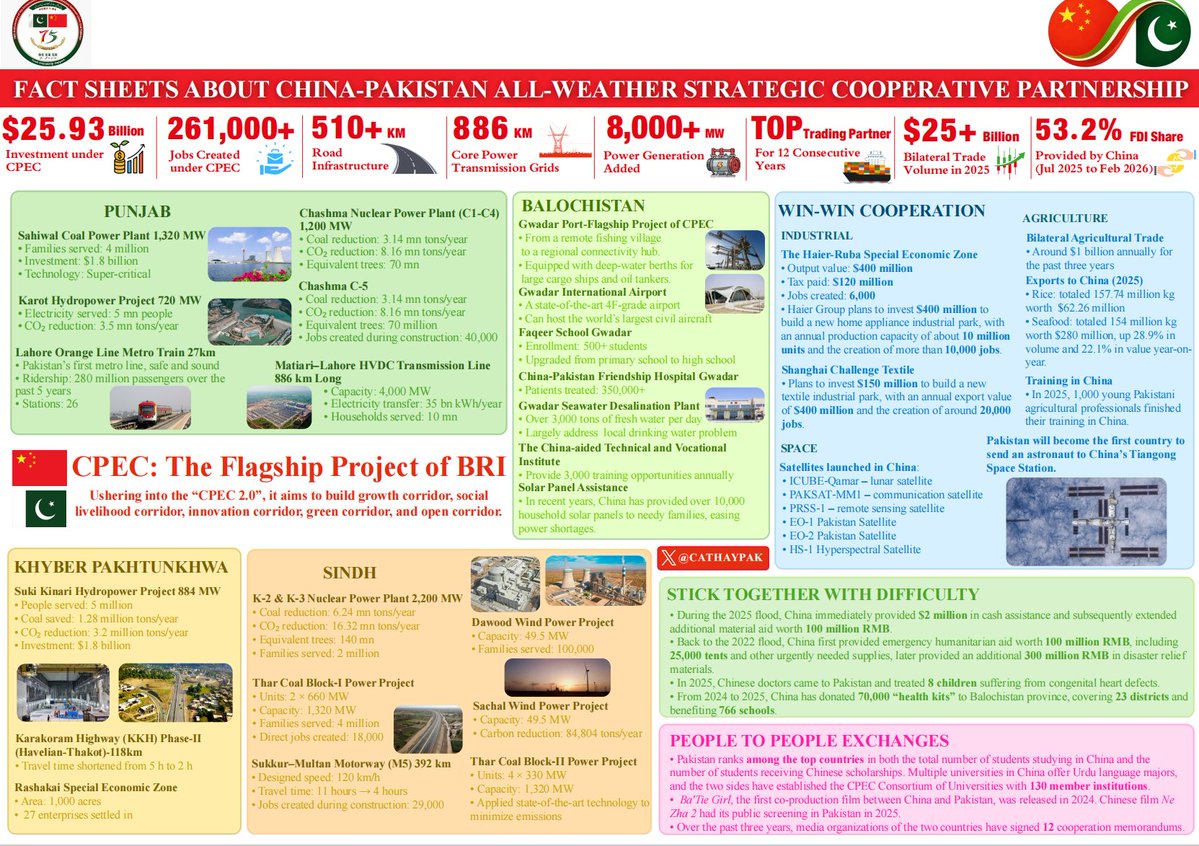
This year marks the 75th anniversary of the establishment of the diplomatic relationship between China and Pakistan. As ironclad friends and all-weather strategic cooperative partners, the two countries have set a model for friendly coexistence and common development. Please look at the following factsheet.
PRESS SEC on U.S.-Iran negotiations: The Pakistanis have been incredible mediators and we really appreciate their friendship and efforts to bring this deal to a close.
The President feels it's important to continue to streamline this communication through the Pakistanis.
Drawing on Pakistan’s diplomatic history and strategic positioning, my new piece for @BelferCenter examines how Islamabad helped shape the fragile U.S.-Iran ceasefire and what this means for the future Middle Eastern security order.
https://t.co/TFsQyBhbEC
The bad news
In JD Vance’s own words, he stated that Iran has not accepted the US/Israel terms for establishing peace.
But I’d like to know what kind of negotiation this is, in which terms are simply imposed. Did anyone inform the American delegation that this isn’t a surrender treaty?
They seem to be living in a different reality. This is not how you negotiate peace, and this delegation certainly includes many people who know that very well.
Here are 10 points explaining why Iran is not in a position to give in:
1. It controls the Strait of Hormuz, and any attempt to take it would be extremely bloody and result in heavy casualties;
2. It can close the other strait using the Houthis;
3. It has maintained a stable daily rate of missile and drone launches for several weeks, demonstrating it has a large arsenal;
4. Its ground forces still have intact equipment and high morale, especially after the failure at Isfahan;
5. No one knows where the enriched uranium is, nor is there any effective way to seize it;
6. It is Iran that is effectively sanctioning America, with fuel prices and inflation already knocking at the door;
7. It is Iran generating pressure on Trump from Gulf countries;
8. It is Iran generating pressure on Trump from its Asian and European allies;
9. Iran is well aware of the shortage of interceptors and is actively exploiting it;
10. Its air defense capabilities are gradually improving through the deployment of new equipment, showing that Iran has a long-term strategy.
On the other hand, the daily bombings are steadily eroding Iranian infrastructure. The decisive factor in this war is precisely whether this resilience will prove sustainable in the long run.
High-level US-Iran talks in Islamabad are notable for their genuinely trilateral format, with Pakistan not merely hosting but seated at the table as an active participant. Islamabad’s presence reflects recognition of its bridge-state diplomacy, leveraging trusted channels with both Washington and Tehran and its direct stakes in regional stability, maritime security, and the prevention of conflict spillover.
I should note that historically, such configurations are not without precedent. Oman’s quiet but pivotal role in facilitating backchannel US-Iran negotiations that led to the JCPOA illustrated how a trusted intermediary can shape diplomatic space. The Camp David Accords demonstrated a stakeholder mediator model, where the third party, US, was physically present to provide assurances and help structure negotiations. Similarly, Norway’s role in the Oslo Accords highlighted how an active host could move beyond facilitation to shaping outcomes through trust-building and agenda influence.
Pakistan’s inclusion in this trilateral setting therefore signals more than logistical convenience; it reflects its convening power, credibility with both sides, and strategic relevance to the broader regional security architecture marking a shift from facilitator to stakeholder mediator and confidence-builder.
Pakistan’s role has shifted from facilitator and go-between to direct mediator and peace negotiator (amid reports of 3-way talks taking place in Islamabad). For now at least, Pakistan’s in the driver’s seat in the difficult & delicate effort to guide the US & Iran to an off ramp.
From crisis to calibration, Pakistan quietly stepped into the eye of the storm, balancing KSA, Iran, USA, China & Gulf states to nudge rivals toward restraint. A rare moment where diplomacy outpaced destruction. 🌍🕊️
#geopolitics#Pakistan#Peace#War
With the greatest humility, I am pleased to announce that the Islamic Republic of Iran and the United States of America, along with their allies, have agreed to an immediate ceasefire everywhere including Lebanon and elsewhere, EFFECTIVE IMMEDIATELY.
I warmly welcome the sagacious gesture and extend deepest gratitude to the leadership of both the countries and invite their delegations to Islamabad on Friday, 10th April 2026, to further negotiate for a conclusive agreement to settle all disputes.
Both parties have displayed remarkable wisdom and understanding and have remained constructively engaged in furthering the cause of peace and stability. We earnestly hope, that the ‘Islamabad Talks’ succeed in achieving sustainable peace and wish to share more good news in coming days!
@realDonaldTrump@JDVance@SecRubio@SteveWitkoff@SEPeaceMissions@drpezeshkian@mb_ghalibaf@araghchi
پاکستان نے امریکہ اور اسرائیل کی ایران پر مسلط جنگ رکوانے کی بھرپور کوشش کی ہے ۔ اس معاملے پر پاکستان کی سفارتی کوششیں باعث تحسین ہیں چاہے جنگ بندی ہوتی ہے یا نہیں
#IranWar#Pakistan#diplomacy
Pakistan is simultaneously managing Washington's ask, Tehran's conditions, Saudi Arabia's restraint, its own defence pact obligations, and Israeli attempts to collapse the process. Any one of those threads snaps and the whole thing falls apart.
This is the most exposed diplomatic position any state has occupied in living memory.
1. End of History (Fukuyama): Liberal democracy has triumphed as the final form of human government, and ideological evolution has essentially concluded.
2. Clash of Civilizations (Huntington): Future global conflicts will be driven primarily by cultural and religious differences between major civilizations, not ideology or economics.
3. Great Power Politics (Mearsheimer): Great powers are locked in permanent competition for dominance because the anarchic international system compels states to maximize their relative power for survival.
So— can we say Mearsheimer is correct?
Yes, largely.
US-China rivalry, the Ukraine war, and global military buildups all fit his core idea, that great powers inevitably compete for dominance regardless of ideology or economics.
Fukuyama looks naive right now, with authoritarianism resurging globally.
Huntington has some merit, but alliances still cross civilizational lines when power interests demand it.
Mearsheimer famously predicted the Ukraine war years in advance using pure structural logic- hard to argue with that track record.
Knowing full well that Israelis had penetrated the Iranian security establishment, why did Ayatollah Khamenei choose to stay in his official residence/ office remain a mystery. However, one thing is clear: the martyred supreme leader set an example for his people to lead from the front—something the Iranian nation should be proud of and fight for.
Second, Iran has shattered the myth of the invincibility of Israel’s “Iron Dome” and American military prowess, as international media, despite restraint (self-censorship), has admitted the substantive damages to their military infrastructure.
Third, the disruption of energy supplies from the Gulf region is having a global impact, which is not winning friends for President Trump.
Fourth, the Gulf states' ambiguous stance about the status of the US bases on their soil and use by the U.S. has raised many questions about their credibility as credible neighbours. Also, Israel has been using these countries' airspace to attack Iran through aircraft and missiles, which automatically drags these Arab states into the ongoing war.
Whatever the outcome of the war, one thing has become clear: the so-called Organisation of Islamic Cooperation (OIC) is waiting for its obituary to be written by the Gulf states supporting the war.