@noahrshinn Hi Noah, I’m a biotech President and COO building an AI COO operating system for early-stage companies. It creates persistent operating context across governance, finance, development, fundraising, risks, decisions, and reporting.
DNBSEQ-T10x4 in a customer site - the newer “dip-seq” sequencing technology is ready to roll, and its throughput will be over 50k human WGS per year per instrument. It is a great team work to pull all together in a short time.
Day 13 of great biology papers.
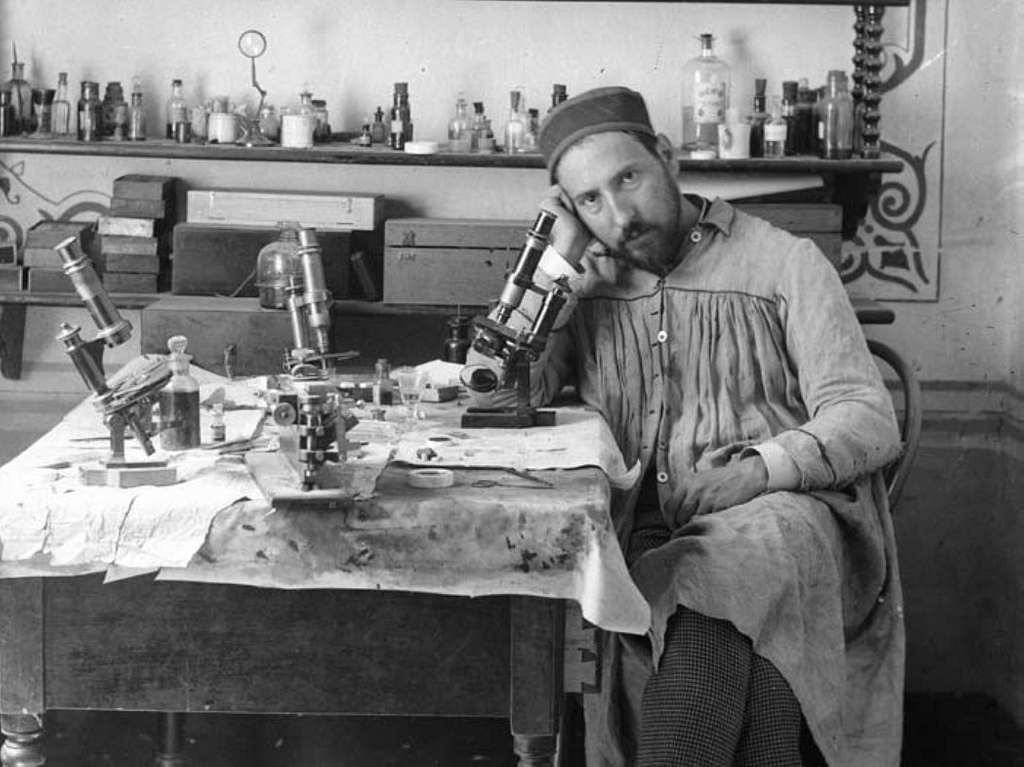
"The structure and connexions of neurons," by Santiago Ramón y Cajal.
This 1906 Nobel Lecture laid the foundation for modern neuroscience.
***
Camillo Golgi shared the 1906 Nobel Prize in Medicine with Ramón y Cajal. And Golgi gave his lecture first.
He talked about his work on 'reticular theory,' and believed that the nervous system was a bundle of nerve fibers that form an intricate, connected network. Golgi thought that nerve impulses propagate through this network, but that neurons are more like long ropes, rather than individual cells.
Ramón y Cajal spoke next and entirely dismantled Golgi's ideas. A rare moment in the history of Nobel Prizes.
Ramón y Cajal made several claims about the nervous system:
1. "The nerve cells are morphological entities, neurons."
2. "The nerve currents are transmitted from one element to the other as a consequence of a sort of induction or influence from a distance."
3. "The cell bodies and the dendrites are...conductive devices."
In other words, neurons are distinct cells and there are physical gaps between them. This idea was contrary to Golgi's claims.
Ramón y Cajal also defined "the law of dynamic polarization," stating that nerve cells receive information from other neurons through their cell bodies and dendrites, and also send new information to distant neurons through axons.
"During twenty-five years of continued work on nearly all the organs of the nervous system and on a large number of zoological species," he said, "I have never met a single observed fact contrary to these assertions." Boom.
I've chosen to feature this lecture by Ramón y Cajal because it's a nice history, includes beautiful images, and he otherwise wrote too many excellent books and articles.
Lecture: https://t.co/QKCZioN99N
More history: https://t.co/itQjufp0M6
Read "This Cannabis-Based Drug Has Outperformed Pfizer's Lyrica In Clinical Trials: A New Dawn For Diabetic Nerve Pain Management?' https://t.co/32LVi0fLw8