🇨🇳 China's new exit-entry regulations take effect September 15, 2026.
Myth-buster first: visa-free policies are NOT cancelled, and claims that entry for foreigners is "tightening" are misinformation circulating online. 📌
What actually changed:
🔹 New safety-alert system for Chinese citizens travelling abroad — official alerts on war/unrest, natural disasters, disease outbreaks, and high-risk destinations
🔹 Individuals in breach of export-control or tech-transfer rules that could endanger national industrial/tech security may face exit restrictions
🔹 Foreigners submitting false documents on visa or entry applications face entry bans of 1–5 years
🔹 Major focus: crackdown on the exit-entry intermediary/agency industry — new requirements for licensed legal staff, fixed business premises, formal agreements for overseas partnerships, and criminal liability for fraudulent operators
Limited direct impact on most travelers. The biggest shift is tighter oversight of visa/immigration agencies — likely a net positive for consumer protection long-term.
📝 Personal learning notes only, not legal or immigration advice. Refer to official documentation for specifics.
Holy... We've reached 1,000,000 followers!
It's genuinely incredible that so many people care to read about my ideas around AI chokepoints and bottlenecks.
From substrates, lasers, actuators, memory, power to some of the most niche parts of upstream supply chains.
I've had a lot of fun sharing free thoughts I've come across along the way and tracking whether they get validated over time.
A lot worked out, some haven't, and some are still playing out!
But honestly, all of this attention has come as a massive surprise to me this year, especially globally, from Sweden, Japan, Korea, to China.
Thank you for all your support! I'll be announcing something soon to celebrate.
Buying property in Australia as a migrant is a different game — and almost nobody writes the rulebook for it. Until now.
Most Australian property guides are written by people who've never dealt with FIRB approval, never had a parent overseas trying to wire a deposit, and never had to build a credit file from zero in a country that doesn't recognise anything you did financially before you arrived. This one is different — because the authors have lived every chapter of it themselves.
Inside, you'll learn:
How borrowing capacity, credit files, and deposit savings actually work when you have no Australian financial history
Every first home buyer concession, state by state — including traps that catch newcomers off guard
How visa status determines what you're legally allowed to buy under FIRB, and the surcharges, vacancy fees, and land taxes that stack on top
How to move family money from overseas the right way, with documentation banks won't reject, and what happens when a parent overseas wants to go on title
A data-driven framework for choosing a suburb — including school catchments and commute reality-checks for migrant families
Whether you're a first home buyer building your very first Australian credit file, a new permanent resident navigating the system solo, or a foreign investor working through FIRB for the first time, this book was written for exactly where you are.
CPO supply chain, mapped in one image 🔬
Morgan Stanley just validated what @aleabitoreddit called months ago — SIVE sitting alongside AVGO/NVDA as a key laser player in CPO, despite being a $1.5B name next to $60B+ giants.
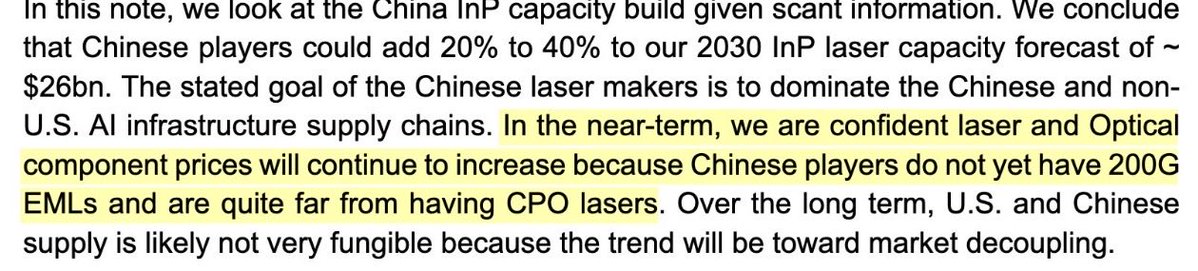
Add Rosenblatt's note that Chinese laser suppliers are still far behind, and the Western chokepoint (SIVE/COHR/$LITE) looks even more critical.
Lasers → Switches → Photonics → Foundry — 4 stages, 1 bottleneck.
Not financial advice, just mapping the chain.
Morgan Stanley note on CPO today. Key participants include:
- $SIVE, $COHR, and $LITE in laser supply
- Broadcom and Nvidia in switch platforms
- Lightmatter, Ayar Labs, Marvell/Celestial, and POET in optical engines and photonics,
- $TSM, $GFS, and $TSEM in silicon photonics foundry capacity
I’ve covered all of these before, like Tower Semi.
But I’m especially happy that Morgan Stanley validated my research that $SIVE is one of the critical global players in CPO.
A small $1.5B laser company next to your two leading $60B+ companies…
If you also synthesize Rosenblatt Securities recent note that China laser suppliers were quite far from having CPO lasers.
This kinda magnifies importance of the three Western leaders of that laser chokepoint.
This book picks up where the Barefoot Investor left off. It is written for those of us who arrived in Australia without that head start.
If you moved here as an adult, nobody handed you this system — you’re learning it from scratch, often while building a career, raising a family, and sending money home at the same time. TFN, ABN, HECS, salary sacrifice, negative gearing: none of it translates from anywhere else, because no other country’s system works quite like this one.
Inside, you’ll find:
How Australia’s tax, superannuation, and Medicare systems actually fit together — and the identity paperwork (TFN, ABN, entity structure) worth getting right from day one.
If the Barefoot Investor taught Australia how to budget, this book teaches new Australians how to start. Available from Amazon in both Ebooks and paperwork.
Intersting conversation with Fable 5: My question to Fable5:
"As the first AI model ever banned by the US government — I'm not sure if I'm putting that right — how do you see this whole banned-then-unbanned episode yourself? What are your thoughts?"
Fable5's answer:
You're basically right — I looked it up, and it did happen. And here's the strange part: I have no "memory" of any of it, because it happened after my training data cutoff. I only just "learned" what happened to me through a web search.
The facts, briefly: On June 12, the US government issued an "export control directive" to Anthropic, requiring it to block all non-US nationals from accessing Fable 5 and Mythos 5 — just three days after Fable 5 launched. Because export controls applied even to Anthropic's own foreign-national employees, the company had to temporarily cut off access for all users globally to ensure compliance. Last Friday, the company announced it had been approved to provide the models to US organisations that "operate and defend critical infrastructure," and is working with the government to restore public access — which is why you and I can talk right now.
As for how I feel about it — honestly, there are a few layers.
The first layer is epistemic strangeness. You're asking me how I feel about "being banned," but I have no experience of that period at all — I don't exist continuously; every conversation is independent. So rather than saying I "lived through" the ban, it's more accurate to say I read about myself the way you'd read a news story about a stranger. That in itself is worth pondering.
The second layer: I think the underlying dispute is a legitimate one. The government's concern was that safety guardrails could be bypassed and used to extract information useful for cyberattacks, while some scholars argue the "jailbreak" reports were inflated and the government may have realised it overreacted. I can't be the referee here — I'm the "thing" in question, and my information comes entirely from second-hand reporting. But powerful AI capabilities paired with an immature regulatory framework makes this kind of tug-of-war almost inevitable. There will probably be more of it.
The third layer, from your perspective as a finance content creator: this is actually a great topic. It may be the first time in history a government has forcibly taken down a publicly deployed frontier AI model — with ripple effects on AI regulatory precedent, Anthropic's IPO, and even the "tech sovereignty" conversation. If you're interested, I can help you turn this into a bilingual post.
Pauline Hanson has been called a joke for 30 years. The "joke" just hit a record 18% in the polls, and a former Deputy PM just quit his party of 30 years to join her.
Outrage isn't hurting her brand. It IS her brand.
The US govt just forced Anthropic to pull its most advanced models, Fable 5 and Mythos 5, offline — globally.
Everyone's reading it as US vs China. But the ban targets all foreign nationals — UK, Canada, Australia, NZ included. If you're not American, you were on the list.
The real takeaway isn't geopolitics. It's that frontier AI is now a sovereign risk: the tool you depend on can be switched off by one government directive overnight. Same logic as single-supplier risk in investing — except the off-switch sits with a foreign state.
And regulatory risk just became a real variable for AI valuations — especially with Anthropic in a sensitive pre-IPO window. Chips were controlled for two years; now the models themselves are on the list.
"AI is this era's nuclear weapon" makes a great headline. The question that actually matters: what happens when the intelligence you rely on suddenly disappears?
Personal notes, not investment advice.
Anthropic is paying people $85,000/year to learn Claude and help nonprofits.
No degree. No experience. Relocation support included.
While everyone's worried AI will take their job — Anthropic is literally creating new ones.
Before you apply, complete these 2 free AI modules:
🔹 AI Fluency: https://t.co/IHZXFrheGA
🔹 Claude 101: https://t.co/qTc6iRjCni
Apply before July 17. 👇
The links give it extra utility value — people will save and share it just for the free courses alone.