You handle the job. We help you price it. 📐 Takeoffs, estimates & bid-ready packages for contractors, from plans or just measurements. Starting at $150 / $200 / $250, with a written quote before any payment. Hablamos español; deliverables in English.
https://t.co/UKhyEDcsTY
SAMPLE quantity note (example numbers): a 40' x 30' house with 1' overhangs is 42' x 32' = 1,344 SF. At a 6/12 pitch, multiply by 1.118 and you get 1,503 SF, or 15 squares. Add 10% waste on a simple gable and order 17 squares. Ridge, starter and drip edge get their own lines.
¿Ya tiene las medidas pero le falta la propuesta?
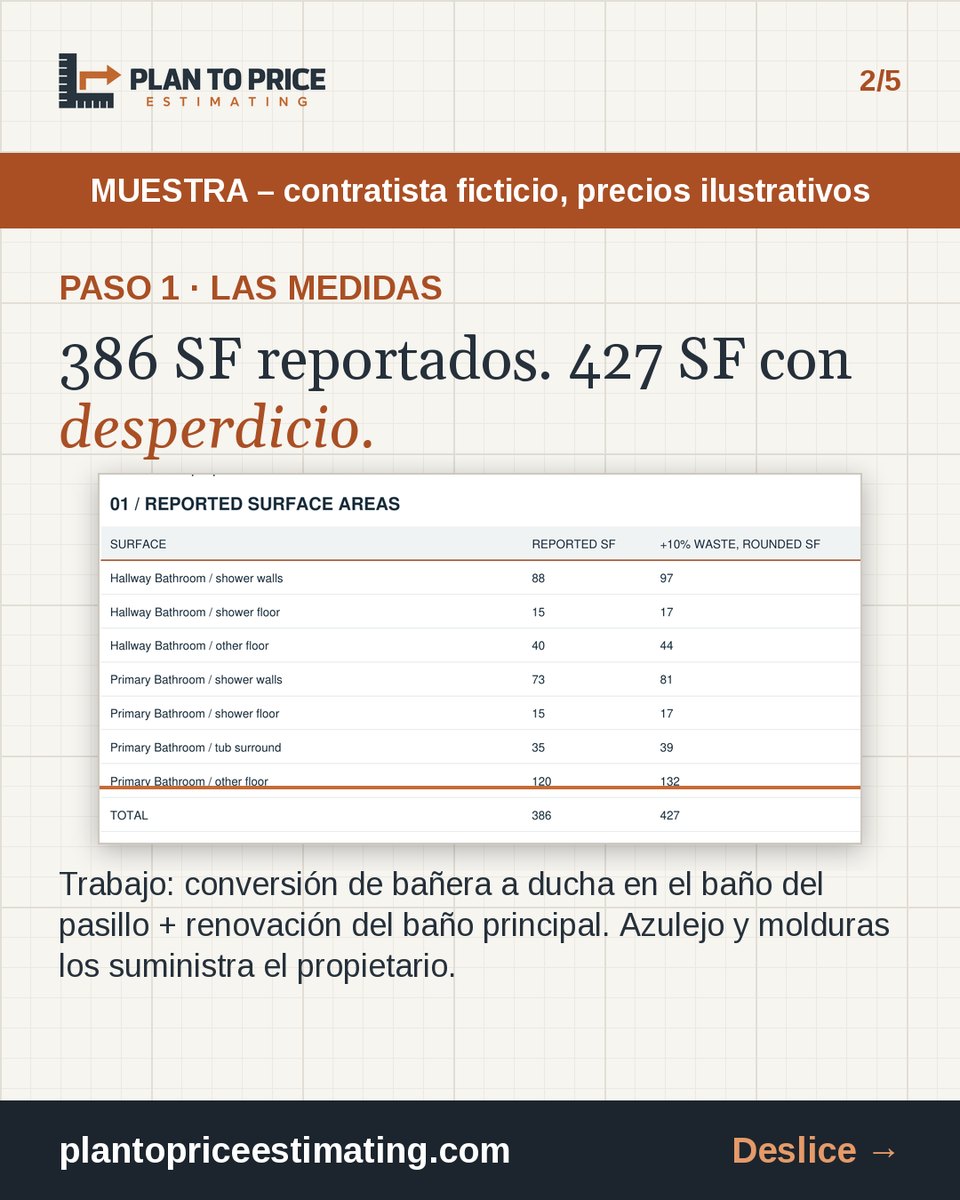
Nuestra MUESTRA de dos baños: de 386 SF reportados (427 SF con desperdicio) a una propuesta con un solo precio.
Hablamos español; documentos en inglés.
https://t.co/um7lCpsZpC
#contratistas
Every trip to the site costs money. If the schedule brings your crew out three separate times for rough-in, trim and punch, price three mobilizations, not one. On small jobs, the extra trips are where margin quietly disappears.
@BuildersSunrise Smart timing. Locking the plans and the takeoff over winter means the material order is ready for spring, and the price can be reviewed before the season starts.
@homestylehhi Clean job. On combined exterior work, pricing the skylight flashing and any decking replacement on their own lines keeps the roof number clear when the old layers come off.
@SantosCedarInc Good scope list. On deck jobs the joist count is the hard part before demo, so a unit price per replaced joist keeps the quote fair once the boards come up.
@RobReichJr Agreed. It starts at the estimate too. A job priced with its real overhead, retainage and payment timing is one that actually pays you on the 1st, not just one that looks good on the top line.
@JHicks_HomePro Insurance work rewards a detailed scope. When the estimate shows the same line items and quantities the adjuster uses, supplements for hidden damage go a lot faster.
@MiltonSunrooms Fair point. Either way, separating the foundation, roof tie-in and electrical lines on the estimate makes the comparison clearer. The tie-in is usually where sunroom numbers move the most.
@Urban_Builders Good approach. On aging-in-place baths, the blocking for future grab bars costs very little at framing and a lot later. It's worth carrying as its own line on every bathroom estimate.
@tspremodeling Nice finish. Wall repair is the line that usually grows once the old cabinets come off, so pricing it per sheet or per area on the estimate helps the homeowner see why.
@BravoPlumbing01 Good catch. Finds like that are why a small allowance for code corrections on bathroom jobs is worth carrying. Once the drain is opened up, the fix is already in the number.
@CLTroofer Good topic. On TI jobs the rooftop work often lands between trades: curbs, penetrations, patching and warranty letters. Pricing those as their own lines keeps them from falling through the gaps in the GC's scope.
@RDCflooring Helpful breakdown. Listing the slab count, edge profile and sink cutouts on the quote also makes it much easier for a customer to compare marble against quartz on the same layout.
@TrinityBuildDFW That's a find. On old houses like that, carrying an allowance for sistering or added beams before the floor opens up keeps the structural fix from turning into a fight over a change order.
@goswiftpro Well said. A written number holds up best when it also says what isn't included, like wall access or patching. The price stays honest, and nobody is surprised when the invoice shows up.
@SoulSistaNatl Backup is the whole point of a change order. When the original bid lists quantities and unit costs, pricing the change is simple math against that baseline, and nobody has to argue about where the number came from.