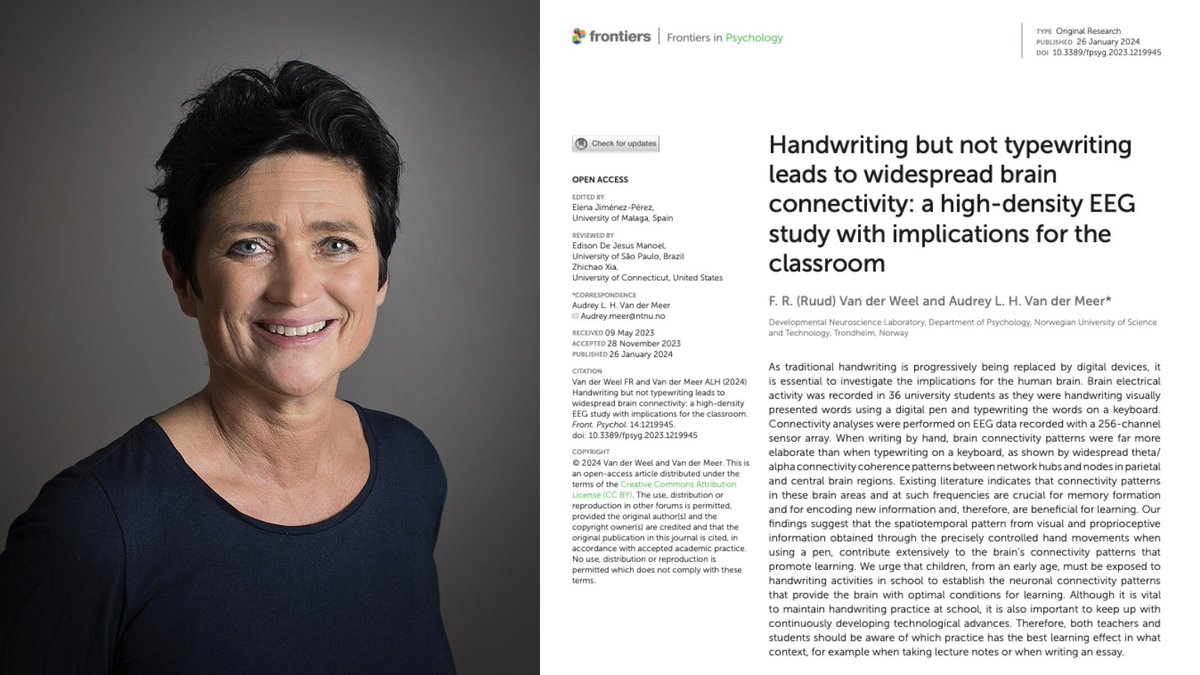
A Norwegian neuroscientist spent 20 years proving that the act of writing by hand changes the human brain in ways typing physically cannot, and almost nobody outside her field has read the paper.
Her name is Audrey van der Meer.
She runs a brain research lab in Trondheim, and the paper that closed the argument was published in 2024 in a journal called Frontiers in Psychology. The finding is brutal enough that it should have changed every classroom on Earth.
The experiment was simple. She recruited 36 university students and put each one in a cap with 256 sensors pressed against their scalp to record brain activity. Words flashed on a screen one at a time.
Sometimes the students wrote the word by hand on a touchscreen using a digital pen, and sometimes they typed the same word on a keyboard. Every neural response was recorded for the full five seconds the word stayed on screen.
Then her team looked at the part of the data most researchers had ignored for years, which is how different parts of the brain were communicating with each other during the task.
When the students wrote by hand, the brain lit up everywhere at once.
The regions responsible for memory, sensory integration, and the encoding of new information were all firing together in a coordinated pattern that spread across the entire cortex. The whole network was awake and connected.
When the same students typed the same word, that pattern collapsed almost completely.
Most of the brain went quiet, and the connections between regions that had been alive seconds earlier were nowhere to be found on the EEG.
Same word, same brain, same person, and two completely different neurological events.
The reason turned out to be something nobody had really paid attention to before her work. Writing by hand is not one motion but a sequence of thousands of tiny micro-movements coordinated with your eyes in real time, where each letter is a different shape that requires the brain to solve a slightly different spatial problem.
Your fingers, wrist, vision, and the parts of your brain that track position in space are all working together to produce one letter, then the next, then the next.
Typing throws all of that away. Every key on a keyboard requires the exact same finger motion regardless of which letter you are pressing, which means the brain has almost nothing to integrate and almost no problem to solve.
Van der Meer said it plainly in her interviews.
Pressing the same key with the same finger over and over does not stimulate the brain in any meaningful way, and she pointed out something that should scare every parent who handed their kid an iPad.
Children who learn to read and write on tablets often cannot tell letters like b and d apart, because they have never physically felt with their bodies what it takes to actually produce those letters on a page.
A decade before her, two researchers at Princeton ran the same fight using a completely different method and ended up at the same answer. Pam Mueller and Daniel Oppenheimer tested 327 students across three experiments, where half took notes on laptops with the internet disabled and half took notes by hand, before testing everyone on what they actually understood from the lectures they had watched.
The handwriting group won by a wide margin on every question that required real understanding rather than surface recall.
The reason was hiding in the transcripts of what the two groups had actually written down.
The laptop students typed almost word for word, capturing more total content but processing almost none of it as they went, while the handwriting students physically could not write fast enough to transcribe a lecture in real time, which forced them to listen carefully, decide what actually mattered, and put it in their own words on the page.
That single act of choosing what to keep was the learning itself, and the keyboard had quietly skipped the choosing and skipped the learning along with it.
Two studies. Two countries. Same answer.
Handwriting makes the brain work. Typing lets it coast.
Every note you have ever typed instead of written went into your brain through a thinner pipe. Every meeting, every book highlight, every idea you captured on your phone instead of on paper was processed at half depth.
You did not forget those things because your memory is bad. You forgot them because typing never woke the part of the brain that would have made them stick.
The fix is the thing your grandmother already knew.
Pick up a pen. Write the thing down. The slower road is the faster one.
Severe neck and upper shoulder pain. MRI is clean. Orthopedic exam is normal. Physical therapy does not help.
"Coat hanger" distribution pain is one of the most recognizable patterns in autonomic dysfunction.
IN LEBANON — @cbonneauimages: “A message to 🇺🇸 taxpayers: while you can’t afford groceries and are 1 medical emergency away from bankruptcy, your tax dollars are going to 🇮🇱 to kill civilians in foreign countries… the # of massacres here in the last 24 hours is dizzying.”
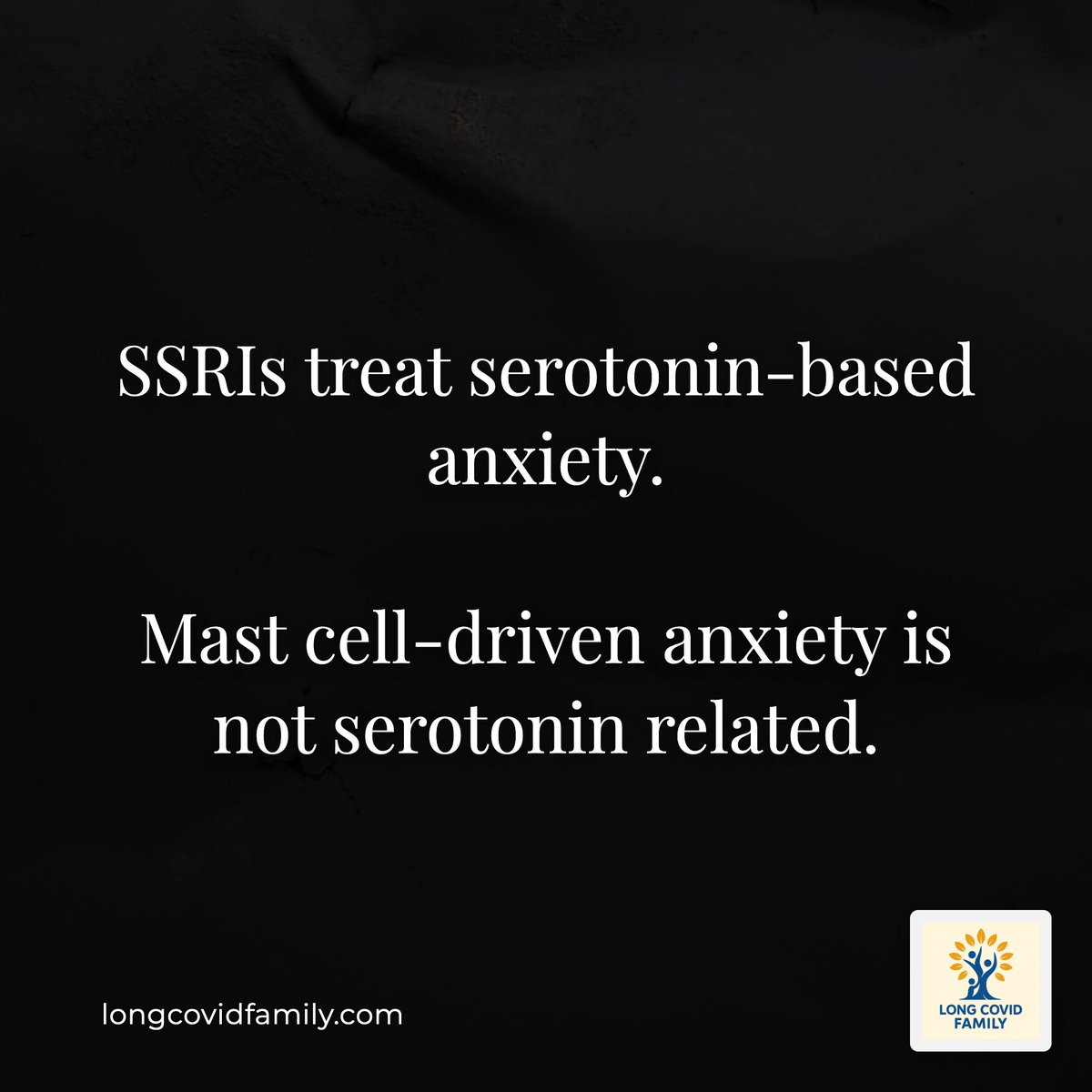
SSRIs treat serotonin-based anxiety. Mast cell-driven anxiety has nothing to do with serotonin.
When mast cells degranulate, histamine crosses the blood-brain barrier and activates receptors in the amygdala.
I told my therapist,
“I keep falling for people who never really choose me back.”
She didn't give me comfort.
Hearing her, my whole body went still.
Here's what she just replied:
If your nervous system has been stuck in survival mode, you need a reset.
After years of stress, trauma, and modern life, it's forgotten how to truly relax.
Here are 16 specific techniques to reset it completely: 🧵
1) Neurogenic Tremoring (TRE)
IMPORTANT: Stop calling the troops in LA National Guard Troops. They are not. When Trump activated them against the wishes of the Gov they became FEDERAL troops… like the 82nd airborne with no Law enforcement power! Don’t let them confuse you!
Your body fights off 10,000 microscopic cancers every day.
But modern life is sabotaging your natural defenses
A Harvard doctor helps terminal cancer patients recover by switching these defenses back on.
His 10 tips to rebuild immunity against chronic disease:🧵
I can appreciate skepticism of long COVID as a concept. After all, it may instinctually seem like an epistemological overreach to assign a singular cause to such a heterogeneous disease presentation.
On the other hand, consider the localization of ACE2 throughout your body. Consider the reach of your blood vessels. Couple that with imaging studies that demonstrate spike persistence in areas such as the brain and skull. Consider also that viral persistence has been identified in the gut with replication competent virus.
In the last few years, I've interacted with tons of people on this platform, both vaccinated and unvaccinated, who have lost a significant amount of mobility after having had COVID infections. Healthy and unhealthy, comorbidities or not. People in their 40s are also dying of rare cancers. Athletes and soldiers are having a decrease in functional performance after a single COVID infection, let alone reinfections.
The deeper you look into viral persistence (look at the work Polybio and Erturk Lab are doing on imaging, for example), the more you'll find yourself willing to consider that COVID might play a role in it.
The key is in recognizing that the microvascular changes COVID causes are difficult to detect with off-the-shelf diagnostics. Once research develops more readily commoditized diagnostics, perhaps the condition will gain wider recognition. In the meantime we have a large segment of young, middle-aged, and previously healthy athletes succumbing to unusually debilitating chronic illness after COVID infections. That illness is real despite misgivings some may have. And so too is the underlying damage COVID causes, even if it's not straightforward to detect in all instances. Whatever you want to call the disease, those patients deserve medical treatment despite limitations in the diagnostic tools conventionally available.
McGovern: "You are literally taking food off kids' plates to buy Elon Musk another yacht. I guess he's getting a good return on his campaign donations ... this is not policy. This is theft."
A new study confirms what so many already know: being dismissed by doctors can be as traumatic as illness itself.
Patients report four kinds of harm: shame, lost trust, delayed diagnosis, avoiding care.
This is the harm I tried to name in my book The Invisible Kingdom:
MAJOR BREAKING: The Trump administration has asked the Supreme Court to keep DOGE’s operation and decisions a secret, including details of its inner workings; firings; grant terminations; and other actions proposed by DOGE. Why??
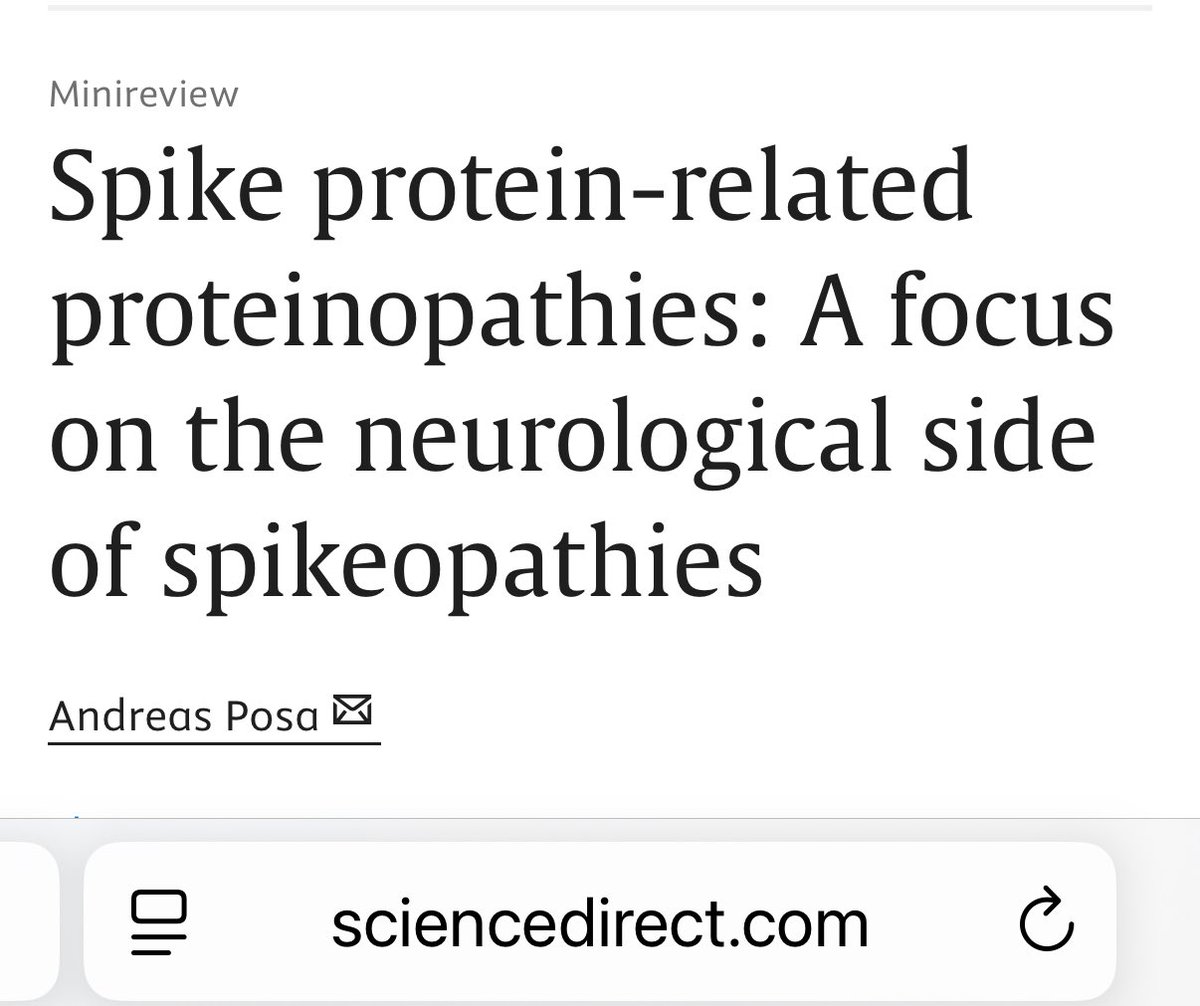
NEW: 🚨 🤯 Spike Protein (SP) from COVID & 💉 is toxic, crossing in 🧠 & causing neurological issues. 🤦🏻♀️😵💫😫🤬
Spikeopathies: thrombogenic, neurotoxic, inflammatory, degenerative.
“To combat the COVID-19 pandemic, novel gene-based products (mRNA) have been used worldwide to induce human body cells to produce spike protein to stimulate the immune system. This artificial spike protein has a harmful effect on the human nervous system.”
“Remarkably, Spike protein has the ability to cross…into the brain and cause cerebral damage through various pathomechanisms.”
Shhhhh! They are catching on!
Can Sunlight Cure Disease?
Sunshine may hold healing rays for a variety of autoimmune diseases such as multiple sclerosis. Scientists are turning this surprising discovery into treatments
https://t.co/h268PcY5A1
A new study published in the Journal of Virology has revealed that the Spike proteins from SARS-CoV -2 and other human coronaviruses directly activate mast cells, initiating a rapid inflammatory response through a well-defined intracellular signaling cascade.
Significant Findings:
✅ Spike protein binding alone, independent of full viral infection, was sufficient to trigger mast cell degranulation.
✅ This activation occurred via an intracellular signaling pathway, which led to an influx of intracellular calcium.
✅ Elevated Ca²⁺ then triggered microtubule-dependent granule transport, resulting in mast cell degranulation and release of inflammatory cytokines like IL-1β, IL-6, TNF-α, and IL-8.
✅ The study confirmed that multiple coronaviruses (not just #SARSCoV2) could initiate this cascade via their spike.
Clinical Relevance:
This mechanism provides an explanation for the hyperinflammatory responses observed in acute COVIDー19 and the persistent inflammation seen in #longCOVID syndromes. Mast cell degranulation contributes to tissue injury in the lungs, brain, and airway epithelium—and may underlie common post-viral symptoms such as fatigue, brain fog, dysautonomia, and histamine intolerance..
This study underscores what many clinicians are observing: #mastcellactivation plays a central role in COVID-related inflammation and long-haul symptoms.
https://t.co/CtVmOOVcaf