Speaker of Parliament Hon. Jacob Mudenda, confirms the final tally on #CAB3 at its third reading was 216 votes in favour and 42 votes against. This outcome surpasses the constitutional threshold of a two‑thirds majority, which requires at least 187 votes out of the 280 members of the House. Accordingly, the Bill was declared duly passed in line with Section 328(5) of the Constitution, and the Clerk proceeded to read the Bill a third time.
@Jamwanda2@bla_bidza Kadoro aka kakatozara Harare yose. Every bottlerstore in the ghetto has stock of these illicit beers. Inspections must be conducted throught every location
This video really broke my heart. It is painful to watch, yet it reflects the reality of life for many ordinary Zimbabweans.
The woman in the video is Zimbabwe’s Minister of ICT, Postal and Courier Services, Tatenda Mavetera, who is also a Member of Parliament.
She is presiding over a dispute involving just US$300 that was allegedly meant to be passed on to someone else. What is striking is not the dispute itself, but the fact that this amount has become the centrepiece of a community gathering, with scores of people waiting anxiously because that money matters so much to them.
Forty years ago, a Zimbabwean civil servant could earn around US$300 a month. Today, an entire community can be consumed by a dispute over that same amount.
But the US$300 is not the real story.
The real story is that people need money for hospital bills, food, clothing, school fees, transport, and countless other necessities. They are struggling to meet basic needs. That is why this issue has attracted such attention.
At the centre of a community discussion being adjudicated by a Cabinet minister is an amount of money that can disappear in a single evening at a restaurant in London or Johannesburg.
Yet for the people gathered here, that money means everything.
This is what poverty looks like. This is what economic failure looks like. It is not measured by the luxury cars driven by a small elite, or by the mansions built in affluent suburbs. It is not hidden by people drilling private boreholes because public water systems no longer function, or installing solar systems because the national electricity supply is unreliable. Those are symptoms of dysfunction in themselves.
The real measure of a country is the condition of the average citizen.
And the average Zimbabwean is struggling.
When people ask why Zimbabweans leave their country in such large numbers, this video provides part of the answer. They are not running away from Zimbabwe. They are running away from poverty, hardship, and the daily struggle to survive.
Imagine the British Secretary of State for Science, Innovation and Technology, or South Africa’s Minister of Communications and Digital Technologies, having to preside over a public dispute involving the equivalent of R5,800 or £220. It would be almost unimaginable. Yet in Zimbabwe, such a matter can become the focal point of an entire community.
As Africans, we must be honest with ourselves. We cannot measure progress by the lifestyles of a tiny elite while the majority live in deprivation. A country is not successful because a few people drive expensive cars, travel abroad, or live comfortably. A country succeeds when ordinary people can afford food, healthcare, education, housing, and a dignified life.
I might drive a nice car. I might own a beautiful home. I might travel the world and enjoy privileges that many can only dream of. But none of that says anything meaningful about the health of my country if the average child goes to bed hungry.
The success of a nation is not measured by the wealth of its elite. It is measured by the wellbeing of its ordinary people.
And that is the conversation Zimbabweans, and Africans more broadly, need to have.
Other nations beyond Zimbabwe, beyond our continent, and people of other races will not respect us. Even if I turn up to a meeting in Harare driving a Bugatti or a Lamborghini to meet an investor from London, they will have a very dim view not only of my country, but of me as well.
Driving a Lamborghini on pothole-ridden roads, they will look down on me as an individual and on my country as a nation. Nobody with genuine pride can honestly believe they are doing well when the average person is going to bed on an empty stomach.
@paultungwarara@matinyarare Saka ndidzo advice dzaunopa ED here idiot??? 😂🤣😅😅🤣🤣, dzekuti ipai vanhu bribe mdara. Haaa this the most embarrassing tweet in the history of X. A whole man publishing a bribe on social media.
@penuelist_@MmusiMaimane Who welcomed them first? Who rented them their houses and shops? Don't he naive to sound as it these people have emerged from somewhere, they have been in SA for years. So what's the problem today???
Morgan Tsvangirai in an interview with Sir David on ‘Frost over the world’ just a few days before the 2008 election. He was confident of defeating Mugabe in the election & he did 💯
This is BOX-OFFICE. Some content needs to be monetised. Only accessible on payment of a fee. Temba goes nuclear on Chivayo!! It’s a mess!! Kuzoona tasvika 2030? BOOOOM!!
@Jamwanda2 Are thes not matters of national interest which affect every Zimbabwean? Incr3ased transparency are of great importance in such matters. This is a missed opportunity!!
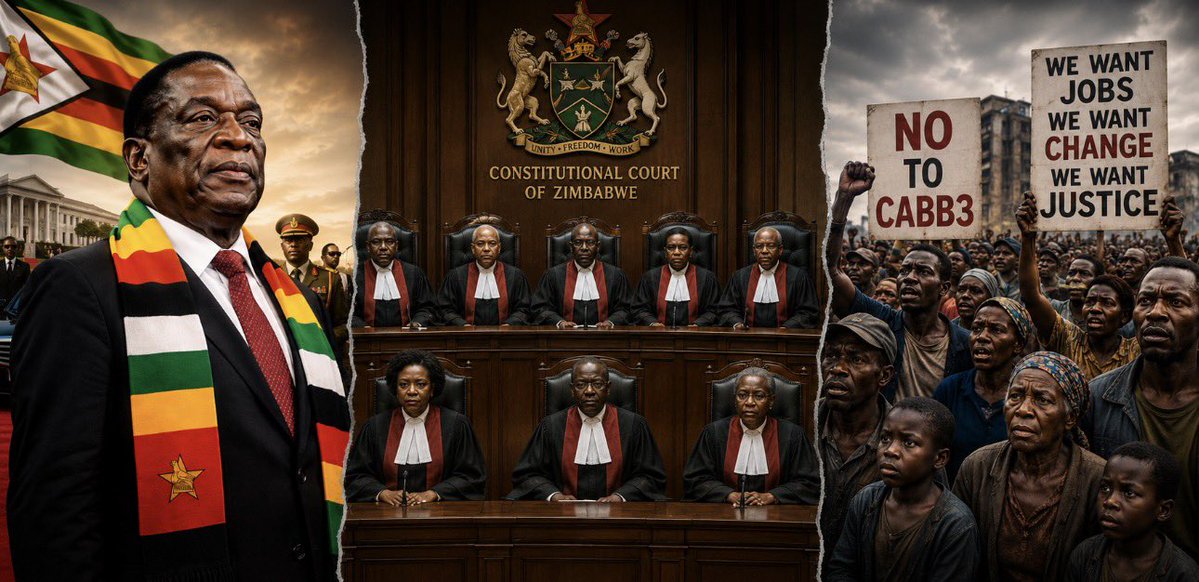
The Constitutional Court of Zimbabwe today reserved judgment in two cases challenging Constitutional Amendment Bill No. 3 during hearings held in Harare.
The judges focused heavily on the issue of timing, repeatedly asking the lawyer representing the litigants, Professor Lovemore Madhuku, whether the applications were not premature and whether it might be better to wait until the entire legislative process had been completed before approaching the court.
One of the judges, Justice Ben Hlatshwayo, suggested that some of the contentious issues could potentially be resolved through a referendum. The remarks appeared to signal that the bench may be more inclined towards allowing citizens to decide on the proposed constitutional changes through a referendum, rather than allowing the amendment to pass solely through Parliament without direct public approval.
However, the true position of the court will only become clear once the judges deliver their ruling. The matter was reserved to allow the bench time to consider the arguments presented by all parties before handing down judgment.