When budgets tighten, financing for the health of women, children and adolescents is too often among the first areas to be cut, when it should be among the most protected.
That message took centre stage at a high-level dialogue at the Africa Health ExCon, where leaders made the case that investing in women's, children's and adolescents' health is not a cost to be reduced, but a foundation for healthier societies, stronger economies and more resilient futures.
Convened by the GLN, @PMNCH and @AfricaCDC , the session brought together ministers, global health leaders, private sector and young people to explore how countries can move from fragmented financing towards integrated, sustainable investment models that deliver lasting impact.
From Egypt’s experience embedding RMNCAH into law and national budgets, to calls for stronger domestic financing, integrated primary health care and community-led solutions, one message was clear: the cost of inaction is far greater than the cost of investment.
Read the full story: https://t.co/94niMwyWJA
#WCAH #HealthFinancing #RMNCAH #PrimaryHealthCare #AfricaHealthExCon #DomesticFinancing
The launch of the Global #SRMNCAH Professional Association Partnership marks an important step toward stronger collaboration to advance maternal, newborn, child and adolescent survival.
Bringing together @world_midwives, @ICNurses, @FIGOHQ, @IPAWorldorg and @COINNurses, the Partnership aims to strengthen the health workforce, promote interprofessional collaboration and support country-led action.
With 260,000 women and 2.3 million newborns dying each year from preventable causes, sustained investment and coordinated action remain essential to accelerate progress beyond 2030.
Read more: https://t.co/br42tDv2Vt
PMNCH was delighted to meet with Ambassador @andafilip as she prepares to become the first woman and first Eastern European to lead the @IPUparliament.
We are thrilled to welcome Ambassador Filip to the PMNCH Board at a pivotal moment for advancing gender equality and women’s leadership.
In a time of growing global uncertainty, we reaffirmed a shared vision: harnessing the power of parliaments to turn commitments into action for women, children and adolescents, especially those most vulnerable and marginalized.
We thanked outgoing Secretary General @MartinChungong for his outstanding leadership and steadfast partnership over the past decade.
We look forward to building an even stronger IPU–PMNCH partnership to accelerate parliamentary action for the health, well-being and rights of women, children and adolescents in countries and communities worldwide.
@khosla_rajat, @FlaviaBustreo
🎙️ The new PMNCH Touchpoint episode is live
In this episode, @kchalkidou, Director of Health Financing and Economics at WHO, Prof. Justice Nonvignon, Technical Director for Health Economics and Financing, MSH and @khosla_rajat , Executive Director, PMNCH, discuss why investing in women’s and children’s health delivers some of the highest returns in global development.
Evidence shows that interventions such as skilled birth attendance and immunization can generate returns of up to 20:1 through lives saved, lower health costs, higher productivity and stronger human capital.
▶️ Watch the full episode today:
https://t.co/mS0xo3IC0Y
Pandemics expose the strengths and weaknesses of health systems. Yet 4.6 billion people still lack access to essential health services, leaving millions vulnerable to health emergencies and financial hardship when they need care most.
A new statement from the Coalition of Partnerships for #UHC and Global Health calls on world leaders to place Universal Health Coverage, primary health care and social participation at the centre of pandemic prevention, preparedness and response. Strong, equitable and resilient health systems are essential to protect health, build trust and strengthen preparedness.
As preparations continue for the 2026 UN High-Level Meeting on Pandemic Prevention, Preparedness and Response, governments and partners must invest in health systems that deliver for people in times of both crisis and calm, ensuring no one is left behind.
📖 Read the statement: https://t.co/fARIIg1QUn
@UHC2030
Today, on the International Day for the Elimination of Sexual Violence in Conflict, we recognize the devastating impact of conflict-related sexual violence on women, children and communities worldwide.
Protecting women, children and adolescents in humanitarian and conflict settings requires sustained investment, survivor-centered services, stronger accountability mechanisms and unwavering commitment to international humanitarian and human rights law.
Learn more: https://t.co/liGX1d0J70
Childhood onset heart disease affects millions of children worldwide, yet access to timely diagnosis, treatment and lifelong care remains out of reach for many.
Developed by the Global Coalition for Pediatric and Congenital Hearts, the new policy brief The Invisible Child calls for a #WHA Resolution on Childhood Onset Heart Disease Care to strengthen health systems, expand access to cardiac services and accelerate progress towards #UHC.
Read the policy brief here: https://t.co/7ecX8Ognjq
Midwives save lives. Yet the world faces a shortage of one million midwives, leaving millions of women and newborns without access to essential care when they need it most.
New evidence shows that investing in midwifery is one of the smartest investments governments can make. With the right training, support and working conditions, midwives can help avert up to 67% of maternal deaths, 64% of newborn deaths and 65% of stillbirths, while generating an estimated 16:1 return on investment.
The message is clear: investing in midwives is not only a health imperative, it is an investment in healthier families, stronger health systems and more prosperous societies.
📖 Read the full article: https://t.co/gNQ84hKzde
@world_midwives, @lwazimanzi, @ChikuselaS, @khosla_rajat, @HealthPolicyW, @GLN_Community, @PMNCH
🎙️ Tune in to the latest PMNCH Touchpoint conversation
In this episode, @khosla_rajat, Executive Director, PMNCH, discusses the increasingly difficult financing environment facing countries as they work to improve health and well-being outcomes for women, children and adolescents.
Global health financing is under growing strain. Development assistance for health is declining, fiscal space is constrained by debt and macroeconomic pressures, and households are shouldering a greater share of healthcare costs.
Rajat highlights that this is no longer simply a question of budgets. It is also a question of how countries can create and protect fiscal space to safeguard essential health services and continue investing in the health and well-being of their populations, particularly those most at risk of being left behind.
▶️ Watch the full episode today: https://t.co/mS0xo3IC0Y
The G7 Leaders' Declaration on mutually beneficial international partnerships reaffirms the importance of international cooperation, development finance and investment in human development. It also highlights the need for a more effective and impactful development architecture that responds to today's challenges.
Importantly, G7 leaders recognize that the empowerment of women and girls, and the full enjoyment of their human rights and fundamental freedoms, are key drivers of development and economic growth. This is an important entry point for discussions on global health architecture and sustainable financing.
📖 Read the full declaration: https://t.co/fTEZ9ZHM8D
#G7 #GlobalHealth #HealthFinancing
What does the appointment of H.E. Monica Geingos as PMNCH Board Chair mean for Namibia, Africa and the future of global health leadership?
As aid declines and health inequities deepen, her selection signals the growing role of African leadership in shaping global solutions and advancing accountability for women’s, children’s and adolescents’ health and well-being.
H.E. Monica Geingos brings a unique combination of experience across finance, governance, advocacy and development. Her appointment also represents an important milestone for women’s leadership in global governance and a powerful affirmation of Africa’s voice on the world stage.
Read this incisive analysis by Silas Mwaudasheni Nande to find out more: https://t.co/Y1VA0bJMGd
As G7 leaders gather in Évian this week, the stakes could not be higher.
Every two minutes, a woman dies from pregnancy or childbirth complications. In 2023 alone, 260,000 women died, alongside 4.8 million children under five and 1.9 million stillbirths. At the same time, shrinking global health financing threatens to reverse decades of progress.
Investing in women’s, children’s and adolescents’ health, and protecting sexual and reproductive health and rights (SRHR), is not only a moral imperative, it is one of the smartest investments governments can make, generating up to US$20 in returns for every US$1 invested.
We urge leaders to protect financing, defend SRHR, invest in adolescents, and prioritize the countries carrying the highest burden of preventable deaths.
Read PMNCH's full recommendations for the G7 and join us in calling for renewed leadership and investment in women’s, children’s and adolescents’ health: https://t.co/kP6YwY91YA
On the #DayoftheAfricanChild, we join partners across Africa in advancing the 2026 theme: ensuring universal access to water, sanitation and hygiene (#WASH) for every child.
The urgency is clear. In 2024, Sub-Saharan Africa accounted for 58% of all under-five deaths worldwide, while adolescent deaths (10–19 years) have increased by 14% since 1990. More than 190 million children across ten African countries remain exposed to unsafe water, inadequate sanitation and climate-related risks.
Investing in child-responsive health and WASH systems is essential to protect hard-won gains and help every child survive and thrive.
Learn more: https://t.co/tlAeVBExOh
📢 Approaches and Tools for the 2026 Voluntary National Reviews – a resource for use!
As 36 countries get ready to report on progress towards the Sustainable Development Goals (#SDGs) at the High-level Political Forum (#HLPF), this resource offers practical guidance for strengthening review processes, stakeholder engagement and evidence-based reporting to support countries preparing their 2026 Voluntary National Reviews (#VNRs). @PMNCH has shared resources to review progress towards #Women’s, #Children’s and #Adolescents’ Health.
📖 Explore the publication: https://t.co/ooYhzk6ql7
New research published by @TheLancet and @WHO is challenging decades of conventional maternity care and redefining how postpartum haemorrhage (#PPH), the world's leading direct cause of maternal death, is detected, treated and prevented.
The Lancet Series highlights the global scale of the problem, revealing how many women remain at risk and the significant social and economic costs associated with PPH.
Bringing together the latest global evidence, the Series argues that too many women are still dying from a condition that can often be prevented or successfully treated, and outlines a bold new vision for transforming maternal survival worldwide.
Explore the full series here:
https://t.co/LKBSw1BArJ
https://t.co/zzg3CychgN
https://t.co/xB9ewkXnAT
Looking for insights into how countries are shaping the future of women’s, children’s and adolescents’ health (WCAH)?
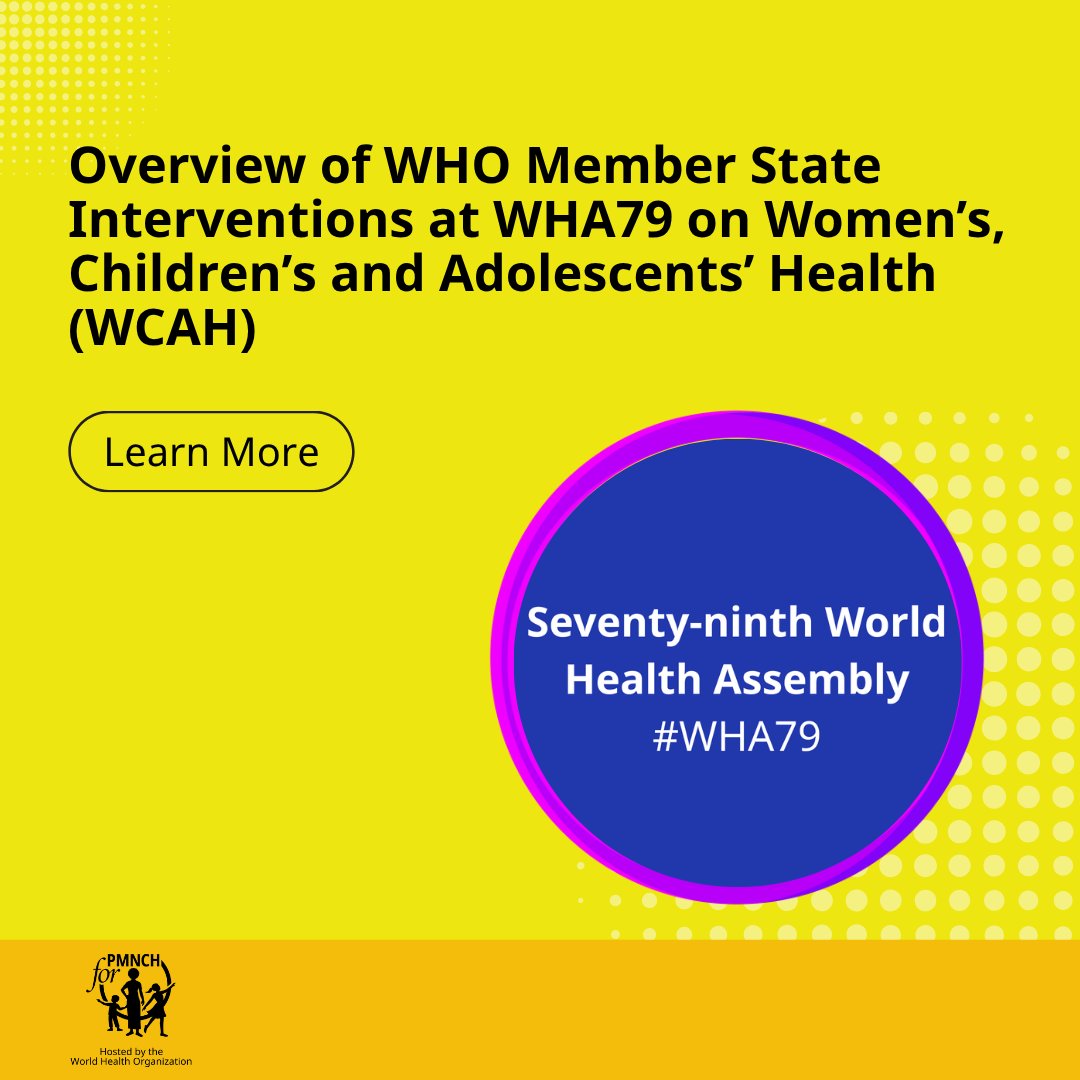
This new PMNCH resource analyses Member State interventions at WHA79, highlighting what countries said about global health architecture reform, health emergencies, financing and the policies needed to protect WCAH in an increasingly challenging global context.
Explore key themes, country positions and selected quotes from governments across regions, including members of the Global Leaders Network, and discover what these discussions could mean for WCAH advocacy.
Read the report here: https://t.co/vF4pCYUWEB
Global health architecture reform must deliver for those who need it most.
Health Ministers from Ethiopia, Liberia, Malawi, Senegal, Sierra Leone, South Africa, Tanzania, Somalia and Spain, through the Global Leaders Network (@GLN_Community ), are calling for women’s, children’s and adolescents’ health, including #SRHR, to be explicitly prioritized in ongoing reform efforts.
As aid declines and climate, conflict and economic pressures grow, protecting these services is essential for stronger, more equitable health systems.
📄 Read the full statement and join the call to put #WCAH at the centre of global health reform: https://t.co/kECqgl5ZZp
Global health architecture reform must deliver for those who need it most.
Health Ministers from Ethiopia, Liberia, Malawi, Senegal, Sierra Leone, South Africa, Tanzania, Somalia and Spain, through the Global Leaders Network (@GLN_Community ), are calling for women’s, children’s and adolescents’ health, including #SRHR, to be explicitly prioritized in ongoing reform efforts.
As aid declines and climate, conflict and economic pressures grow, protecting these services is essential for stronger, more equitable health systems.
📄 Read the full statement and join the call to put #WCAH at the centre of global health reform: https://t.co/kECqgl5ZZp
🔎 In a digital landscape increasingly shaped by misinformation, access to trusted health information matters more than ever. PMNCH FactCheck is a new platform dedicated to addressing misleading claims related to sexual and reproductive health and rights, maternal health, fertility and vaccines through expert review and evidence-based communication.
By combining scientific expertise with accessible information, PMNCH FactCheck aims to support advocates, programmers and policy-makers in protecting the health and rights of women, children and adolescents, while helping counter harmful narratives online.
Explore PMNCH’s FactCheck today: https://t.co/3ddurP5MBP
📢 As partners finalize advocacy efforts ahead of next week’s #G7 Leaders’ Summit, PMNCH has developed a short advocacy brief highlighting key recommendations to protect and advance investments in women’s, children’s and adolescents’ health and sexual and reproductive health and rights (#SRHR).
At a time of growing funding constraints, the brief calls on G7 leaders to safeguard financing, defend SRHR, invest in adolescents, and prioritize countries facing the highest burden of maternal and child mortality.
We hope this resource supports coordinated advocacy efforts in the lead-up to the Summit.
📄 Read the advocacy brief: https://t.co/kP6YwY91YA