With @Arm's expertise, our Chain on Chip tech will be the blockchain inside everything.
No onboarding needed, just quietly working away to improve your quality of life in the most unexpected ways.
What is Trackium? 🧵
Trackium is a decentralized IoT & logistics security layer.
We secure real-world movement, not just data -
by turning physical movement into verifiable blockchain proof.
Hey everyone!
Big news from @Minima_Global – they just smashed their crowdfunding target on Republic Europe!
They were aiming for £350,000… and they’ve already raised over £536,000 with more than 14 days still to go! That’s more than £120k extra – wow!
This shows how much people believe in what they’re building. Minima is creating a super lightweight blockchain that runs directly on phones, IoT devices, edge hardware, and even small gadgets.
No need for big powerful servers or heavy computers.
It’s designed for the real world – think decentralized networks for autonomous machines, AI agents, connected devices, and DePIN projects. Gasless, super secure, and ready for the future where everything is connected.
If you’re in Europe and want to support a cool project that’s pushing blockchain to the edge, there’s still time to join the raise.
Check it out here: https://t.co/cMLLGFA2pC
What do you think?
Is putting full blockchain nodes on everyday devices the next big step in Web3?
Drop your thoughts below! 👇
I invested in @Minima_Global because the thesis is architectural, not speculative.
The EU AI Act becomes enforceable for high-risk systems on August 2, 2026. Every autonomous machine operating in Europe (drones, industrial robots, medical devices, embedded AI) will need tamper-proof audit trails that regulators can independently verify.
The compliance infrastructure the market has built so far assumes a cloud server and a persistent internet connection. Most of the machines that need it most have neither.
Minima runs a full blockchain node in 300 megabytes, on a microprocessor, on the device itself. No gas fees. Quantum-resistant cryptography. The partnerships are not slideware. @Arm contributed security-rich IP to build the first blockchain-on-chip. @Siemens is distributing through automotive, robotics, energy and healthcare channels. @Fetch_ai has integrated the compliance layer into Agentverse for autonomous agents. @unisouthampton validated the architecture in live drone flight with a 500x performance gain.
The Minima market cap sits around 3.7 million dollars. A single enterprise AI compliance implementation costs more than that. I have looked at this from the regulatory side, the technical architecture, the partnership validation, and the market pricing. The asymmetry between what has been built and what has been priced in is the largest I have found in the infrastructure layer. This is not financial advice, but I am a buyer.
Minima is listed on @MEXC and @BitMartExchange and @XTexchange
We’re not getting quantum ready. We already are.
Minima runs on WOTS + SHA3, no elliptic curve exposure. No hard fork dependency.
Most chains are planning upgrades.
We’re built to evolve.
If you want to understand why that matters 👇
https://t.co/A6OTJkTvmT
Thanks for the coverage!
Blockchain-on-Chip, pioneered by Minima, embeds blockchain directly into hardware so machines can securely record and verify their actions.
The blockchain black box is just the first application.
Most blockchains scale by reducing decentralisation.
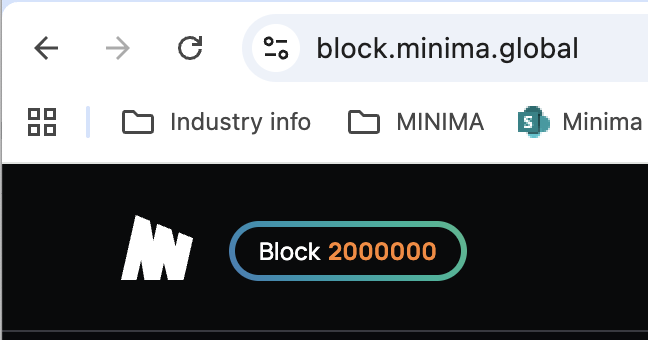
The Minima network just passed 2,000,000 blocks produced with:
1. Zero downtime
2. No centralised validators
3. Every user running a full node
Radically different design. Completely decentralised outcome 🔥
Technology only becomes powerful when people understand it.
Not when they speculate on it.
Not when they hear about it.
But when they can learn it, question it, and build with it.
One of the biggest gaps in Web3 today isn’t innovation.
It’s education.
Many talented young developers in places like Lagos, Nairobi, or Accra are curious about blockchain.
They want to build.
They want to contribute.
But the barrier often isn’t intelligence.
It’s access to clear, structured learning.
Documentation that assumes prior knowledge.
Tutorials that skip foundational steps.
Communities that feel closed instead of welcoming.
Education determines who participates.
And participation determines who benefits.
That’s why educational resources matter more than marketing campaigns.
@Minima_Global approaches this differently by making its architecture lightweight and accessible — meaning developers don’t need expensive hardware to experiment or run a node.
When your phone can run the network,
learning becomes practical.
Instead of reading about decentralization,
you experience it.
Instead of watching from the sidelines,
you participate.
Strong educational ecosystems do three important things:
➤ They lower the technical barrier to entry
➤ They encourage experimentation without heavy capital
➤ They create communities that grow through understanding, not hype
This is how real ecosystems expand.
Not through noise.
Through knowledge.
In emerging economies especially, accessible education in blockchain technology can reshape opportunity.
When developers can learn without needing elite infrastructure,
innovation becomes local.
And when innovation becomes local,
value stays local.
That’s the long-term power of education-driven ecosystems like @Minima_Global.
Not just users.
Builders.
Because sustainable networks aren’t built by audiences.
They’re built by informed participants.
This week, the spotlight 🔦 on Minima has noticeably grown.
Industry voices and tech publications 🛠(like Siemens and The Engineering) are increasingly discussing its work on blockchain embedded directly into hardware, including collaborations involving Arm and the University of Southampton
It is a reflection of the value already being built and the potential still ahead.
Let’s look at it through the Minima Success Framework 👇🏾
The event gaining attention is the "Blockchain-on-Chip" system demonstrated in drones.
Flight data was recorded directly onto a tamper proof blockchain ledger, creating a verifiable “black box” for machines.
This opened the door to a future where machines produce and verify their own data autonomously. 📝
The Minima Success Framework explains how that kind of technology adoption could translate into long-term network value.
The idea is simple:
Technology adoption → Network participation → Economic activity
Such that as machines run nodes, they are active participants in the network.
Instead of a few validators or data centres, the network now expands across phones, IoT sensors, vehicles, and industrial machines.
Every device running a node contributes to network activity and decentralization.
This is where value begins to form.
As machines interact autonomously, entirely new economic layers emerge:
• verifiable data markets
• automated service coordination
• device-driven commerce
A common concern is whether private or permissioned deployments reduce token demand.
The Success Framework assumes a hybrid model.
Even private systems often rely on a public trust layer for things like:
• data anchoring
• auditability
• cross-organization verification
• neutral settlement.
Companies may run internal systems, but regulators, partners, or insurers may still require publicly verifiable proof of activity.
Anchoring those proofs to the public network creates external trust and network interaction.
Minima is targeting and building an infrastructure, not just applications.
As blockchain is embedded directly into chips used by machines, the protocol becomes part of the hardware layer of the digital economy and it changes the scale entirely, taking note that machines generate far more interactions than humans do.
Sensors, vehicles, robots, and energy systems can produce continuous streams of verifiable events.
Multiply that by millions of devices.
This makes the core thesis of the Minima Success Framework:
If machines need a decentralized coordination layer, the network providing that layer becomes valuable infrastructure and is afoundation for machine driven economies, not just a platform for apps.
For investors, it’s also worth noting that the technology is developed by Minima Global, while the MINIMA token powers the decentralized network.
Public participation typically happens through the token ecosystem rather than direct equity in the company.
So, the growing attention this week matters.
It signals that more engineers, researchers, and industry players are beginning to explore embedded blockchain systems for machines and as that shift accelerates, networks designed for this future, like Minima, are critical infrastructure for the success of machine economy.
A World First: a drone with a blockchain black box.
Working with the @unisouthampton, and supported by @Arm and @Siemens, we demonstrated autonomous flight data recorded directly to a tamper-resistant ledger.
A major milestone for Blockchain-on-Chip, now at Technology Readiness Level 6.
From drones to satellites, machines will be able to prove what they did independently.
🏝️🚢✈️🛰️
🎥 Documentary:
Huge credit to the brilliant team at @unisouthampton 👏
Taking Blockchain-on-Chip from concept to a live drone demo is no small feat.
This “blockchain black box” milestone moves the project to TRL 6 - system/subsystem model demonstrated in a relevant environment.
Proper engineering. Real-world validation. 🚀
#CT check out the DEX, Stablecoin & Blockchain on Chip vision that $MINIMA brings to life
The recording for yesterday's February Community Call is now available on Youtube (https://t.co/xS9Qn53X63)
Leave a like and let us know what you thought of the discussion in the comments !
Great to be partnering with @relayaisolana and bringing Integritas to the RelAI Marketplace.
RelAI’s focus on trusted, verifiable AI marketplaces makes it a natural home for Integritas. By hashing data at the edge and anchoring it on-chain in real time, Integritas provides immutable, timestamped proof of AI data provenance and integrity.
Delivered via a standard API, this enables auditable, verifiable AI workflows - from dataset ingestion to training and inference.
Provenance you can verify. Integrity you can prove. 🔐🤝
Our recording of this weeks Dev Call is now up on Youtube !
https://t.co/ODFmpoAyqq
Leave a like and let us know what you think in the comments section 🗨️
One of the hardest things for teams to do in crypto is to stop performing and start communicating like a serious technology company.
@Minima_Global recently dropped a blog that I think is worth reading. Not because it’s “bullish”, but because it’s a rare example of a team choosing clarity over theatre.
'From Roadmaps to Results.'
For a long time, crypto has trained us to expect dates.
Milestones. Timelines. Countdown clocks.
The problem is: roadmaps often end up optimised for narrative, not outcomes.
Minima are basically saying: we’re done doing that.
Not “we’re going quiet”.
More like:
We’re going to communicate like a serious technology company, where progress is measured by evidence, execution, trade-offs, and learning… not by whether a PDF timeline survived contact with reality.
I think that matters more than people realise.
Because as the space matures, there’s a growing gap between two mindsets:
The mindset that needs constant catalysts and short-term signals
And the mindset that understands infrastructure takes years, and the only real proof is shipping
Minima are drawing a line in the sand:
🔸Not shaping strategy around short-term price action
🔸Not reacting to speculative narratives
🔸Not debating everything through the lens of near-term market movement
Whether you like that or not, it’s coherent. And coherence is rare.
What I also like is the precision of how they frame themselves now:
Minima isn’t trying to be “a Web3 company with enterprise ambitions.”
They’re positioning as a technology company solving real infrastructure problems, that uses a blockchain only where a blockchain is actually the right tool.
That’s an important shift in language:
Blockchain isn’t the product.
Speculation isn’t the strategy.
The product is embedded trust, distributed verification, and infrastructure that still functions where centralised systems fail.
And rather than pretending the future is predictable, they lay out themes they’re focused on:
🔸Proving $Minima at the hardware layer
🔸Strengthening the on-chain economic stack (mxUSD, DEX, maturing interfaces like MiniMask)
🔸Earning trust through proof, not claims
🔸Building a smaller but aligned pioneer base
No hype. No deadlines. No “soon™”.
Just a pretty clear statement of intent:
🔸Durability over applause
🔸Infrastructure over cycles
🔸Outcomes over optics
If you’re building (or investing) with a long-term lens, this is the kind of comms you should want more of in the space.
Bravo, Minima, Bravo!
You can read the full blog article here: https://t.co/dvwbiRGP6x
Q4 wasn’t about promises.
It was about delivery.
As we close the quarter, here’s what the Minima team shipped, and why it matters for what comes next 🧵