There are so many ways to make money in crypto besides just trading coins:
• airdrop/yield farming
• funding rate arbitrage
• prediction market arbitrage
• hackathons (if you're a dev)
• join underfarmed trading competitions
• find prediction market inefficiencies
• stablecoin peg arbitrage
• market making
• yield trading
• mining
My advice to anyone still trying to become profitable:
Experiment with as many different strategies as possible until you discover what you’re truly good at.
There’s something for everyone in this space. You just have to find your edge.
🚨 The AI ROI numbers are starting to look very ugly.
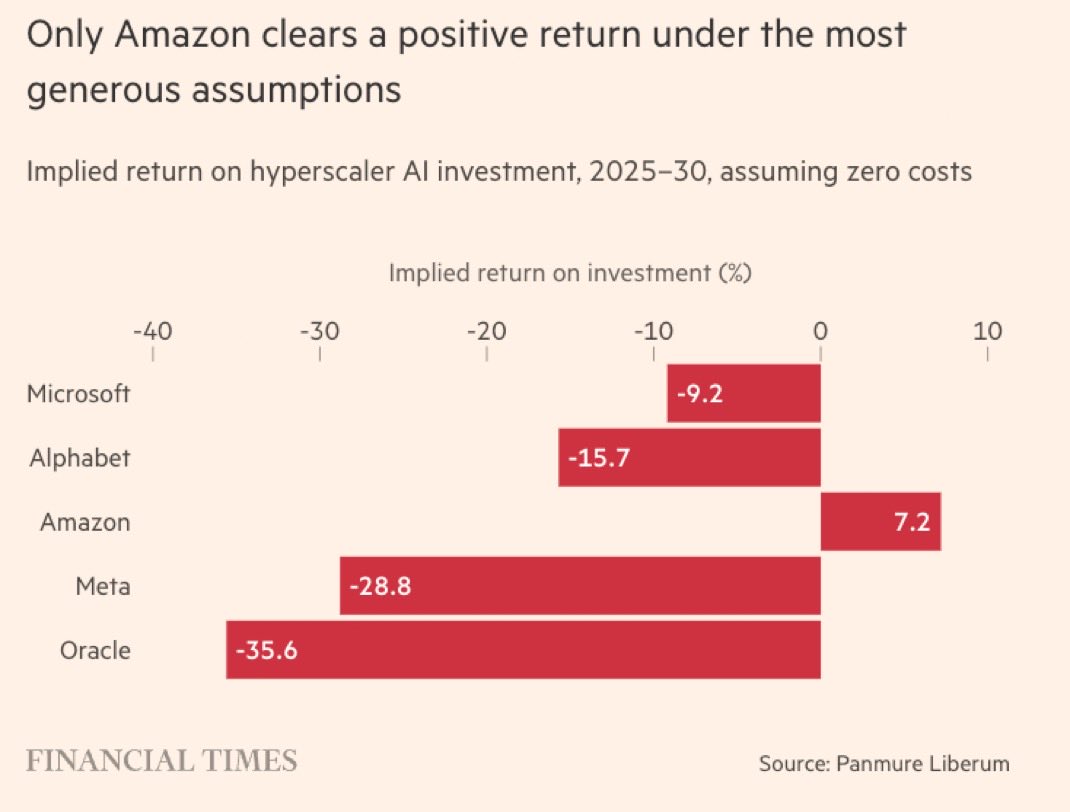
Even under "best case" assumptions — assuming zero costs, just revenue against capex — the Financial Times calculated the implied return on hyperscaler AI investment from 2025 to 2030.
Only one of them clears positive.
Implied return on AI investment (FT / Panmure Liberum)
– Microsoft: -9.2%
– Alphabet: -15.7%
– Amazon: +7.2%
– Meta: -28.8%
– Oracle: -35.6%
And remember: that's assuming zero costs. In reality, GPUs depreciate, power bills run, salaries get paid.
The real returns are worse.
This is exactly why the dot-com comparison keeps coming up. Incredible technology does not automatically mean sustainable economics. The internet survived. Most internet companies didn't.
Two anecdotes from this week alone
Vivek Garipalli, Fortune 20 insider: a CEO asked for $1B in AI-driven opex savings this year. The team spent $200M on tokens chasing it. The results? Modest customer service savings and slightly less hiring in engineering. The CEO has now ordered token costs to be dramatically slashed because the ROI isn't there.
Axios: an AI consultant reported a single client spent half a billion dollars in one month after forgetting to put usage limits on Claude licenses for employees.
Right now hyperscalers are spending trillions hoping future demand catches up to present capex.
That's not certainty. That's a leveraged bet.
The technology is real. The infrastructure buildout is real. The eventual winners will be real.
But "AI is transformative" and "every hyperscaler will earn its capex back" are two completely different statements.
In 2000, the internet was real too.
Cisco has recovered.
After 26 years…
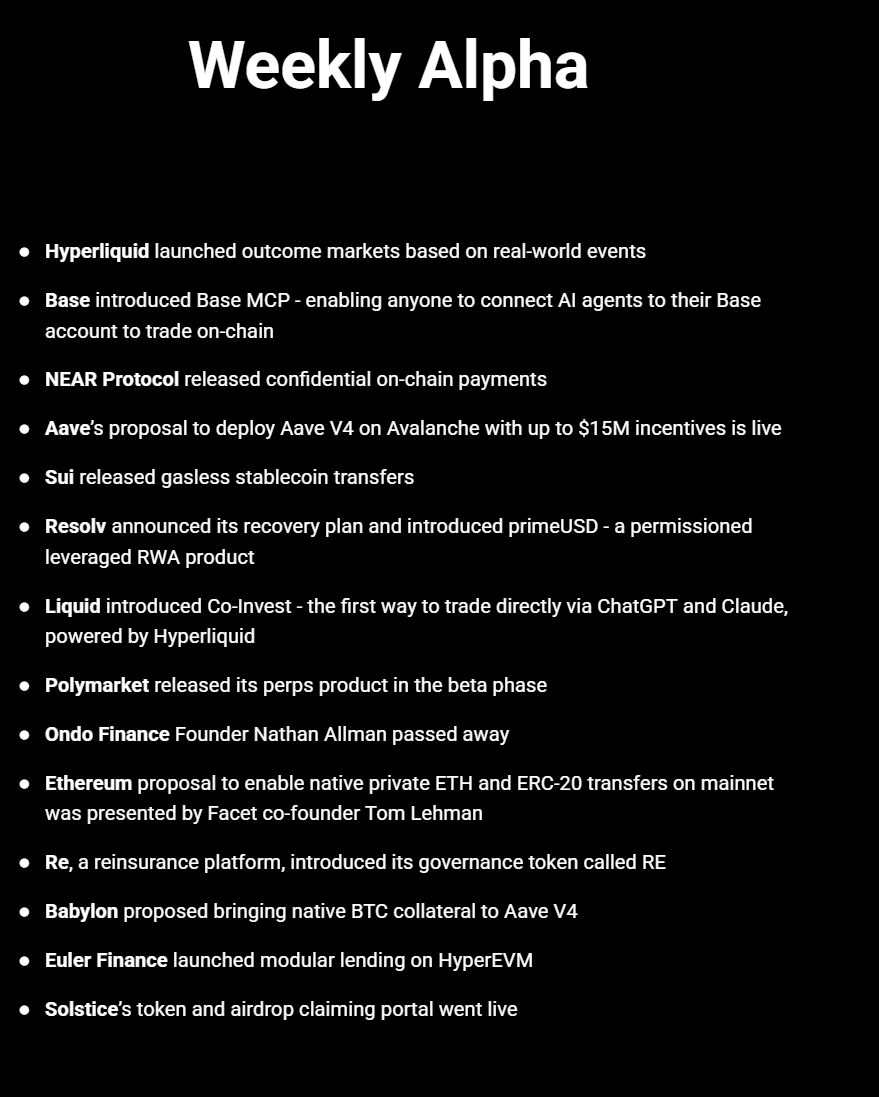
The latest developments in DeFi👇
Hyperliquid launched outcome markets based on real-world events
Base introduced Base MCP - enabling anyone to connect AI agents to their Base account to trade on-chain
NEAR Protocol released confidential on-chain payments
Aave’s proposal to deploy Aave V4 on Avalanche with up to $15M incentives is live
Sui released gasless stablecoin transfers
Resolv announced its recovery plan and introduced primeUSD - a permissioned leveraged RWA product
Liquid introduced Co-Invest - the first way to trade directly via ChatGPT and Claude, powered by Hyperliquid
Ethereum proposal to enable native private ETH and ERC-20 transfers on mainnet was presented by Facet co-founder Tom Lehman
Polymarket released its perps product in the beta phase
Ondo Finance Founder Nathan Allman passed away
Re, a reinsurance platform, introduced its governance token called RE
Babylon proposed bringing native BTC collateral to Aave V4
Euler Finance launched modular lending on HyperEVM
Solstice’s token and airdrop claiming portal went live
I hope you found this recap helpful🫡
I've been farming DeFi yield for 3+ years.
Here are the tools I use every day to make my life easier:
• Yieldz io - Great for finding high APY loops across Aave, Morpho, and Fluid
• Pharos watch - I use it to set stablecoin depeg alerts on Telegram
• Debank com - My go-to DeFi portfolio tracker for EVM blockchains
• Jup ag/portfolio - Most comprehensive DeFi portfolio tracker for Solana
• Bendbasis com - amazing tool for funding rate arbitrage - I recommend it if you want to farm perps DEXs
There are a few other tools I like as well, but those are the ones I use the most.
Pharos is the most underrated one in my opinion. Check it out if you haven't yet.
It's a good idea to set depeg alerts for the stablecoins you hold to make sure you are able to react quickly if one of them gets exploited/suffers a loss.
Consider following me if you like yield farming related content🤝
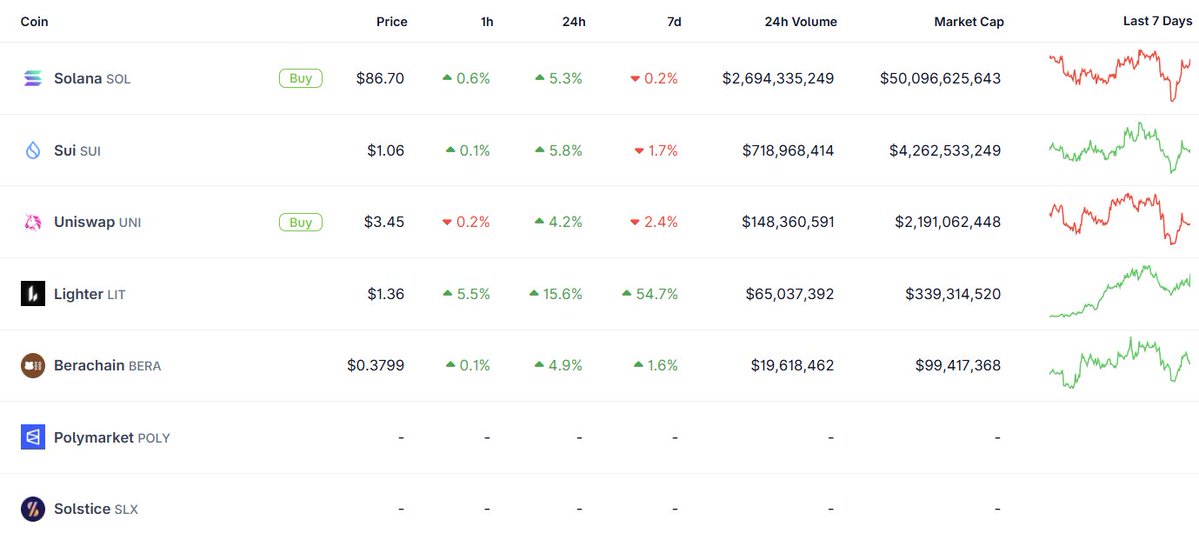
Crypto Watchlist for the week ahead:
$LIT vs Variational - A debate between Lighter and Variational on order books vs RFQ DEXs will happen next week
$SUI - Sui confirmed it will launch private transactions very soon
$UNI - Voting for Uniswap's proposal to expand protocol fees to more chains starts on May 24
$SOL - Solana's monthly ecosystem call is scheduled for May 28
$BERA - Berachain will release a big upgrade for its Proof of Liquidity incentive mechanism on testnet on May 26
Polymarket - Polymarket will launch taker rebates for up to 50% of fees next week and parlays in the near future
$SLX - Solstice will launch its token and airdrop claiming portal on May 25
If you enjoyed reading this, a like and a repost would be appreciated🫡
The largest investor on the planet is Norway's sovereign wealth fund. It owns roughly 1.5% of every listed company in the world.
The strategy?
DCA and chill.
Oil revenue gets deposited into a globally diversified portfolio of stocks and bonds. No market timing. No stock picking. No clever rotation. Just systematic buying for thirty years.
Since inception in 1998-2024:
• Inflows after costs: +4.8 trillion NOK
• Investment returns: +9.8 trillion NOK
• Currency effect: +3.1 trillion NOK
The country that could afford the most expensive financial advice in the world chose the cheapest version of it.
The smartest thing you can do with your money is often the simplest thing nobody is trying to sell you.
Elon Musks erste Frau beschrieb einmal, wie es ist, ihn scheitern zu sehen.
Sie sagte, dass er nicht so reagiert, wie normale Menschen reagieren. Wenn eine Rakete explodiert, schweigen die meisten Menschen im Raum. Einige weinen. Einige beginnen, den finanziellen Schaden zu berechnen.
Musk zieht sein Telefon heraus und beginnt zu telefonieren. Keine emotionalen Anrufe. Ingenieursanrufe. "Was ist gescheitert? Wann können wir es reparieren? Wann ist der nächste Start?" Seine Stimme ändert sich nicht. Sein Gesicht ändert sich nicht. Die Rakete, die gerade 60 Millionen Dollar gekostet hat, liegt bereits in der Vergangenheit. Der nächste Start ist alles, was existiert.
Sie sagte, es sei das Beunruhigendste, was sie je erlebt habe. Nicht, weil er kalt ist. Weil er wirklich nicht betroffen war. Der Fehler wurde nicht als Fehler registriert. Er wurde als Daten registriert. Ein Experiment, das Ergebnisse hervorbrachte. Ergebnisse, die das nächste Experiment beeinflussen.
Deshalb gewinnt er. Nicht, weil er nicht versagt. Er scheitert spektakulärer als jeder andere in der Geschichte. Er gewinnt, weil das Scheitern keinen psychologischen Raum einnimmt.
Die meisten Menschen verlieren nicht, weil sie scheitern, sondern weil sie Wochen damit verbringen, das Scheitern zu verarbeiten, bevor sie wieder handeln. Musk verbringt null Sekunden. Die Lücke zwischen dem Scheitern und dem nächsten Versuch ist ein Anruf.