🙏Pray for America🙏
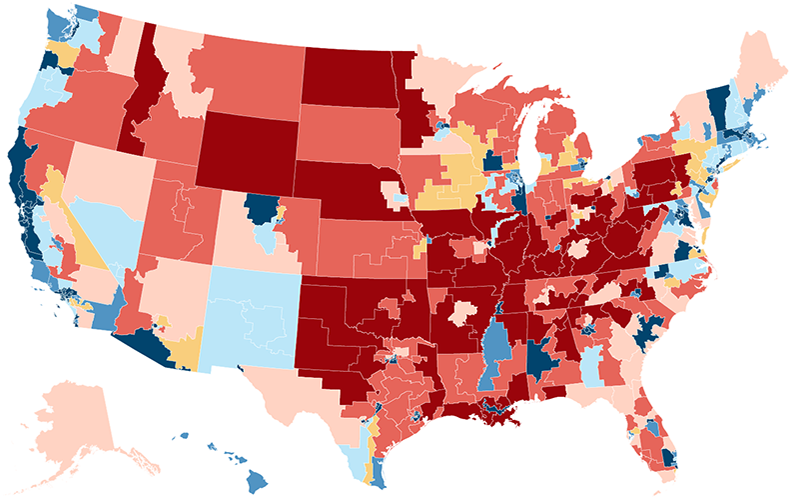
Many people predicted a “blue wave” in last week’s midterm elections. What we saw was more dramatic than even a blue tsunami. Democrats took the House and Senate, flipping several Republican strongholds including both Carolinas, Kansas, and Texas.
In the weeks and months to come, Americans will continue to analyze Republicans’ historic defeat, especially as the nation enters the early stages of the 2028 presidential election process. Let us pray that we have eyes to understand this outcome with clarity.
President Trump has had an undeniably historic impact on American politics and especially the Republican Party, but his era is coming to a close. What will happen when Trump leaves office for the last time? Will we see a continued rightward shift toward populism, or a resurgence of conservatism at the helm of the GOP?
It’s time to pray for our leaders, for the future of the conservative movement, and the future of our nation.
Please pray the following prayer along with us:
Dear God,
Your Word tells us to pray for our leaders. Today, we pray for every person elected to a position of public service last week. Guide them with divine wisdom, motivating them to stand up for what is right and defend their constituents’ Constitutional rights.
Help us remember that You are in control and that our hope lies in You—even if we are disappointed in the results of a particular election.
One political era in American politics is ending. Show us the way we should go in the future and raise up leaders to steer the nation in the direction You have for America.
Reinvigorate Your people to continue advocating for families, for the unborn, for freedom, and every issue that intersects with our Constitutional rights.
Help me to apply biblical values in the way that I vote, react to election results, interact with political opponents, and advocate for policies I believe in.
In Jesus’ Name,
Amen.
Thank you for praying today. Prayer is the most powerful thing we can do in any situation. Please share this prayer with others in your community.
#prayforamerica
Are we living in a "Fourth Turning"?
The term was coined by William Strauss and Neil Howe who wrote the bestselling book, "The Fourth Turning: An American Prophecy." They argued that history could be understood as coming in turnings, which have cycles of four. Each cycle spans a length longer than human life, roughly 80 to 100 years. That unit of time was what the ancients called the saeculum. These four turnings of the saeculum comprise the historical rhythm of growth, maturation, entropy, and destruction. The authors predicted that political, economic, and social upheavals would rattle the United States in and around the 2020s.
Three years ago, Neil Howe wrote The Fourth Turning Is Here. The title tells it all. We are in crisis as illustrated by a government that does not seem to function, low public trust in just about any institution, political polarization, moral and legal chaos, and a collapse of families. He reminds us of the Abraham Lincoln quote that “a house divided against itself cannot stand” and that the government “will become all one thing, or all the other.”
In his book, he reminds us of the other fourth turning crises in America. That would be World War II, the Civil War, and the American Revolution. Perhaps you can see why some social commentators argue that we are living in the fourth turning. We see a crisis in government and the economy. We see moral and social chaos.
I think what we need more than anything is a true revival and a biblical reformation.
Do you think we're living in a "Fourth Turning"?
One year after the assassination of Charlie Kirk, Kerby Anderson welcomes Christy Edwards, a close friend of Charlie, to remember his life and legacy. Christy shares Charlie Kirk, in His Own Words, a memorial photobook featuring Charlie’s words, photographs, and reflections from those who knew him. Together, they look back on his faith, convictions, and lasting impact.
Go listen to this amazing episode! Live now on most platforms - link in bio!
#charliekirk #faithandculture #highlights #pointofview
Happy Veterans Day!
Take a moment. And thank God for the courageous Americans who have answered the call for freedom and served our country.
Today, we remember their sacrifices for our nation. They’ve given up their personal comforts, time with their families, their safety, and sometimes even their lives for the cause of freedom.
If you are a veteran, or if someone you love has served our nation, we want to thank you. Because of these heroes, America remains a beacon of freedom to the world.
❤️🤍💙Thank you to all who served❤️🤍💙
-All of us at Point of View
The Issue of Debanking...
A new federal report has uncovered “irrefutable evidence that the nation’s banks have denied, debanked, and discriminated against” conservatives and certain businesses because of their political perspective. The 47-page report comes from the Office of the Comptroller of the Currency. The banks mentioned are JPMorgan Chase Bank, Bank of America, Citibank, Wells Fargo Bank, U.S. Bank, Capital One, PNC Bank, TD Bank, and BMO Bank.
For example, according to the report, Wells Fargo forced a payment processor to debank a religious nonprofit over its opposition to same-sex marriage, The bank also declined loans to firearms businesses. PNC apparently denied a line of credit to a media company after employees complained that the conservative owners had opinions “contrary to PNC’s beliefs/values.”
Apparently four of the largest banks I just mentioned also relied on the Southern Poverty Law Center in decisions affecting conservative and religious organizations.
This is not the first time I have talked about debanking in my commentary, and I suspect it won’t be my last. But I am encouraged by some of the comments this report has generated.
Jonathan Gould serves as the Comptroller of the Currency and noted that, “Americans should have access to financial services regardless of their beliefs, affiliations, or political views.” He added that the "Trump Administration is committed to ending the weaponization of finance against hardworking Americans, once and for all.”
House Oversight Committee Chairman, James Comer explained that “[n]o American should be locked out of the banking system for being conservative or Christian.”
It is time to end this practice of debanking.
Is America in a Jonah moment or a Nahum moment?
When Jonah preached to the city of Nineveh (the capital of the Assyrian empire), they repented. The king arose from his throne, removed his robe, and covered himself in sackcloth and sat in ashes (Jonah 3:6). He then sent out a decree to the people, and God spared the city from the impending disaster (Jonah 3:10).
That generation of Ninevites listened and turned from their sins toward the Lord. Following generations did the same until 150 years later when another generation of Ninevites refused to listen to the Word of God.
Nahum then pronounces a woe upon Nineveh. “Woe to the bloody city, all full of lies and plunder—no end to the prey! . . . Horsemen charging, flashing swords and glittering spears, hosts of slain, heaps of corpses dead bodies without end—they stumble over bodies!” This is the vivid description of the destruction that was to come to Nineveh in 612 B.C.
Is America in a Jonah moment? Or are we in a Nahum moment? The number of abortions has increased after Roe v. Wade was overturned. Families are in disarray. The country has been rocked with violence on many occasions.
Most of us recognize that if we as a people and a country continue to turn away from God, the problems in our society will grow worse. Are we ready to repent, or will we be like the people Paul talked about who were “holding to a form of godliness, although they have denied its power” (2 Timothy 3:5).
Where is America headed? The next few months and years will answer that question.
Rinkonomics and Socialism
The Democratic Socialists that were elected last week might learn a simple lesson from “Rinkonomics.” That was an article written many years ago by Daniel Klein. He used the idea of a skating rink to illustrate some important economic principles.
If we had never seen a roller rink or skating rink, we would assume that you would need lots of organization. Imagine a 100 people skating around. Wouldn’t you need smart leadership to keep skaters from injury? Of course, whenever you see a skating rink, you don’t see that at all. There are some reasons for that.
One important quality governing the possible collisions is “mutuality.” If I keep from colliding with you, you don’t collide with me. I promote my interest and your interest by avoiding a collision with you.
Another key concept is “coincidence of interest.” I don’t intend to promote your interest, but I end up doing so by promoting my own interest. Spontaneous order surfaces from seeking your self-interest.
John Stossen filmed a video of him using a bullhorn in which he would call out directions. His attempt to keep order made the circumstances worse.
Daniel Klein also points out that central planning gets harder the more complex the interactions. If you have 4 skaters, you could probably control all the actions with a bullhorn. But if you have 100 skaters, there is simply no way you could effectively and efficiently control all the actions.
There is a lesson here for socialists and central planners. The thousands and millions of interactions in a market economy are too difficult to predict. In fact, many of the government restrictions are like a foolish central planner trying to impose restrictions on 100 skaters. It ends up interfering with the spontaneous order that naturally surfaces in skating or the economy.
What do you think?
#rinkonomics #economicdebate
Concerns About Digital Currencies
For more than a year, the European Union and the European Central Bank have been developing a retail and wholesale Central Bank Digital Currency (CBDC) known as the digital euro. It has been promoted as a more efficient means of transacting commerce and settling accounts. Some even argue that it will provide billions of unbanked people with access to digital money.
One frequent concern of CBDCs is the lack of privacy and the possibility of using it for surveillance. This would allow central banks and the government to track and monitor every transaction. The government would know even more about you, your family, your clients, and your charities.
Another significant concern is the fact that CBDCs would make it easier for governments to freeze your financial resources. If the current government disagreed with your purchases, they would have the power to shut down your digital currency.
In fact, these CBDCs could be programmed to prohibit people from buying certain goods or at least place a limit on how much they might purchase. It might also have a limit that would require the digital money to be used before it expired. The expiration dates and the bans on specific purchases and the ability to freeze accounts could be used to punish or censor citizens.
A few years ago, President Joe Biden signed an executive order encouraging the Federal Reserve to study the feasibility of digital currency. When he took office, President Donald Trump signed an executive order that banned government agencies from taking any action to create or promote a CBDC.
Unfortunately, attempts to write this into law have not been successful. That is why we need to continue to evaluate what is being done by our government.
What do you think?
#digitalcurrency #cbdc #centralbankdigitalcurrency #digitalprivacy
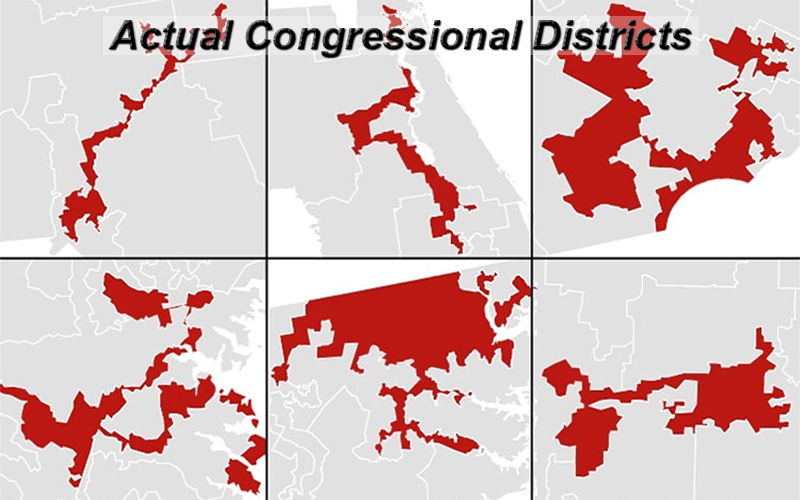
Although the election is in the rearview mirror, it is worth asking a question from this election that will affect the next election. Who should draw the lines for Congress? Supreme Court justices have differing opinions.
The editors of the Wall Street Journal begin with these two sentences. “Charles de Gaulle once said that he always had ‘a certain idea of France.’ Now we learn that from her prominent perch as a Supreme Court Justice, Elena Kagan has a certain idea of democracy.”
Her recent comments were about partisan gerrymanders. She disagrees with the majority that decided to take federal courts out of the business of policing state legislatures that draw congressional boundaries. She would like to put judges in charge of drawing maps.
She is correct that these partisan gerrymandered districts do reduce the number of competitive elections. It’s also true that they drive voters to the extremes. But I am not convinced that unelected federal judges will do a better job than state legislators who are accountable to the people.
As I have mentioned in previous commentaries, the idea of so-called independent commissions drawing lines isn’t any better. In California and New York, we saw that these two independent commissions eliminated several Republican seats.
And the solution isn’t always to create majority-minority districts. Justice Clarence Thomas wrote many years ago that putting a significant percentage of minority voters (Black or Hispanic) isn’t the solution. He argued that making both major parties compete for minority votes is healthier for democracy.
We may not like how the system works now, but it at least provides a remedy through electing or defeating state legislators who gerrymandered districts.
What do you think about gerrymandering? Share your thoughts in the comments.
#midtermelections #gerrymandering #districts
Faith was never meant to be passive!
Are fear, anxiety, or comparison keeping you from living out your faith with confidence? This week on Highlights, Liberty McArtor talks with author Megan Feveryear about her new devotional, "Reclaiming Boldness."
Through Scripture, reflection, and practical challenges, Megan encourages readers to simplify their faith, trust God more fully, and step into the life He has called them to live.
It's time to stop holding back and start living boldly!
#pointofview #highlights #christianliving #faithinaction #devotional
Is the American Dream still alive?
Now that the election is behind us, it is worth revisiting one of the major themes of the 2026 campaign. That was the issue of affordability. There is an accurate way to quantify what many voters felt.
Each year, writers at Investopedia do a calculation of the true cost to achieve the “American Dream.” This year they estimated that the “American Dream” now costs $5.3 million. They come to that conclusion by calculating the cost of eight milestones: owning a home, buying new cars, raising two children and sending them to college, retiring, paying for healthcare, having a wedding, owning pets, and taking a yearly vacation.
The original concept of the “American Dream” came from writer James Truslow Adams in his book, Epic of America. It was the fulfillment of a life that was “better and richer and fuller for everyone.”
If we assume that the writers at Investopedia have accurately calculated what amount is necessary to achieve the “American Dream,” we immediately crash into reality. They compare the $5.3 million figure to what most Americans might earn.
For example, a single wage-earner falls short. “A full-time worker with a bachelor’s degree earns a median of about $3.6 million from age 25 to 64.” That is based on a reasonable analysis of Census Bureau data. Even if we add Social Security retirement, that worker never reaches the necessary amount.
As I have mentioned in previous commentaries, Americans in our world today fall short because the value of the dollar diminishes. Thus, the cost of living goes up faster than any increase in wages and salaries. That is why the “American Dream” seems illusive today.
What do you think?
#americandream #economy #affordability