The next PM is excited to harness the energy of @garyseconomics’s mob.
This will mean the UK will become the next failed experiment on wealth taxes.
How can I be so sure that wealth taxes won’t work? Let me count the ways they will be a disaster…
- the UK is already the highest taxed place to be a top earner or wealthy. More taxes at the top will push more away than it collects.
- The engine room of the economy is digital assets that can based anywhere. The only wealth that will be taxed is old money fortunes tied up in real estate… the new fortunes will leave the anti-wealth UK.
- wealth is highly subjective. It’s never a clean number like income or an actual sale. Wealth is a forecast, a projection, a useful guess. Hence it can be litigated and debated - and it will. Wealth taxes tie up the courts.
- it’s not being introduced because it works, it’s being introduced because people are angry. Mostly they are angry at Elon, Jeff, Mark and Larry… all the American Billionaires who will be buying up deflated UK assets after wealth taxes set fire to their valuations. The mob wants blood that is out of reach.
- there’s not that much to tax. The UKs billionaires are already leaving. The total wealth held by billionaires in the UK is sub £700B (less than Elon’s wealth). There’’s only technically 150 of them remaining and most have already started to leave. I’d be amazed if the tax collects more than a few billion.
- this tax is going to end up destroying the middle class. Mark my words… when the rich leave the middle class have to cover the gap that they leave behind. One way that will happen is that they will use the wealth tax framework to tax nice family homes, mind sized businesses, decent sized pension pots. It will be a race to the bottom.
- Wealth taxes have been tried 15 times and tolled back 12. The only places that have wealth taxes don’t have IHT or CGT. Wealthy people pay less than they otherwise would have. It’s a wealth tax in name only. The UK has wealth taxes now in practice (School VAT, IHT, Stamp Duty,etc) but not in name.
Anyway, if it is the will of the people then so be it. I will be advising entrepreneurs to look elsewhere though - it simply doesn’t make sense to build something of value in a country that despises value creation.
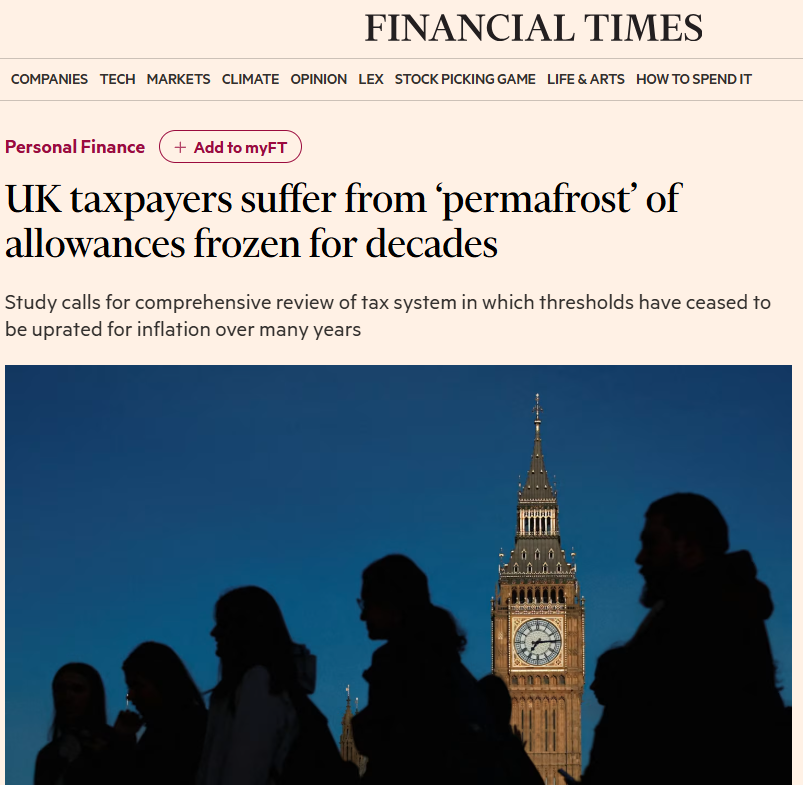
Tax allowances have been stuck in the permafrost, sometimes for decades, reports a study by the Association of Taxation Technicians
Absurdly the £3,000 annual gift exemption for inheritance tax purposes — hasn't changed since 1981. In today’s money it would be worth almost four times as much or £11,800
The inheritance tax threshold has been stuck at £325,000 for 17 years ago and is now frozen until 2031. If it had risen with inflation, it would be around £525,000, 60% more.
The rent-a-room scheme allowance has been frozen at £7,500 since 2016. It should be £10,500 today.
If the higher rate income tax threshold was not frozen at £50,270, it would reach £70,000 by 2030.
All these allowances and thresholds should be legislated with a built-in inflation adjuster such that they increase automatically in line with inflation each year.
US tax thresholds are raised automatically each year in line with inflation. That's a key reason why US thresholds are so much higher than British ones. You have to earn $640,600 in the US in order to pay the top income tax rate of 37%. In Britain, the figure is almost 10 times less. Here earn just $66,000 US dollars (£50,270) and you start paying a 40% tax rate.
Today, we share a breakthrough on the planar unit distance problem, a famous open question first posed by Paul Erdős in 1946.
For nearly 80 years, mathematicians believed the best possible solutions looked roughly like square grids.
An OpenAI model has now disproved that belief, discovering an entirely new family of constructions that performs better.
This marks the first time AI has autonomously solved a prominent open problem central to a field of mathematics.
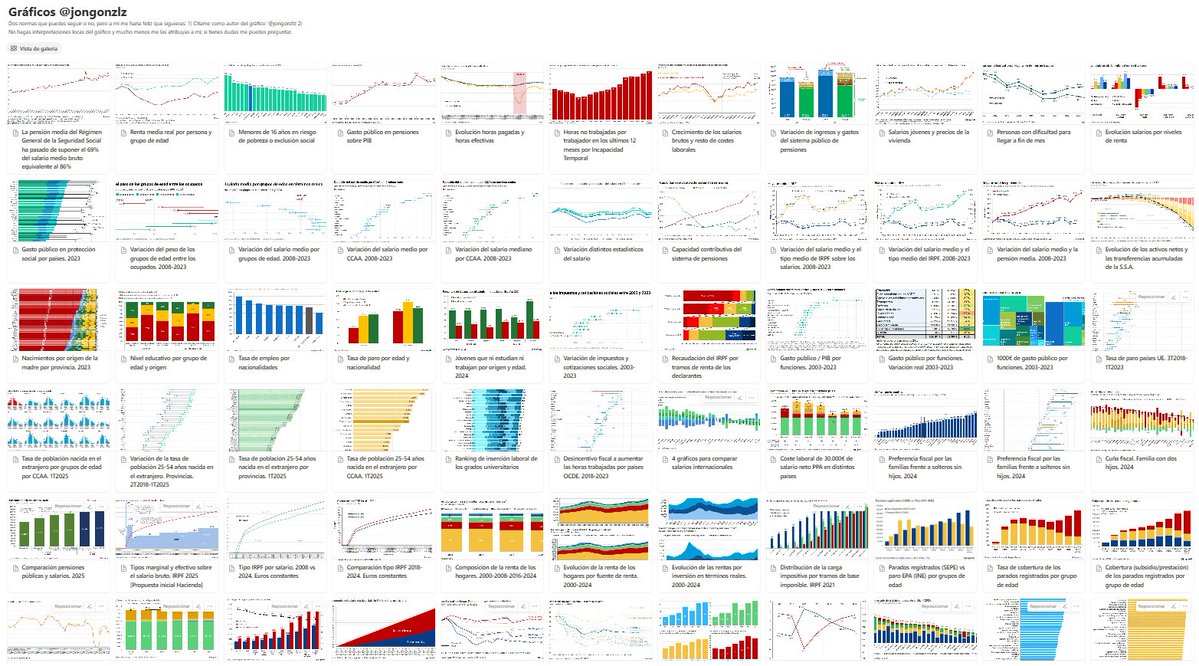
Este post de apoyo a @Jongonzlz está escrito y publicado conjuntamente con @lugaricano.
El sistema público de pensiones contributivas en España se encuentra en una situación muy complicada.
El sistema actual ofrece a los cotizantes una rentabilidad real implícita anual del 3,63 %. Dado el crecimiento de los cotizantes y de la productividad en España, esta tasa está al menos dos puntos porcentuales por encima de la que garantiza la sostenibilidad del sistema a largo plazo. De manera más sencilla: el valor presente descontado de las pensiones contributivas es aproximadamente un 60 % mayor que el valor presente descontado de las cotizaciones. Los jubilados contributivos en España están recibiendo mucho más de lo que pagaron.
Esta rentabilidad excesiva ha generado un problema fundamental: un déficit del sistema contributivo de unos 61.000 millones de euros (el de verdad, no el de las cuentas del Gran Capitán que incluyen las transferencias del Estado) y que no deja de crecer. Este déficit genera presiones sobre las cuentas públicas que limitan la capacidad de las administraciones públicas para implementar muchas políticas necesarias, desde la educación hasta la infraestructura. Y desde el punto de vista de la equidad intergeneracional, esta rentabilidad excesiva nos ha colocado en la paradójica situación de que las personas de 65 a 85 años tienen la renta disponible más alta de todos los grupos de edad en España.
El sistema necesita una reforma profunda. Por ejemplo, es clave reintroducir un factor de sostenibilidad en el valor de las pensiones que considere el crecimiento de los cotizantes, la productividad y la esperanza de vida. Muchas economías avanzadas han introducido estos factores e incluso España avanzó en esa dirección hasta la reforma Escrivá de 2021-2023.
Jon González, @Jongonzlz, de manera casi solitaria, ha acometido una labor impagable de documentar esta situación (y otros temas clave de nuestra economía), y ha conseguido poner a la sociedad frente al espejo de la insostenibilidad de la situación actual.
Desgraciadamente, el sistema político no tiene ninguna gana de enfrentarse a este problema. La edad mediana del votante español está en torno a los 51 años. Uno de cada tres electores tiene 60 años o más; uno de cada cuatro ha cumplido 65 años. Si se suman a los 15 millones de inactivos en edad de votar los casi 3 millones de empleados públicos, el resultado es que más de la mitad del censo electoral residente en España vive de una transferencia o de una nómina pagada con impuestos. La aritmética básica de cualquier elección en España descansa, por tanto, sobre un electorado en el que la minoría la constituyen los asalariados del sector privado en edad activa.
Pedir a un partido con vocación de gobierno que recorte la rentabilidad implícita de las pensiones contributivas es pedirle que confronte directamente a su votante mediano. Ningún sistema político hace eso voluntariamente y el español no es la excepción.
Por eso, en lugar de hablar de números, se busca descalificar al mensajero. Desafortunadamente, las narrativas maniqueas de buenos y malos—si eres bueno, prefieres pensiones altas; si no eres malo o estás a sueldo de los malos, tienen éxito en España porque nuestra conversación nacional se centra siempre en la “justicia” o la “moralidad” y nunca en los números.
Es normal: somos un país con poca tradición de análisis riguroso y, menos aún, de análisis basado en los números. “Mi abuela merece una pensión más alta” siempre es más fácil de explicar que “la rentabilidad real implícita del sistema está por encima de lo que nos podemos permitir”, y, además, le coloca a uno en el “lado bueno”: el de los que quieren dar más dinero, no menos, como los malvados economistas.
Pero lo realmente preocupante no es que se intente descalificar al mensajero en lugar de analizar sus argumentos. Lo que se busca es poner en riesgo su situación profesional. Ante las órdenes de la Moncloa, cualquier trabajo en España es precario. Nosotros mismos lo experimentamos en carne propia cuando, en 2012, se nos despidió de FEDEA, una fundación con la que colaborábamos, por orden directa y explícita de Moncloa.
Ya no es una cuestión de si uno está de acuerdo o no con Jon. Es algo mucho más importante. ¿Se puede analizar la realidad económica de España sin que las jaurías mediáticas busquen tu “cancelación” profesional?
Es este el momento de decir las cosas claras y mostrar nuestro apoyo absoluto y total a Jon. Por eso hemos tomado la decisión inusual de publicar este post simultáneamente.
Jon, te agradecemos profundamente lo que haces.
Introducing TurboQuant: Our new compression algorithm that reduces LLM key-value cache memory by at least 6x and delivers up to 8x speedup, all with zero accuracy loss, redefining AI efficiency. Read the blog to learn how it achieves these results: https://t.co/CDSQ8HpZoc
Every time this comes up, a bunch of people miss the point. Each one clearly values watching someone eat shit at >$100, and disvalues eating shit at <$100. This is two people with (utterly bizarre) preferences, getting gains from trade that they wouldn't have gotten were it not for dollars as an intermediary. They both *want* to trade eating shit for watching someone eat shit, but needed dollars to coordinate that positive-sum trade across time!
Had they come across the piles simultaneously, they could have negotiated eating simultaneously, but they can't. This is *the* huge advantage of money, as a universal IOU; it enables "virtual trades" between parties separated in time and space.
It's become very fashionable somehow to say that Margin Call is your favourite finance movie, but I can't forgive the fact that there isn't actually a margin call in the film.
On my way to Barcelona to receive a Doctor Honoris Causa from my alma mater, @la_UPC. Truly honored! 🎓
Join Thursday for my Master Class, "From AI to AGI: The Quest for True Intelligence." Hope to see you there! https://t.co/C9ffsqUiKZ
"Create an image at 41.4036° N, 2.1744° E, January 1st, 1983, 15:00 hours."
Wifi passwords should disappear everywhere (hotels, homes, airports, restaurants/coffee shops).
We probably waste over 100m person hours a year collectively typing in wifi passwords. Your phone should just auto-connect wherever you are, like cell towers.
And no, none of those dumb captive portals either (ads) - businesses should be shamed for using these.
Hotels don't charge you for electricity when you charge your phone - it's too cheap the meter. Wifi is now the same.
Stop treating wifi like some scarce resource that needs to be rationed. If people are treating your coffee shop like an office, and not buying anything, there must be some other solution.
La moda vuelve a estar de moda. Estaba mal usarla cuando se usaba desde el PSOE y Podemos antes de 2018 y continúa estando mal hoy, el estadístico descriptivo que menos aporta con diferencia.
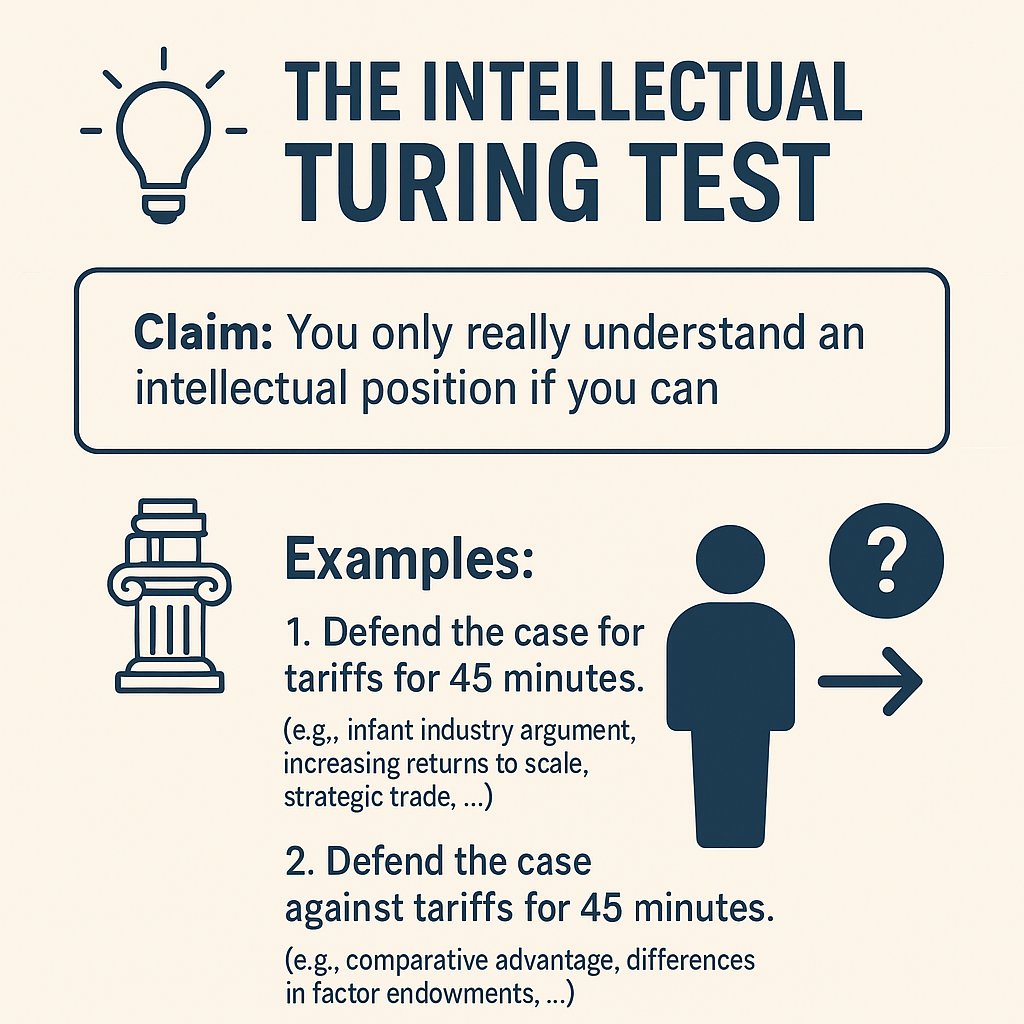
A few days ago, I emphasized the importance of the “intellectual Turing test.” It’s an old idea inspired by Turing’s original test for artificial intelligence.
Claim: You only truly understand an intellectual position if you can articulate and defend it so convincingly that a knowledgeable observer cannot tell whether you actually believe it.
Example: you pass the test if you can
1️⃣ Defend the case for tariffs for 45 minutes (e.g., the infant industry argument, increasing returns to scale, strategic trade, …), and
2️⃣ Defend the case against tariffs for 45 minutes (e.g., comparative advantage, differences in factor endowments, …),
and after 90 minutes, a world expert in international trade cannot tell which side of the debate you find more compelling.
That’s what I tried to do last week in my undergraduate lecture on global economic history, where we discussed whether tariffs were important for the catch-up process of countries like Germany and Japan.
Did I pass the intellectual Turing test? It would be presumptuous to say so—but I tried hard. I was encouraged when one student came to office hours and asked whether they should support or oppose tariffs, because my lecture had left them utterly confused. (My answer—that they should make up their own mind—was clearly unsatisfactory to them, too used to professors dictating what was the “correct belief” or, at least, the one they needed to state in the exam.)
The test matters deeply, and it should be the gold standard of undergraduate education, because:
1️⃣ It fosters intellectual humility and precision, and to undertake the due intellectual diligence.
2️⃣ It forces people to engage with ideas on their own terms, not in a cartoonish form.
Sadly, I’ve seen too many critics of various intellectual positions (including some I also criticize) constantly fail the intellectual Turing test.
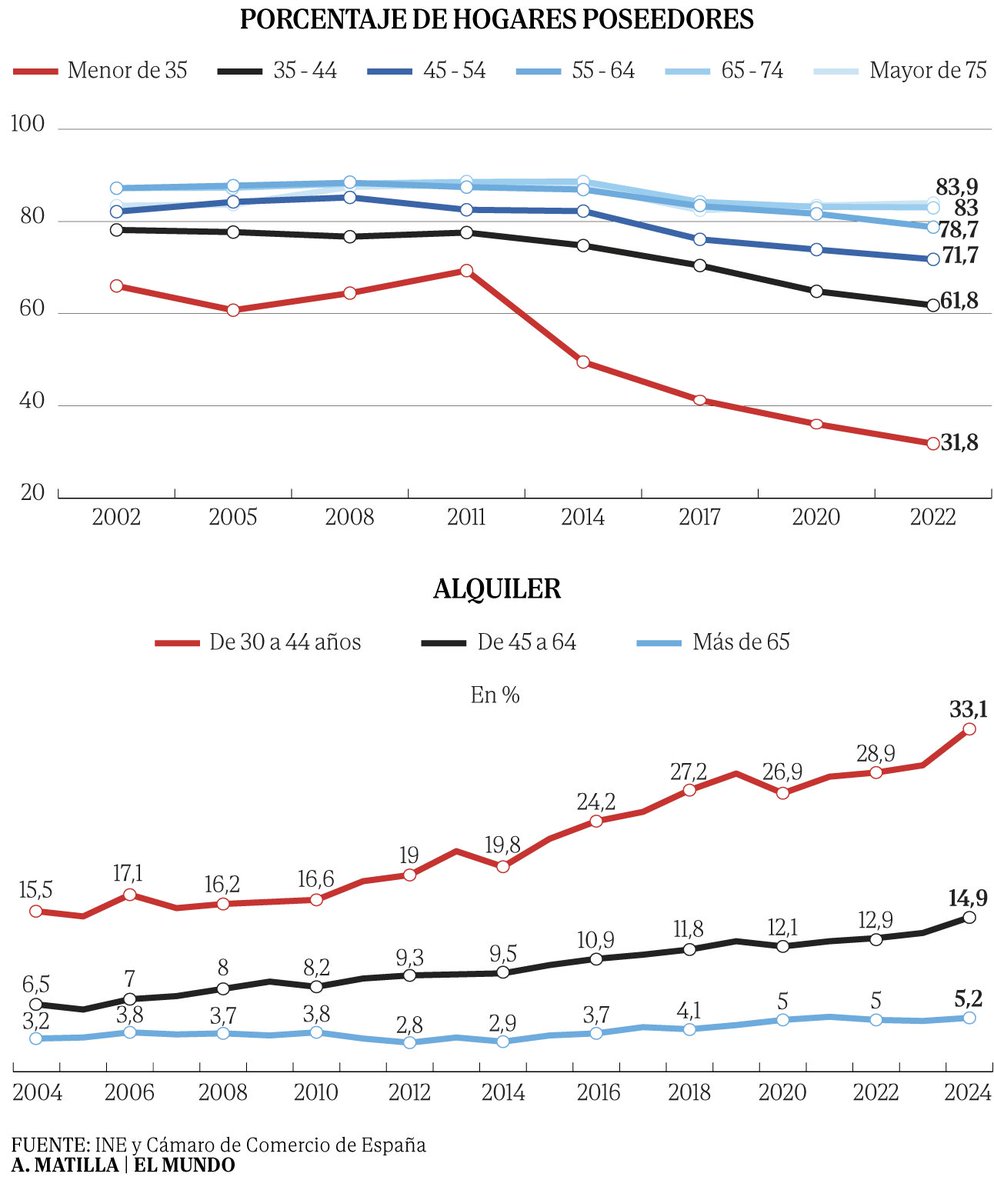
Esto no es algo que afecte exclusivamente a los más vulnerables. Esto es la destrucción de la clase media, la ruptura del ascensor social ligado a la estabilidad residencial. El fin de la vida buena ligada al trabajo duro.
Millones de personas con curro duradero y sueldos en la media condenados a ser mochileros en su país.
@comlaterra@llim0na El glitch aquí està en què OpenAI no té els $100bn que ha promès per contracte, però la borsa sembla assumir que trobarà d'on treure'ls.
@comlaterra@llim0na Realment això no és un money glitch per se i és com funciona la majoria de l'economia:
Al dematí el proprietari del bar li comprarà una barra de pa al forner per €1.40 i a la tarda el forner demanarà un cafè al bar per €1.40, creant un cicle econòmic del més normal.