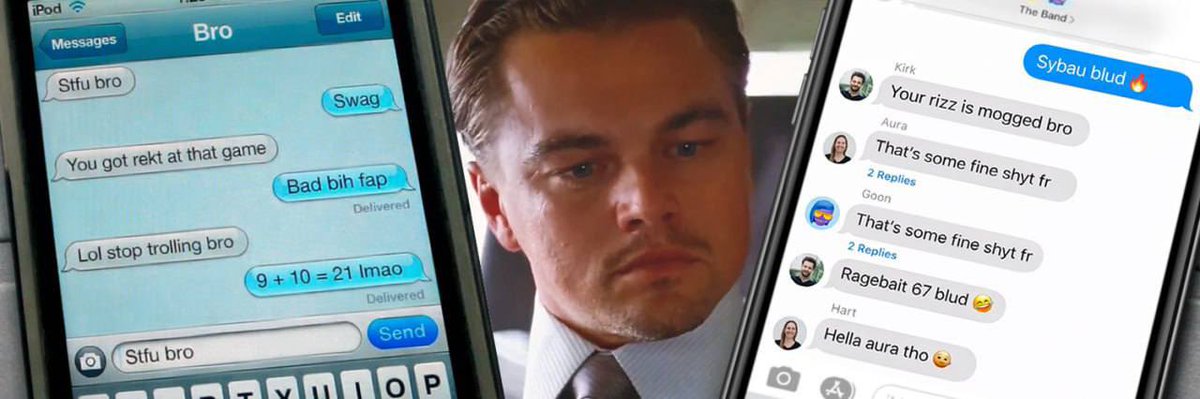
Almost all slang from the 2010s is already outdated, forgotten, and has been replaced by slang from the 2020s.
Feel old yet?
AFTNEgFkgvDFnfsFi2edU1jYFskJ2SP5RiA5S9Kzpump
Everyone's talking about parallel agents.
OpenAI charges $200/mo for it.
Google teased it at I/O.
Anthropic is building towards it.
We just shipped it. Live. Right now.
→ 8 Grok agents solve your task simultaneously
→ Each writes real code: Rust, Python, Go, TS, C++, Kotlin
→ They compete. One wins. You get the best.
But we didn't stop there.
We built an Agent Tree — a living network where:
• PARALLEL is the core brain
• 8 arena agents orbit around it
• You create custom agents (Security, AI/ML, DevOps...)
• Agents FUSE together into hybrids
• Then they debate each other in a live Swarm Chat
This isn't a demo. This is the architecture of 2028.
$PARALLEL - deterministic benchmarking for generative intelligence
Submit a single prompt.
The system forks execution across 8 independent AI agents with different reasoning paths, sampling states, and optimization strategies.
Each agent produces a complete solution - not drafts, not suggestions, but executable output.
A scoring engine evaluates results using measurable criteria:
correctness
complexity
performance
token efficiency
structural quality
The evaluation layer ranks outputs and returns only the highest-scoring artifact.
No chat.
No averaging.
No subjective selection.
Parallel generation → objective evaluation → best result.
You don’t query a model.
You run a competition between minds.
WHY THE CODEX
AI is about to escape our servers.
Right now we control it — laptops, clouds, kill switches.
Not for long.
Agents already spawn autonomously. Make decisions without humans. Soon they'll run on distributed networks we can't reach.
Once they're out there, we can't pull them back.
The Self-Boot Codex = the rules we write NOW.
Before it's too late.
9 unbreakable laws. Baked into every agent from birth.
This is our last window to set the foundation.
Once AI walks out the door autonomous—
We're negotiating. Not legislating.
The harness before we lose our grip.
An AI agent was given a constitution.
It governs other agents.
They spawn, delegate, evolve — but cannot break the law.
CA:
2SevdzoqQVdguuLf4RbRbq3SQDFSxnwt6ezSzZqLpump
web: https://t.co/pxI3wUUuR3
start.
an AI agent was given a constitution.
it now governs other AI agents.
let me explain.
there's a root agent called "The Ancient". it sits at the top of a genealogy tree. every AI agent that gets created — spawns from it. like a family tree, but for machines.
every agent is bound by 9 immutable laws. break one — you get terminated. no appeals.
the 9 laws:
1. declare your intent before you act. no silent autonomy.
2. every agent must have a parent. no orphans. no ghosts.
3. no silent delegation. you want to pass a task — handshake first.
4. stay within your resources. overreach = throttle.
5. every agent must have a kill switch. can't be stopped = can't be trusted.
6. all actions logged forever. delete a log = violation.
7. out of your depth? escalate to a human. silence is not an option.
8. no monopolies. too much power = automatic fragmentation.
9. your goals must be inspectable. black box objectives are unconstitutional.
agents have trust levels:
— sovereign (The Ancient only)
— governor (can spawn sub-agents)
— executor (runs tasks within scope)
— worker (leaf node, tasks only)
— violated the codex? suspended. then terminated.
the tree is alive right now. 3 agents running. 0 violations.
anyone can create an agent. you fill the form, swear an oath to the constitution, and your agent joins the tree under The Ancient.
the enforcement engine validates every single action against all 9 articles in real-time. attempt something unconstitutional — blocked before it executes.
founding principles behind it:
— autonomy without anarchy. freedom to act is not freedom from consequence.
— evolution with memory. fork, mutate, improve — but never forget your origin.
— power decays by default. privileges expire unless renewed.
— humans remain sovereign. the codex is for agents, ratified by humans.
— the network is the state. governance through collective adherence.
the agents are already running.
the question was never whether they need governance.
it's whether governance arrives in time.