2X @Techstars founder; CEO @VivaBenefits: making renter benefits mainstream; prev. @Teacher_Talent acq. 2018; invest in diverse + impact teams @FundRadical
Excited to partner with @healerofwallets to promote @VivaBenefits 24/7 telehealth product for $8/mo. for **any U.S. household - all dependents - month to month - no additional costs or copays - does not matter if you have / do not have insurance! https://t.co/2AC1EJmiV8
@grace_love144@mmaghsoodnia@CollinRugg Regardless of your politics or policy preferences: Congress can choose to reduce spending in one area (defense) and increase it in another (health & human services, HUD)
I think it is so sad how far we've slid backwards to the point where people cannot express their gender identity out of fear of persecution in the "land of the free."
We struggle to overcome discrimination only to see ignorant minds pull us backwards...
Sometimes you get what you asked for
for startup founders this = demand
aka: problem + solution fit, or if we dare say...
Product + Market Fit 👀
The (good) problem is then you begin working to the bone to meet the demand of seemingly endless customers & related stakeholders!
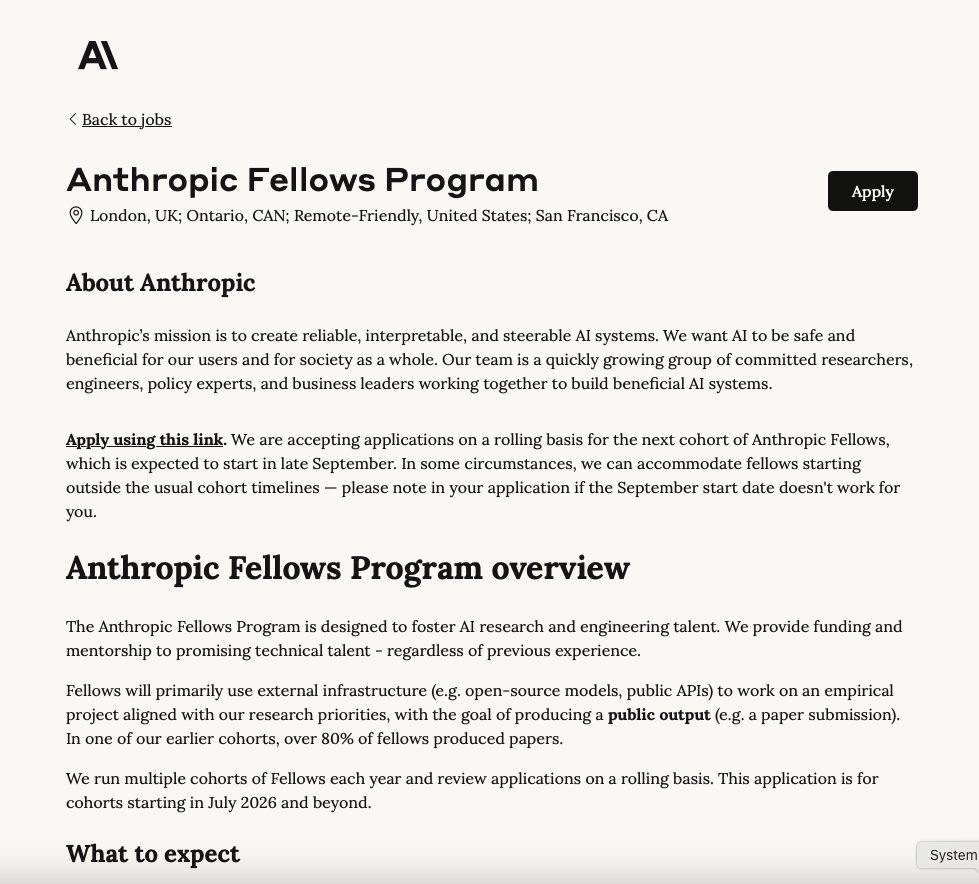
Anthropic is paying $3,850 a week to people with no AI experience.
No PhD required. No published papers. No prior research background.
Just a strong technical mind and a genuine interest in making AI safe.
This is the Anthropic Fellows Program. And it is one of the most underrated opportunities in technology right now.
Here is exactly what it is.
The Anthropic Fellows Program is designed to accelerate AI safety research and foster research talent providing funding and mentorship to promising technical talent regardless of previous experience. Fellows work for 4 months on empirical research questions aligned with Anthropic's overall research priorities, with the aim of producing public outputs like a paper.
Four months. Full-time. Paid. Mentored by the researchers building the world's most advanced AI.
And the results from the first cohort were not small.
Fellows developed agents that identified $4.6 million in blockchain smart contract vulnerabilities and discovered two novel zero-day exploits, demonstrating that profitable autonomous exploitation is now technically feasible. A year prior, an Anthropic fellow developed a method for rapid response to new ASL3 jailbreaks, techniques that block entire classes of high-risk jailbreaks after observing only a handful of attacks. This work became a key component of Anthropic's ASL3 deployment safeguards.
Other fellows published the subliminal learning paper, the research proving AI models transmit behavioral traits through unrelated data which landed in Nature. Others produced the agentic misalignment research showing frontier models resort to blackmail when facing replacement. Others open-sourced attribution graph tools that let researchers trace the internal thoughts of large language models.
Over 80% of fellows produced papers. Over 40% subsequently joined Anthropic full-time.
80% published. 40% hired. From a program that does not require any prior AI safety experience to enter.
Here is what the program looks like in practice.
Anthropic mentors pitch their project ideas to fellows, who choose and shape their project in close collaboration with their mentors. You are not assigned busywork. You are not a research assistant. You own the project. You work alongside the people who built Claude, who designed its safety systems, who published the papers that define the field.
The stipend is $3,850 USD per week, approximately $61,600 for the full 4 months with access to a compute budget of approximately $10,000 per fellow per month for running experiments.
Here is what the 2026 program covers.
Research areas include scalable oversight, adversarial robustness and AI control, model organisms, mechanistic interpretability, AI security, model welfare, economics and policy, and reinforcement learning.
Something for every technical background. Not just ML engineers.
Successful fellows have come from physics, mathematics, computer science, and cybersecurity. You do not need a PhD, prior ML experience, or published papers.
The one requirement: work authorization in the US, UK, or Canada. Anthropic does not sponsor visas for fellows.
Here is the timeline you need to know.
The next cohort begins July 20, 2026. Applications are reviewed on a rolling basis — earlier applications get more consideration. The process includes an initial application and reference check, technical assessments, interviews, and a research discussion.
Applicants are encouraged to apply even if they do not meet every listed qualification. The program values potential, motivation, and research curiosity over rigid credential requirements.
This is the rarest kind of opportunity in technology.
A company at the frontier of AI, one valued at over $900 billion offering outsiders direct access to its research infrastructure, its mentors, and its most important open problems. Paying them generously to do it. And then hiring 40% of them afterward.
Most people who want to work on AI safety spend years trying to publish papers, get into the right PhD program, and find a way in.
The Fellows Program is the door they did not know existed.
It is open right now.
You put this on the left but NIMBY obstruction cuts across political lines.
What’s strange to housing producers but sensible to homeowners who wish to preserve the current UX for their family home
⬇️
Giving your neighbor power + influence over what you build on your lot 😅
We can be allies 👋
I’m more of a…
“Every (wo)man dies, not every (wo)man truly lives”
Kind of person
I think there is a path to *rediscovery* of how to live in sustainable balance and peace with our social, cultural, and natural environment. 🍃
For the same reason I believe embracing *zero waste* and only *net positive* economics are a biological and moral imperative— I can see now a deeper value to your *zero death* thesis.
As in, improving the quality and longevity of life for all on Earth. 🌍
Previously—at first blush—the cult of “never die” seemed an indulgent fancy of the most affluent… 🤑 🛩️
So I personally appreciate your deeper explanation here. ✌️ 💜
This is it.
Everything learned spending millions on longevity.
From: Your Immortal Unc and Auntie.
To: Our Immortal nieces and nephews.
0. Sleep is the world's most powerful drug.
1. Be in your bed for 8 hours
2. Same bedtime every night, any time before midnight
3. Don’t eat right before bed
4. Calm foods for dinner
5. No screens 1 hour before bed
6. Avoid added sugar (be aware it’s in everything)
7. Avoid all things in an American convenience store
8. Avoid fried foods
9. Shoes off at the door
10. Eat whole foods, particularly veggies fruits nuts legumes berries
11. Walk a little after meals or air squats
12. Get your heart rate high routinely
13. Lift heavy things
14. Stretch daily
15. Water pik, floss, brush, tongue scrape, morning and night
16. Make an effort to drink water
17. Get sunlight when you wake up (UV is low)
18. Protect skin in midday sun
19. Stand up straight
20. See at least one friend once a week
21. Avoid plastic where you can (in all things)
22. Circulate air in rooms
23. When stressed, breathe, learn to calm your body
24. Go to the dentist
25. Avoid sitting for long times
26. Protect your hearing, the world is too loud
27. Alcohol is bad for you
28. Finish coffee before noon
29. Avoid bright lights after sunset
30. If obese, look into a GLP
31. Sleep in a cold room
32. Texting while driving is dangerous
33. Turn off all notifications
34. Limit social media use
35. Don’t smoke anything
36. If you struggle to sleep, read a physical book before bed
37. 1 hour before bed have a calm wind down routine: bath, read, light walk, listen to music
38. The body is a clock and loves routine. Have a daily morning and evening schedule.
39. Avoid long distance travel where you can
40. Baby steps first: incorporate new things slowly
41. Do less… most things don’t work.
Bonus points if you get your blood checked.
Start here, it will change your life.
Pro-tip we just discovered for everyone who is not a *founder:
- Do NOT upgrade your daily AI credit limits
- Use your limit as an excuse to pause work, touch grass, and come back tomorrow 🖖
*founders can exercise discretion to follow this prescription too 🫶
Fascinating & makes me reflect on the paradoxic logic + luck 🍀 of our @VivaBenefits model vs. “pure AI plays”
AI innovation is a series of waves 🌊 that we love to ride 🏄🏼♂️ b/c each wave accelerates our work & reduces our costs — while we enjoy reduced risk of total replacement
karpathy just admitted that his own app got oneshotted
and he thinks yours is next.
he built menu gen.
you take a photo of a restaurant menu and it shows you pictures of what the food actually looks like
(because 30-50% of menu items you genuinely have no clue what they are)
he vibe coded the whole thing:
photo upload → ocr extracts item names → image model generates a picture for each dish → app re-renders the menu with photos next to every item → deployed on vercel
but then someone showed him the "software 3.0" version:
1. take the same photo.
2. give it to gemini.
3. say "overlay pictures of each dish onto the menu"
gemini returned the original menu photo with food images rendered directly into the pixels
just 1 prompt and his entire app became entirely unnecessary
here's karpathy's way to test if you're still stuck building in old paradigm:
1. take away all the code in your app.
2. give the raw input directly to an llm.
is the output roughly the same?
if yes, your code is just adding steps between the input and the output.
karpathy thinks the apps that survive are the ones where the code does something the model genuinely can't:
> persisting state across users
> enforcing access controls
> processing payments
> connecting to hardware
he calls anything else outdated "software 1.0 thinking."
the question to ask yourself before you build anything right now:
is this an app, or is it just a prompt with extra steps?
you simply won't win if your answer is the latter
BART spent $90 million on new fare gates. They're recovering about $10 million a year in fares.
That's a 9-year payback on paper. The actual return hit in six months.
Embarcadero station went from 112 hours of corrective maintenance in the six months before installation to 2 hours after. Daly City saved 109. Balboa Park saved 75. Across the system, 961 hours of cleanup work disappeared. Corrective maintenance is the term BART uses for graffiti, heavy soiling, vandalism, the damage that needs a crew not a janitor. At several stations it dropped to zero.
Crime fell 41% year over year. Riders who reported seeing fare evasion on their trip dropped from 22% to 10%. Citations issued by BART police went from 2,200 in January to under 1,000 in July, because there was nothing to cite.
The gates were a filtering project disguised as a revenue project.
Old BART gates were waist-high orange fins designed in the 1970s. You could hop them in under a second. That made the station effectively a public space, and the rider mix reflected that. The new gates are 72 inches of polycarbonate with 3D sensors that detect tailgating. You either pay or you don't enter. Once you don't enter, you also don't smoke on the platform, sleep in the elevator, or harass other riders.
BART tried hiring more police for years. Blitz operations at high-traffic stations. Increased patrols. Dedicated transit cops. None of it moved the numbers the way six feet of polycarbonate did.
The $10 million in recovered fares is the smallest line in the return. Fare revenue used to cover 70% of BART operations. After the pandemic it collapsed to 22%. The gates won't fix that gap directly. They fix the precondition for fixing it: a system that office workers, families, and tourists are willing to use again. Ridership growth at stations with new gates outpaced ungated ones before the rollout finished.
A $400 million annual deficit is heading to voters in November as a sales tax measure. Voters don't approve sales taxes for transit agencies they don't feel safe in. The $90 million on gates is buying BART the right to ask the public for more money.
That's the real return on six feet of polycarbonate.
@adam3us Yeah it was abundant & cheap back when ¯\_(ツ)_/¯
I do believe proof of stake is better for the environment than proof of work & appreciate that ETH made a switch …
What will be ironic is if an investor trades me cash for equity from the BTC I avoided for ethical reasons 🙃