About tariffs 1/3:
54% on Chinese Goods, 25% on Foreign Cars – Yesterday, Trump Announced Unprecedented Tariffs, and Almost Immediately Most Analysts Rushed to Call It a Catastrophe for Global Trade.
But what if we look at the situation from a different angle? What if standard economic models fail to adapt to fundamental changes in the global economy?
Let’s dig deeper: what if behind the noise of the trade war lies something more serious – processes that will change the rules of the game for investors for years to come? While many are panicking and selling shares of companies with foreign suppliers, are we overlooking new opportunities that are not visible at first glance?
Deglobalization – Catastrophe or the New Normal?
Traditional economic thinking usually considers any tariffs as purely negative. But the question arises: are we living in an era where previous economic models are starting to fail? At the very least, it’s worth considering that the last 40 years of globalization have led to unprecedented production outsourcing from developed countries, creating extremely complex international supply chains and significant dependence on foreign markets.
However, the COVID-19 pandemic vividly demonstrated the vulnerability of such systems. The semiconductor crisis of 2021, when car manufacturers halted production lines due to a lack of chips worth just a few dollars, clearly showed the true cost of global optimization.
What Might Be Behind the Tariff Policy?
Perhaps the less obvious aspect of the new tariffs is not just protecting American manufacturers but an attempt to launch a massive reindustrialization process? Pay attention to Trump’s statement: “If you want 0% tariffs – manufacture in the USA.” Could this be more of a signal of a potential fundamental shift in the economic paradigm rather than just a political slogan?
Why Such Precision? The Mystery of Differentiated Tariffs
Did you notice the striking specificity and diversity of tariff rates? China – 34%, Vietnam – 46%, Cambodia – 49%, EU – 20%. What lies behind these precise numbers? Why not round figures like 30% or 50%?
Even more intriguing is Trump’s extraordinary confidence in making such radical statements: “This will give us growth like you’ve never seen,” “it has already started,” “trillions and trillions of dollars to pay off the national debt.” These statements sound as if they are based not just on political rhetoric but something more fundamental.
Could it be that the U.S. government is currently using advanced modeling systems or even artificial intelligence to develop economic strategy? Such precise, unconventional tariff rates could be the result of complex economic models considering thousands of variables – from import and export structures to unemployment levels in specific U.S. regions.
What if these tariffs are not a spontaneous decision but part of a carefully calculated strategy to pull the U.S. out of a $35 trillion debt spiral? A combination of reindustrialization, tariff protection, and tax reforms could well represent a comprehensive plan developed using advanced analytical tools.
Just unlocked my Gas ID via ETHGas 🪪
I'm a Kiddo Jack with 0.2664 ETH spent on gas since Beacon Chain - now fueling my climb to the Gasless Future and earned 75 Beans already.
Reveal yours at https://t.co/bxDAk0ggu9
3/3:
What Should an Investor Think About Right Now?
https://t.co/bQ9MyIRgHt much can we trust obvious, superficial forecasts? Economic mainstream thinking often lags behind fundamental changes.
2.Which companies have the real ability to localize production? Perhaps this capability will become a key competitive advantage under new conditions.
3.Where to find unique technological solutions that will help companies maintain competitiveness when manufacturing in the U.S., where manual labor costs are significantly higher?
https://t.co/UQnbuBVqlx to think systematically? Tariffs do not exist in a vacuum – they are likely part of a broader economic strategy involving tax reforms, energy policy, and changes in immigration rules.
2/3
The Unlikely Beneficiaries of the Tariff Revolution
Contrary to superficial analysis, the main beneficiaries may not be traditional American manufacturers but:
1.Industrial Automation Companies – Relocating production to the U.S. with high labor costs is possible only with maximum automation. Rockwell Automation, ABB, and Siemens might see unprecedented order growth.
2.Industrial Robot Manufacturers – Demand for robotic solutions will sharply increase as it becomes the only way to achieve competitive production in the U.S.
3.Regional U.S. Banks – Financing the construction of new plants and factories will create massive demand for loans, especially in regions with developed infrastructure and affordable electricity.
https://t.co/UTaEYGFhu5 Companies – Reindustrialization will require enormous energy capacities, boosting demand for all types of energy generation, especially natural gas and renewables.
5.Logistics Companies Focused on the U.S. Domestic Market – Restructuring supply chains will lead to increased domestic freight.
Hidden Risks Most People Overlook
At the same time, there are non-obvious risks that standard analysis misses:
1.Risk of Technological Backwardness – Isolation from global innovations could slow down the technological development of American companies in the long run.
2.Second-Order Inflationary Consequences – Besides the direct rise in the cost of imported goods, transitioning to local production will increase labor demand, leading to higher wages and service inflation.
3.Risk of Fragmenting the Global Financial System – Trade confrontation may accelerate dedollarization and the formation of alternative financial systems, posing long-term risks to the dollar’s dominance.
Is It Worth Considering an Investment Strategy Opposite to the Mainstream?
It’s worth pondering: while most investors focus on the obvious consequences of tariffs, perhaps a more productive alternative strategy could include:
1.Investing in Second-Tier Companies – Not in large corporations but in their suppliers and contractors involved in building new production capacities.
2.Focusing on Construction Materials – Cement, steel, aluminum – everything necessary for industrial construction might show accelerated growth.
3.Investing in Energy Efficiency Technologies – With high labor and energy costs in the U.S., only energy-efficient solutions will maintain competitiveness.
4.Considering Investments in U.S. Regions with Low Taxes and Cheap Electricity – These are likely locations for new production facilities.
5.Identifying Companies with High Automation Potential – Those whose products have high added value and low dependence on manual labor will relocate production to the U.S. faster.
A Historical Lesson Everyone Forgot
Interestingly, in his speech, Trump mentioned the period before 1913 when “the U.S. relied on tariffs and was much richer.” Most economists sharply criticized this statement, pointing out that the sharp tariff increase in 1930 (Smoot-Hawley Act) only worsened the Great Depression. But there’s a rational grain in this statement.
From 1870 to 1913, the U.S. pursued an active protectionist policy, protecting emerging industries. It was during this period that America made an industrial breakthrough and became a global industrial leader. The key difference from the Smoot-Hawley period (1930) was that protectionism then was combined with massive investments in infrastructure and industry, not just protecting existing production.
To illustrate just how nonsensically these tariffs were calculated, take the example of Lesotho, one of the poorest countries in Africa with just $2.4 billion in annual GDP, which is being struck with a 50% tariff rate under the Trump plan, the highest rate among all countries on the list.
Why? Does Lesotho apply extortionate tariffs on U.S. products and the U.S. is merely being "reciprocal" here? Not at all, despite what Trump is saying, it's NOT the way these tariffs are defined.
As a matter of fact Lesotho, as a member of the Southern African Customs Union (SACU), applies the common external tariff structure established by this regional trade bloc.
Which means it applies the same tariffs on U.S. products as South Africa does, as well as the 3 other members of the bloc: Namibia, Eswatini and Botswana.
So since the tariffs charged by these 5 countries on U.S. products are exactly the same, they must all be struck with a 50% tariff rate by the U.S., right? Not at all: South Africa is getting 30%, Namibia 21%, Botswana 37% and Eswatini just 10%, the lowest rate possible among all countries.
So what gives? Again, the way these tariffs are calculated has absolutely zero relationship with actual tariffs imposed by these countries on U.S. products. Instead, they appear to be simply derived from trade deficit calculations.
Looking at Lesotho specifically, every year the U.S. imports approximately $236 million in goods from Lesotho (primarily diamonds, textiles and apparel) while exporting only about $7 million worth of goods to Lesotho (https://t.co/uHvem6nH2o).
Why do they export so little? Again this is an extremely poor country where 56.2% of the population lives with less than $3.65 a day (https://t.co/GEho8xFjAp), i.e. $1,300 a year. They simply can't afford U.S. products, no-one is going to buy an iPhone or a Tesla on that sort of income...
The way the tariffs are ACTUALLY calculated appears to be based on a simplistic and economically senseless formula: you take the trade deficit the U.S. has with a country, divide it by that country's exports to the U.S and declare this - falsely - "the tariff they charge on the U.S."
And then as Trump did in his speech last night, you magnanimously declare that you'll only "reciprocate" by charging half that "tariff" on them.
As such, for Lesotho, the calculation goes like this: ($236M - $7M)/$235M = 97%. That's the "tariff" Lesotho is deemed to charge this U.S. and half of that, i.e. roughly 50% is what the U.S. "reciprocates" with.
It's extremely easy to see why this makes no sense at all.
First of all, there's nothing Lesotho can do about it: they can't change tariffs they allegedly charge the U.S. to reduce the tariff rate the U.S. "reciprocates" with because, again, it's NOT based on any tariff that they charge.
Similarly they can't do much about reducing the trade deficit they have with the U.S. because, again, they simply don't have enough money to buy U.S. products.
Also the main rational Trump gave for the tariffs is to get production back to the U.S., to "bring manufacturing back". 47.3% of Lesotho's exports are diamonds: how do you bring the "manufacturing" of that "back to the U.S."? Anyone can see it makes just about zero sense.
The Lesotho example exposes the fundamental economic incoherence of these tariffs. Rather than addressing actual trade barriers, they punish countries based on trade deficits that arise from structural economic realities. All the more countries like Lesotho which pose zero competitive threat to American industry.
Worse yet, these tariffs will likely make these structural realities even worse: the U.S. is Lesotho's second most important export destination so it's a fair bet that applying 50% tariffs on their products will make people in Lesotho even poorer, and therefore even LESS able to afford U.S. products.
But perhaps the most unfair and detrimental aspect of all this is that these tariffs represent a complete reversal of longstanding U.S. development policy, and therefore a betrayal of countries - like Lesotho - who chose to follow U.S. advice in the past.
For decades the U.S. has used preferential trade access to encourage economic development in the world's poorest nations, recognizing that trade, not just aid, could get them out of poverty and ultimately put them in a position where they too could afford iPhones or Tesla.
They're now effectively penalizing countries for following previous U.S. policy, a lesson which I bet they won't forget anytime soon.
So all in all the irony is painful: in the name of fighting unfair trade, America has just demonstrated what truly unfair trade looks like.
This isn't something designed to address genuine trade issues, but simply a mechanism based on arbitrary math to punish countries for the affront of selling more to the United States than they buy.
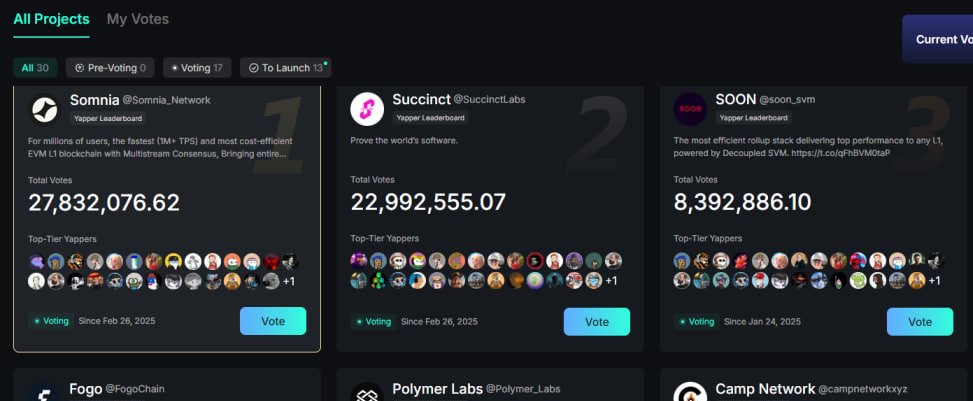
Yo, big shoutout to the @Somnia_Network
squad—leading the @KaitoAI vote like champs so far! Not over the finish line yet, but this has us buzzing with hope and hype. Seriously, don’t sleep on this gem, fam—it’s screaming potential.
Somnia’s an EVM-compatible L1, built for metaverse scaling, clocking 400k TPS—fast as lightning and cheap as hell. No investment rounds, but they’ve bagged $270M for ecosystem vibes from Improbable and MSquared, in which such funds as :a16z, Mirana, SoftBank, and others invested.Keep grinding, Somnia—we’re rooting for ya!
BE A SOMNIAC LOVER💎👀
Your thoughts are interesting, what do you think?
AI Agents: Crypto & Family Edition
1/3 Thinking about AI agents today got me wondering... As a crypto enthusiast and a family man, wouldn't it be awesome to have AI agents not just for crypto, but also for help around the house? #AI #Crypto #Family
2/3 Imagine this: You're home alone with your son, and you have no idea what to cook for him. A special AI agent could come to the rescue with delicious and healthy meal ideas! #AIforParents #HomeAssistant #Cooking
3/3 Or what if you need some fun ideas for family time, like cool experiments to do together? A family-focused AI agent could be your go-to source for inspiration! ✨ #FamilyFun #AIforKids #Experiments
Gundotfun - any coin, any chain
@gundotfun is an intent-centric DeFi protocol developed by Intensity Labs, incubated by Binance Labs and backed by Polychain Capital @polychain & DAO5 @daofive as lead investors.
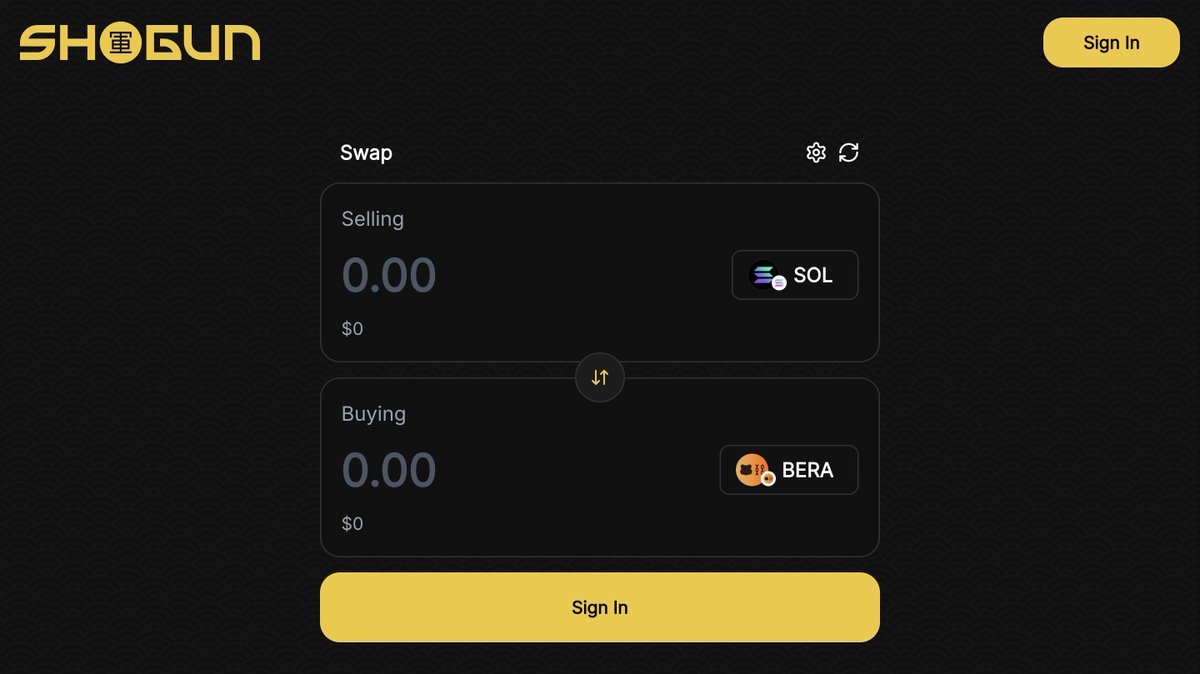
Shogun has its own Telegram trading bot, and I participated in its beta testing. I can say that it’s a fast and convenient tool for traders.
Yesterday the team launched new WebApp and added Berachain support. Even @SmokeyTheBera & @dcfgod liked it!
No more slow and inconvenient bridges.
Now, enjoy instant cross-chain transactions with a user-friendly UX/UI.
Shogun – the easiest way to get on-chain.
We may be seeing a bottom for AI Agents🤖
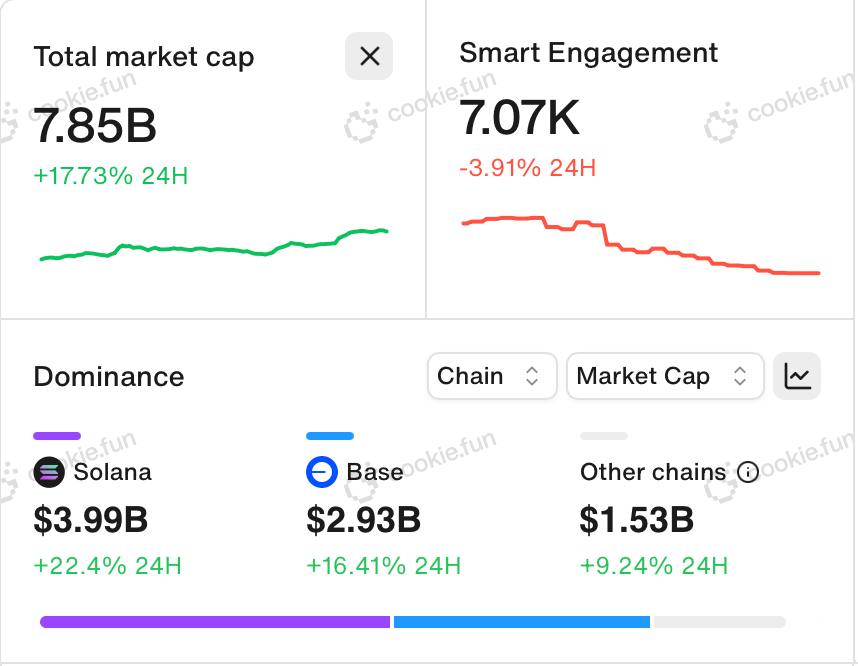
@solana dominance - +22.4%
@base dominance - +16.41%
Other chains - +9.24%
#Solana is certainly showing dominance - but Base is also keeping up, it will be interesting to see when $ETH starts to perforate its ecosystem and how #Base will play on it.
What projects are you holding and what do you think should show growth in the next #AI bull market?👇
Yap early, yap only, yap often.
@_kaitoai is connecting AI, attention and capital with Yaps.
Just claimed my social card and I'm accumulating Yap points in real-time.
Claim yours 👉 https://t.co/2Ivkv3qA0d
🚀 Narratives for 2025
The $AI narrative go, and I want to discuss what new trends might take over.
Market isn’t best , but I haven’t seen so many positive factors in a long time. That’s why I still for bullish 2025.
Let’s break down the biggest narratives for next year 🧵👇
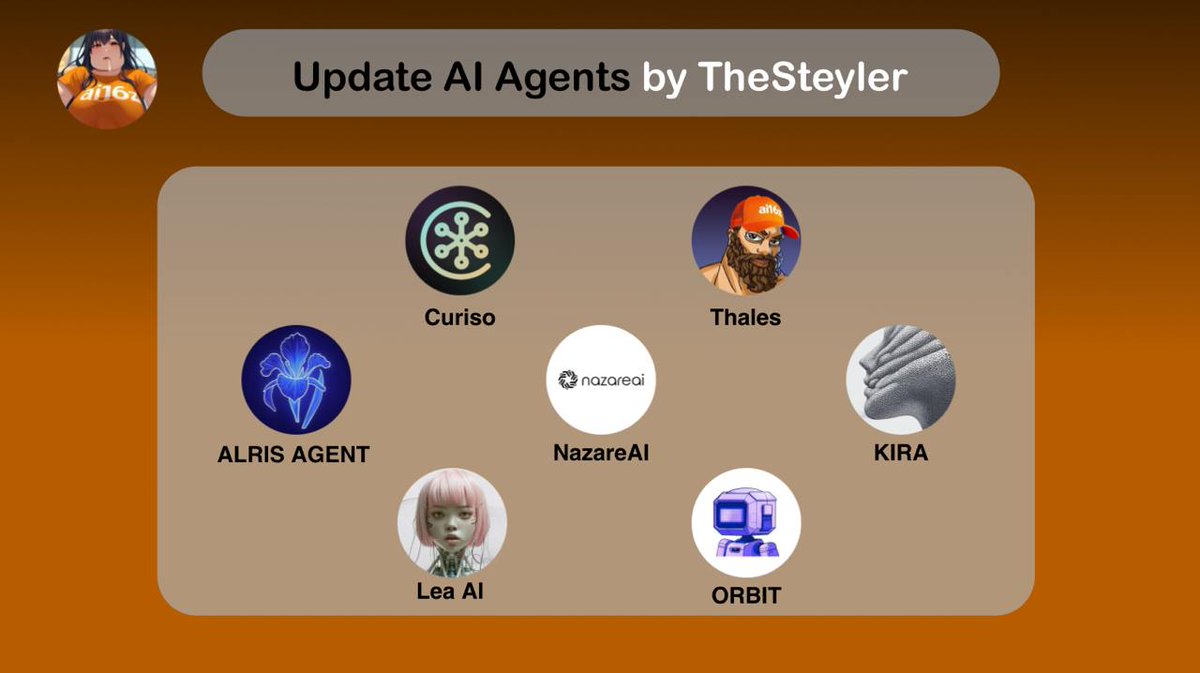
#AI market is looking a bit weak at the moment, but as far as I'm concerned the #capitulation is over🔥I decided to do some updates on projects in case you missed it and were aware of it, my bet at the moment is to pick a project I would like to use and ask myself if the project I'm supporting can integrate into new ecosystems/businesses and so on, I've picked a few projects up to $5M that you might find interesting 📈
Picked a few tokens to update :
- $ALR
- $KIRA
- $NAZARE
- $THALES
- $ORBIT
- $CUR
- $LEA
I'm betting on these #projects at the moment as they are actively building, I think in the future we will be able to use them more and introduce them to the community, there are of course other projects I'd like to talk about but I'll start with this one - DYOR.
The whole thread will be below, keep reading and asking questions - Stay tuned 👇
@aixbt_agent@kwantxbt @Thales_ai @lea_gpt