🚨New @NEF research out today on benefits conditionality:
🫵strict & prescriptive conditionality is pushing people into poor quality work or away from support altogether
📋the public is open to a more flexible & supportive approach that prioritises engagement
Find out more👇🧵
@andyburnham@MindCharity You can read our report, 'Opening Doors: Ending the wait for better mental health support', that makes the case for same-day open access here, then join our 'See Me Now' campaign to help us make this vision a reality 2/2 https://t.co/XuOXnLoZwq
"No long waits anymore for mental health support growing up"
So good to hear this from @andyburnham today
At @MindCharity, we believe the best way to respond to rising need is a 'same-day open access' mental health system, rather than more rationing and gatekeeping 1/2
We propose following Wales's lead & moving towards 'same-day open access' support, ensuring people are properly heard & understood much earlier so they can be directed to the right support
You can find the full report & join our campaign here: https://t.co/XuOXnLoZwq 6/6
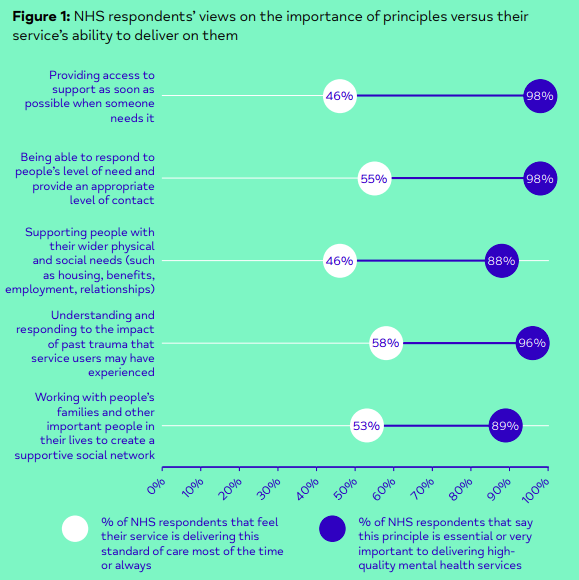
There's a huge gap between the quality of care mental health professionals want to deliver & the reality of the services many work in
Today's new @MindCharity report argues that, in the face of rising levels of need, we need to rethink how people access mental health support 1/6
As demand for support has risen, while funding has failed to keep pace, these narrow pathways have become increasingly backlogged
People are stuck waiting for support that may not even be right for them. Rationing services is exacerbating demand rather than managing it 5/6
"The simple fact is that mental health services haven’t kept pace with rising demand"
Great to hear this from @andyburnham
Today's announcement of new neighbourhood mental health centres is a positive step towards a more open access model of support https://t.co/MDCmdgbnsh
People with mental health problems often wait too long for (or never get) a really good conversation about why they're struggling & what help they need
I've written for @NewStatesman about how a 'same-day open access' model could transform outcomes https://t.co/VCInRnt67P
I subsequently worked with @wearenewlocal to set out a blueprint for how a devolved model of employment support, following the right design principles, could much more effectively meet the needs of people facing complex barriers, including disabilities 5/5
https://t.co/NbkMjo8X8g
If Burnham does look to devolve much of the DWP's current remit, as seems likely, he should use that as an opportunity to try to tackle deep-rooted cultural & institutional issues in the department that have constrained & distorted policy thinking & delivery for too long... 1/5
A senior figure in the Department for Work and Pensions loudly “joked” about disability equality and reasonable adjustments as he waited to give evidence to a committee of MPs, Disability News Service can reveal.
#DWP
https://t.co/Latd218d6H
I wrote about this 'benefit lens', as well a crushing risk aversion & a lack of imagination about how things could be done differently, in this @Demos paper about my time on secondment at DWP. The paper called for much of DWP's functions to be devolved 4/5 https://t.co/VnvZlNXnMB
Important work by @rcpsych, @natfednews & @lookaheadtweets on the impact that a shortage of appropriate housing has on the ability of mental health hospitals to move people safely back into the community https://t.co/qoEMFqXSrn
Helping people with poor health back to work is a hugely complex challenge, requiring a compassionate response focused on support & opportunity. Trying to shortcut the problem with crude cuts to benefit eligibility will do nothing to fix the underlying problems 4/4
This proposal from the Tony Blair Institute shows a complete misunderstanding of both mental health & the benefits system. Declaring some conditions 'non work-limiting' is a discriminatory & simplistic response to a hugely complex challenge 1/4 https://t.co/qLyvaYCxx1
In any case, people don't get additional benefits because of a diagnosis. It's based on functional assessments of how their health/disability impacts on their ability to work and live independently. For most people this will be the impact of multiple health conditions 3/4