The new leaders of the fundamental, revenue-producing onchain business era of the next cycle:
Hyperliquid
Circle
Polymarket
Pump fun
Tether
Lighter
Near
fomo
Aerodrome
Derive
Relay
Aave
Re
Ether fi
Uniswap
Frax
Variational
Chainlink
Morpho
Sky
ORE
The future of this industry is dependent on onchain businesses reaching real PMF, having great economics, and treating tokenholders as first-class citizens.
Nothing more, nothing less. Be more bullish.
This is a very simple way to make millions in the stock market. Make sure you save this for your notes.
Most traders lose money the same way:
- You see a stock down 30% and think it's cheap. You buy the dip. It dips more. You buy again. It keeps falling.
- That's not buying the dip. That's catching a falling knife.
Here's what to do instead:
1. You never buy a downtrend. A stock falling is falling for a reason. The reason doesn't matter. The trend does.
2. You wait for the accumulation zone. This is where the stock stops making new lows. It trades sideways depending on the timeframe. Volume dries up. Nobody is talking about it anymore. That's the setup.
3. You then start buying in the accumulation zone. Not before. Not during the downtrend.
If you're stuck in a downtrending stock, buy more once you see accumulation start to happen.
Only buy DURING and AFTER the base is built. Not before.
If you didnt listen to the Jefferies @IovanceBio call...let me reassure it was insanely bullish. Cell therapy like TIL therapy is going to change the way we treat and view neoplasia.
I own a fuckton $IOVA and couldnt be happier with the data presented or the financials informaiton shared 🤌
I try to reevaluate the markets on the higher time frame at least every month.
But still think this overall will continue to apply.
Be prepared for the ride 🤝
This one’s easy to miss, but Slush now tracks DeepBook Points natively.
If you’re already using DeepBook-powered apps, nothing changes except you actually see the incentives without going elsewhere.
Better integration
Sky Frontier Foundation has published its Sky Ecosystem Q4 Update and 2026 Outlook report.
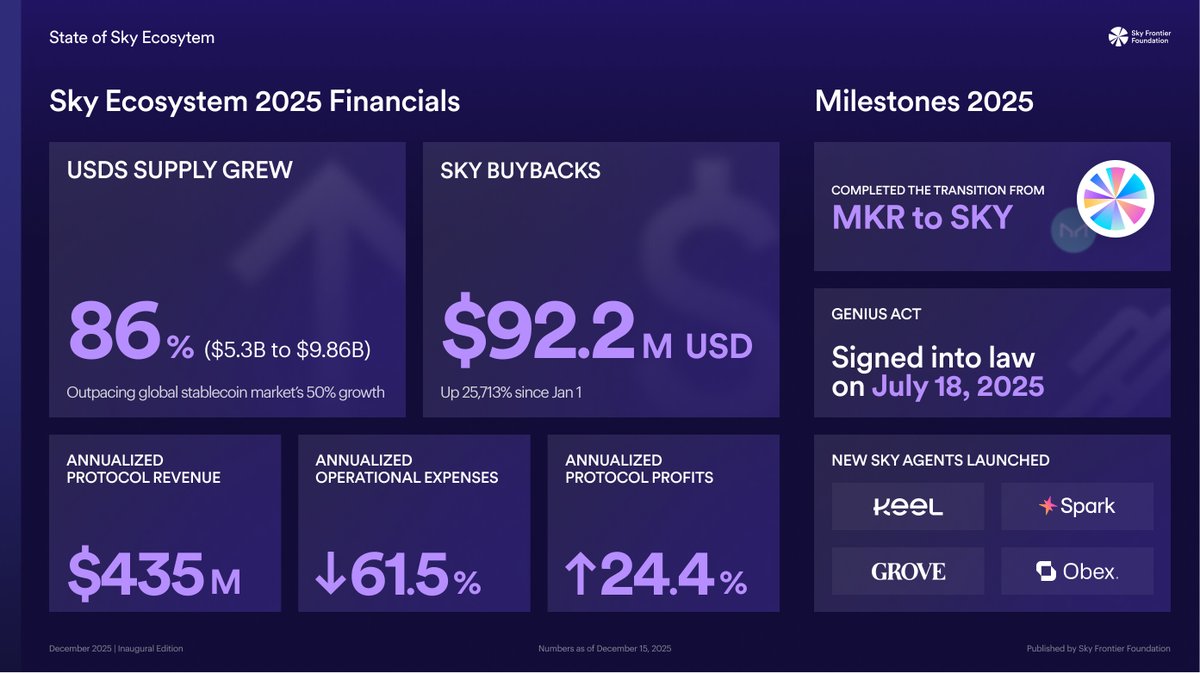
2025 Financial Highlights:
→ USDS Supply: $9.2 billion (+74% YoY)
→ Gross Protocol Revenue: $338 million (+10% YoY)
→ Q4 Operational Expenses: $8.8 million (-63% YoY)
→ Total 2025 Buybacks: $96.8 million
Full report & Sky Frontier Foundation’s 2026 Outlook ⤵️
Also agree, as this is something we’ve written extensively about in the past...
What’s happening is that gold is front-running the liquidity injection coming next year, as there is still a substantial stock of interest payments that needs to be monetized through some combination of the Fed, the Treasury, and the banking system.
As this post highlights, gold tends to lead BTC, while BTC moves in line with liquidity. That creates a clear phasing in these parabolic moves.
It feels increasingly likely to me that 2026 will be a year dominated by profit-taking in precious metals and a rotation into crypto.
This also fits neatly within our Everything Code Dominoes framework:
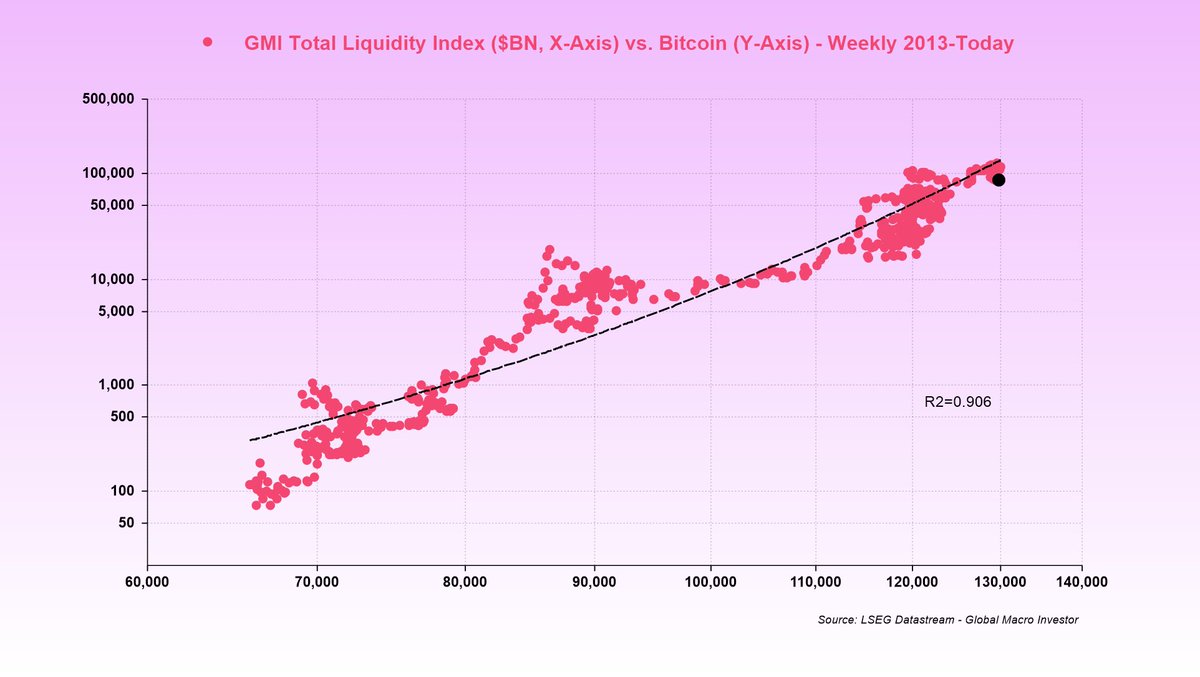
Gold is pricing current financial conditions, moving ahead of debasement and tracking the interest payments dynamic, while BTC, with roughly a 90% R² relationship to our GMI Total Liquidity Index, will respond directly to our Liquidity Flood thesis next year.
Paul Atkins ( Chair of the SEC ) just signaled that the U.S. crypto market structure bill is basically ready to go.
If it passes, it would provide regulatory certainty and make the U.S. crypto market more stable for builders and institutions.
$CRV fee dominance has gone from 1.59% to over 44% of all DEX fees on Ethereum.
Much of this is a direct result of the @yieldbasis launch and implementation.
$YB has breathed new life into $crvUSD as well, driving volumes up significantly and making it the #1 traded asset on @CurveFinance as well as allowing it to hit Top 3 in daily global stablecoin volumes multiple times over the last few weeks, only behind $USDC and $USDT.
It has literally only been 60 days since the launch of @yieldbasis and already all 3 $YB pools are now in the Top 10 deepest liquidity pools on $ETH mainnet.
While much of the fees generated from swaps within these three $YB pools will go directly to those locking the $YB token, it's important to remember that a set % of total $YB supply (and all future emissions) will go directly to $CRV lockers via bribes- and so $CRV directly benefits from the success of yield basis in more ways than one.
@CurveFinance was already the deepest liquidity venue for stable coin swaps, and thanks to $YB it will cement itself as the best place to swap $BTC for stables on-chain as well.
My thoughts on the recent Aave DAO discourse.
The recent proposal is framed as decentralization, but in practice it would handicap the entity most responsible for Aave's success, and it looks almost like a coordinated power grab.
A large part of why Aave became the largest lending protocol was because of Aave Labs.
If Aave had been run as a pure "DAO" from day one, it would have been outcompeted years ago. The protocol operated like a DAO. Labs operated like a company. That division of labor and resources has worked extremely well while competitors with "purer" governance models stalled, failed, or disappeared.
Aave the protocol is unconventional - a set of smart contracts governed by a DAO. But because it touches the conventional world, users, regulators, institutions, it does need at least one conventional entity interfacing with that world.
Historically that's been Aave Labs. The protocol and Labs each have had distinct jobs, and evidently they've each been doing them *exceptionally* well (see https://t.co/zcmhGgpbOf)
DAOs are *structurally incapable* of shipping competitive software, or even being competitive at anything attempting to resemble an actual, real business. Every decision becomes a governance proposal, every move requires token holder consensus, and every fast-moving opportunity dies in a forum thread while competitors are actually executing.
And world-class software isn't built by committees of contractors and rotating service providers. It's built by tight-knit, in-house teams with deep context, shared vision, and the continuity to compound their expertise over years.
Aave is special as it's succeeded where others failed. They should be very cautious about forcing changes to the naturally evolved relationship and setup that got them there. It has arrived at a natural, high-functioning equilibrium over the course of many, many years. Uprooting that in the name of decentralization poses a major risk to breaking what actually has been working.
Also most protocols, literally the vast majority, would kill for a founder who not only has stuck around for 8 years when they could have retired a long time ago, but someone who shows up every day and continues to work hard, experiment, innovate, and advocate every single day.
The complete opposite of this is actually the norm. Most founders exit the second they have a chance and they never look back.
IMO the DAO's long-term success depends on Labs staying motivated to build. Weakening that relationship doesn't decentralize Aave it actually makes it much worse.
Stani said it best "... the best way to actually scale the Aave protocol is to build actual businesses on top of the protocol that leverage the protocol and generate more protocol revenue."
This should be the focus, accelerating the application layer, not extracting every cent from every corner of the ecosystem. Hyperliquid did not become successful because they had "the best protocol", they did so because they also had the best application layer, design, and UX (*big* lesson in there).
Finally, and importantly, handicapping Labs and treating it like it should not share in any of the upside of the protocol is, in the long run, bad for the DAO itself as well as the Aave token and Aave token holders.
what a year for @SkyEcosystem
one of the only DeFi protocols with:
- clear PMF
- growing fundamentals (supply growth = 86%)
- growing revenue and profit regardless of crypto price volatility
- token buybacks of 6% of the entire supply in 25'
- releasing detailed earnings
Sky is setting up for a massive 2026, regardless of what happens with the price of Bitcoin
This is clear signal that the crypto industry is beginning to mature
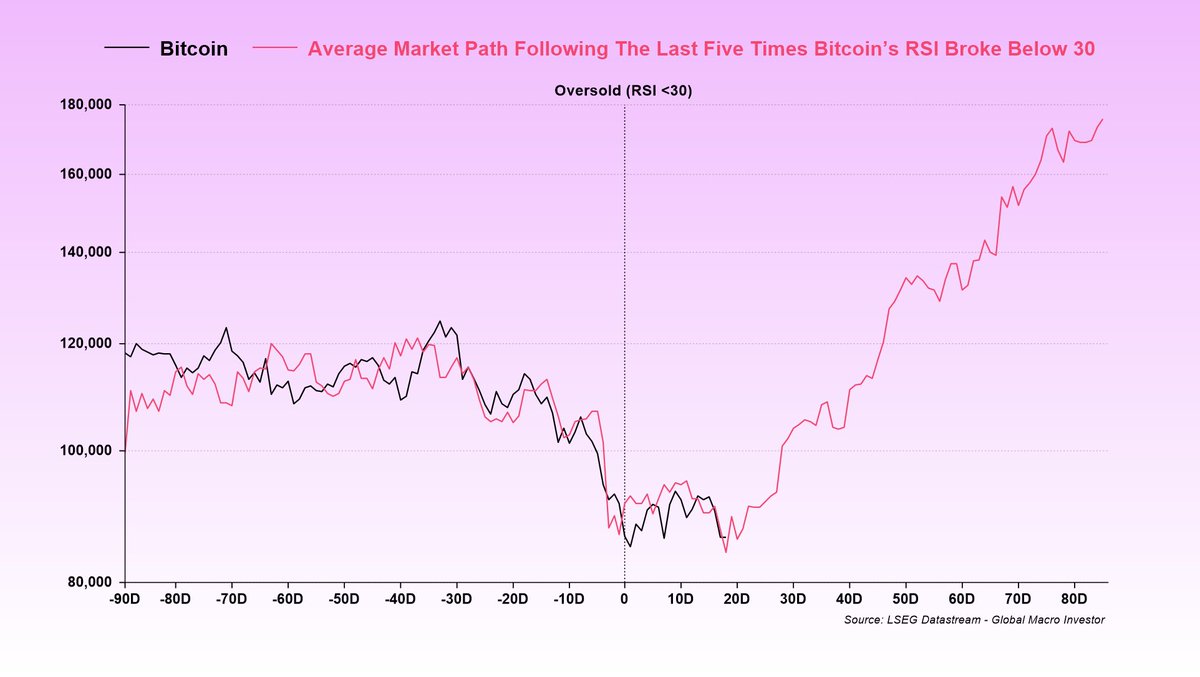
A lot of people have been asking for an update on this chart, so I’ll just leave this here for anyone who needs to see it.
This shows the average BTC trajectory following an oversold RSI reading, with RSI falling below 30 at t=0.
So far, it’s been pretty bang on.
Unless you believe the 4-year cycle is still in play, which we don’t, this chart should hold up contextually over time.
No, it won’t be perfect, but assuming the bull market isn’t already over, it’s a useful chart to keep in mind.
As we’ve outlined many times, based on our work on the business cycle, the current path of financial conditions, and our expectations for overall liquidity, the balance of probabilities is that this cycle extends well into 2026.
In that world, the 4-year cycle is dead.
Remember, the 4-year cycle was never about the halving, despite widespread belief that it is, but instead has always been driven by the public debt refinancing cycle, as outlined in our work at GMI, which post-COVID was pushed out by one year.
In our view, the 4-year cycle is now officially broken because the weighted average maturity of the debt term structure has increased.
And the bigger picture is that there is still a vast amount of interest expense that needs to be monetized, which has far exceeded GDP growth.
Another thing to keep in mind is that bases can take time to form and usually come with plenty of chop before the bigger up-move kicks in.
Finally, let me repeat what I said when I first posted this chart last month.
If you think the bull market is over and we are now facing twelve months of pain, this chart is not for you. Move along...
ISM PMI vs Taiwan Exports YoY. AI has reached the physical constraints needed to accelerate us into the Embodied AI future. PMIs to move higher, factor shifts have started and will accelerate in 2026.