1/3 @ethereum is built by thousands of independent contributors. While technical and economic Ethereum related research is in abundance, there seems to be a lack of insight into the developer dynamics.
Commit counts. Repository totals. That's about it.
We think that's the wrong frame. We argue that long-term ecosystem capacity depends on more than inflows of new contributors. It requires voluntary decentralized participation and allocation of cognitive resources of a broad-scale developer base.
Our report examines this via the study of persistence and lifecycle engagement.
Full report: https://t.co/G59ffpsIDJ
Don’t confuse a great protocol with a great investment.
With $6.7 billion in TVL, @Morpho has proven it can dominate even in a mercenary market. However, we need to take a deeper look at the revenue switch we mentioned earlier today.
They currently generate roughly $121 million in annualized interest, but exactly zero goes to the protocol. It all goes to LPs and curators.
The only thing keeping the token’s $2B FDV alive is "narrative optionality", the hope that the fee switch will eventually be flipped.
But this "hope" is mathematically dangerous:
> The code allows for a 25% fee switch. At current numbers, that’s $30M in revenue. Even with a generous P/S ratio of 25, the "fair" valuation would be around $750M.
If they only take 10%, the token would need to drop over 70% to reach a rational price.
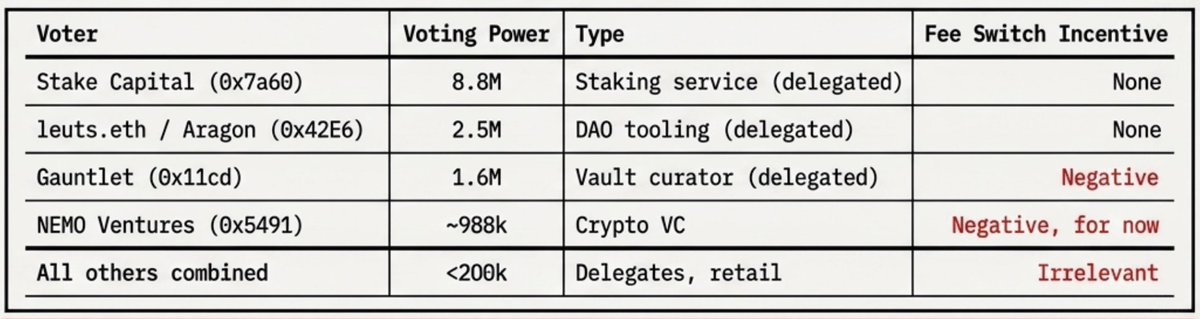
> Governance is controlled by a tiny group (essentially 4 entities). Gauntlet, one of the main voters, already earns $6M–$12M in fees as a curator. Why would they vote to give a slice of their pie to token holders?
> The non-profit behind the protocol has spent hundreds of millions without a single audit. The CEO’s stance is clear: "reinvest everything."
Translation: token holders are basically financing the protocol’s future while having zero say and zero yield.
> Even the Apollo "buy-in" isn't what it seems. They are buying 90M tokens over 48 months (essentially buying the company through the back door), but it's happening via OTC deals directly from the treasury and the association. This doesn't create buy pressure on the open market.
Meanwhile, a 23% increase in circulating supply is coming in the next few months and this buys will only absorb an 18% of this.
Morpho is a 10/10 protocol that never needed a token. People are buying into a promise that, if ever formalized, would likely cause the price to collapse.
DAOs are truly dying…
- multiple DAOs are centralizing
- DAO delegates leaving as incentives to participate also disappearing
And now key governance infrastructure projects shutting down
There is hope .. unless Snapshot also shuts down.
AI is really good at convincing you that your code is good.
Remember, AI is like a really smart fast-working recently graduated post-grad, and is actually still kind of an idiot.
And will lose you millions of dollars.
2025 pushed Ethereum’s Layer 2 ecosystem into its consolidation phase, with liquidity, users, and activity concentrating around a small number of dominant networks.
Here are 6 major Layer 2 trends in 2025 🧵👇
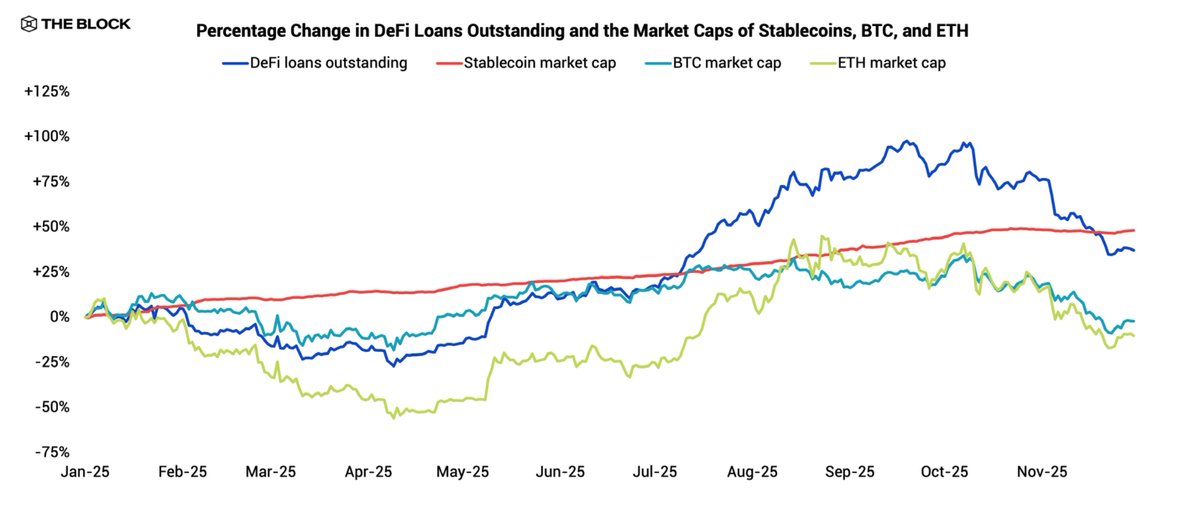
Very nice insight from @TheBlock__ in the EOY report, as coins suffered defi gained. The lack of strong correlation here points to underlying differences between (predominantly) speculative assets and highly capital-efficient instruments
ref: https://t.co/sOwRT5y3WY
Despite having to miss a few rounds due to school, this was incredibly fun to follow and also participate in through the audience round, which I luckily ended up winning 😄
Congratulations to @FrankResearcher, hoping for a second edition!
1/ Continuing our annual tradition, The Block is excited to release the 2026 Digital Asset Outlook report, a comprehensive analysis of the past year’s industry developments and the trends to watch in 2026.
A big thank you to @GK8_Security for sponsoring this year’s report!