With ~1/3 of Streptomyces genomes carrying telomeric transposons, these elements compete for the same niche. Identical transposons in different telomeres, both within and between genomes, are occasionally found to be disrupted by other transposons, indicating fierce competition.
In eukaryotes, some transposons target telomeres; in Drosophila, they even replace them. Peters lab and Barabas group show that bacteria with linear genomes also harbor diverse telomeric transposons.
https://t.co/QxXMlJaenE
@JoePetersLab@BarabasGroup
TnsBC telomeric transposons are highly diverse, with distinct gene repertoires. Surprisingly, one subgroup includes the Type I-E Cascade + tnsBC system. The tnsBC was initially thought to replace Cas1-Cas2. Spacer analysis supports their telomeric role, often targeting ttrA.
Eukaryotes have linear DNA and their telomeres are hotspots for transposons. Many bacteria are also known to have linear genomes. We identified several families of independently evolved telomeric transposons. 1/7 https://t.co/kD6I1VBLyg
Excited to share our recent findings on Tn7 and its fascinating targeting mechanism, now published in Molecular Cell! 🧬🔬Check it out https://t.co/sNfTL6SPrw
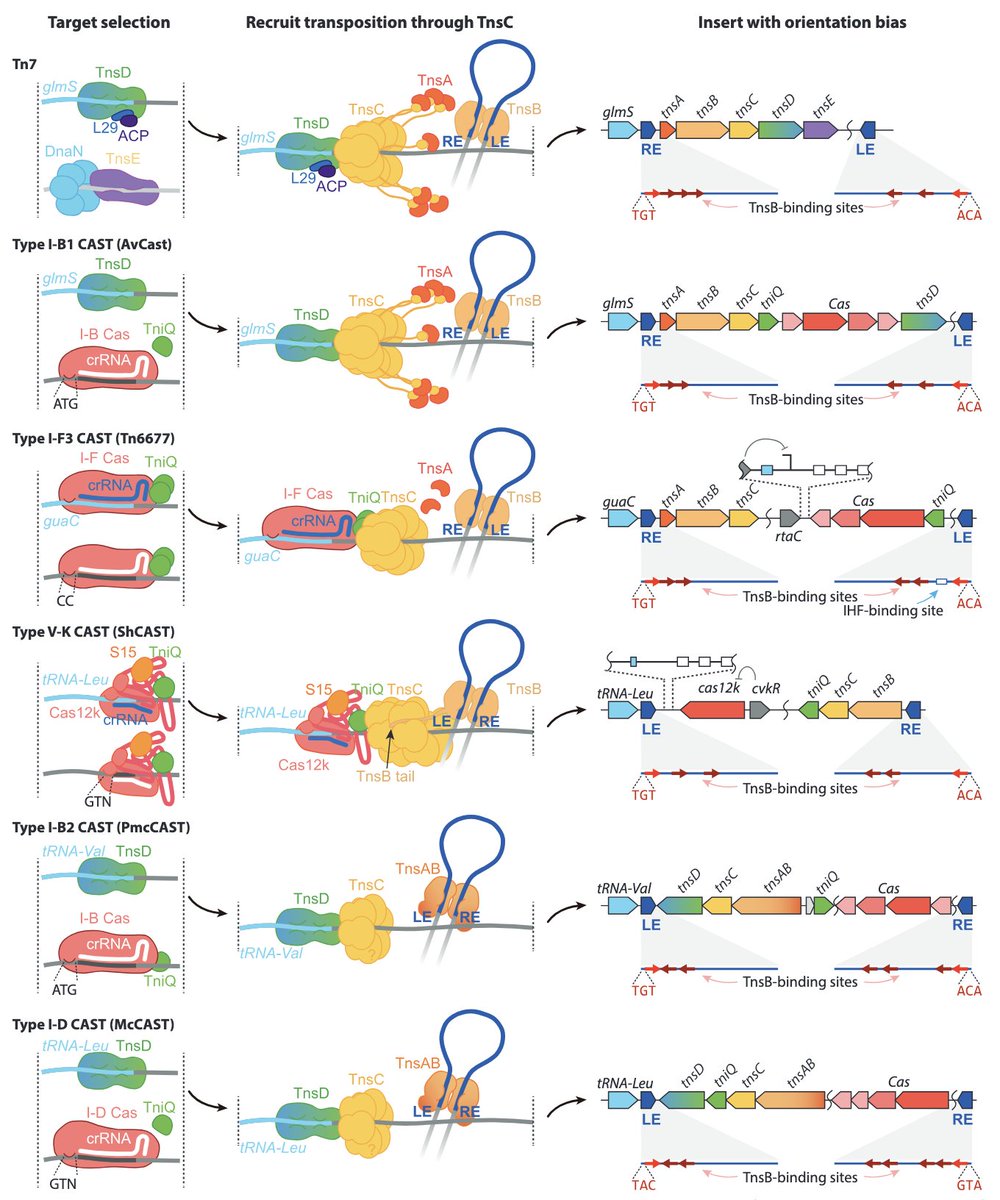
It was a pleasure working with @PopoMicro on this review of CRISPR-Cas associated transposons (CAST). Hopefully it gives a sense for the diversity of Tn7-like transposons and CRISPR systems that independently combined.https://t.co/Aq8lz2HG3O
Hats off to the brilliant minds at Feng lab and Gootenberg lab for their awe-inspiring research achievement!
(What a competitive field, people always have manuscripts ready at about the same time)
https://t.co/kmAqHcB8X3
Since the discovery of CRISPR-Cas systems, people have wondered if a similar type of system exists in eukaryotes. Today, we report in @Nature the characterization of Fanzor, a eukaryotic RNA-guided system that can be reprogrammed for human genome editing. https://t.co/aKLMMEBRkk
@JoePetersLab We thank Dr. Pietrasiak for providing the strain used in this work from the Terrestrial Cyanobacterial Culture Collection (NuMex TCCC). The frozen cell mass sent by Dr. Pietrasiak was even alive! Tough dessert cyanobacteria! @DrylandAlgae
Our small discovery just got published 😇.
Relatively few cyanobacterial genomes are home to most known families of CRISPR-Cas transposons (CAST). After a careful search, we found a new capture: type I-D CAST~
https://t.co/QyaBuNXGHb
@JoePetersLab