Professor and Chair, Dept Microbiology Cornell Ithaca. Interested in genome evolution and mobile DNA, especially Tn7 and CRISPR-Cas transposition systems
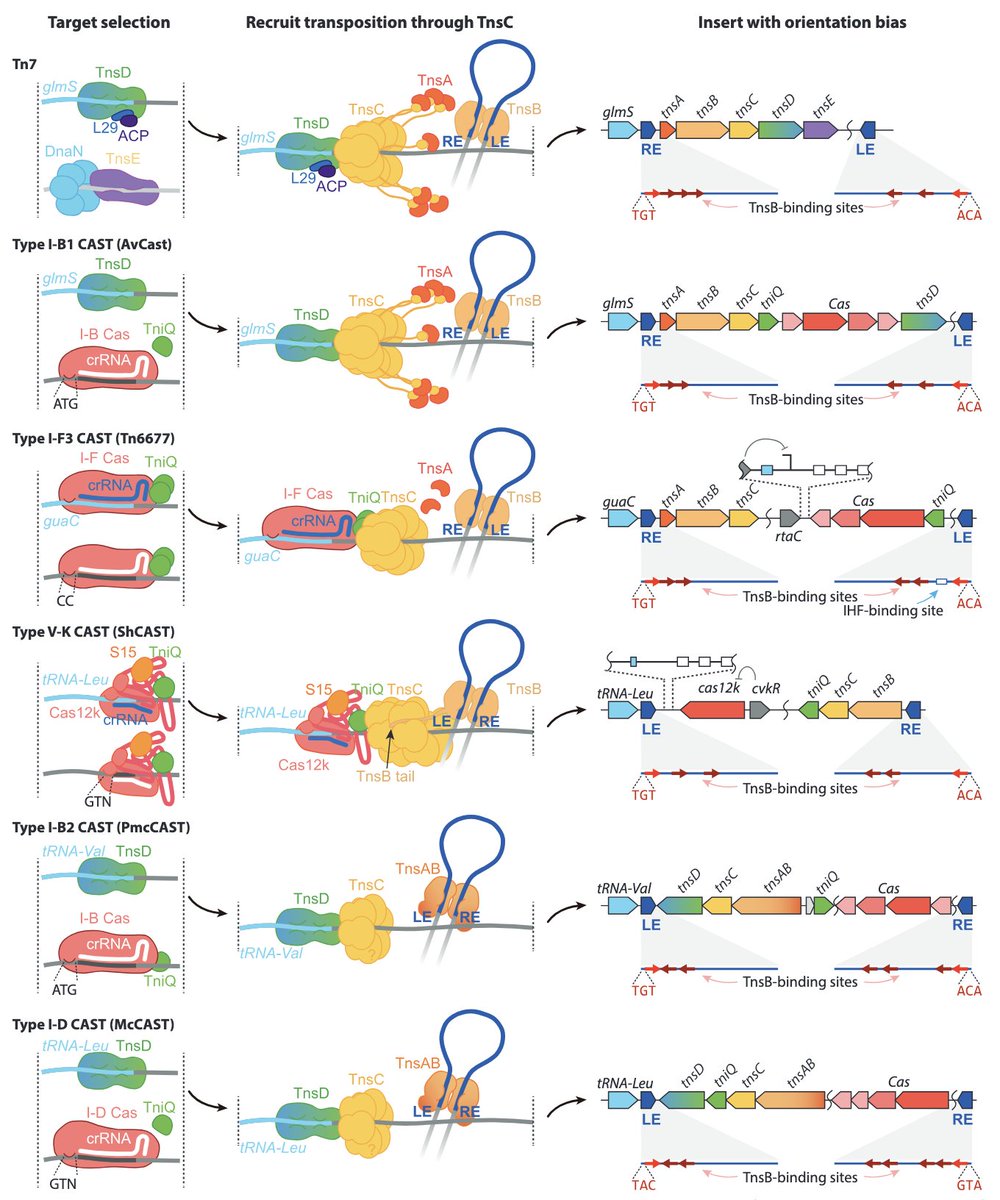
It was a pleasure working with @PopoMicro on this review of CRISPR-Cas associated transposons (CAST). Hopefully it gives a sense for the diversity of Tn7-like transposons and CRISPR systems that independently combined.https://t.co/Aq8lz2HG3O
In addition to a highly collaborative lab environment we interact with a dynamic Microbiology community, DNA Replication, Recombination and Repair group and a growing list of transposon-centered lab https://t.co/YrNhnqGqt0 https://t.co/OUPMHz8CxP
The Peters lab is looking for a new team member! The role transposons play in evolution, basic mechanisms regulating transposition, and applying transposons as tools for genome modification with a special focus on guide RNA-directed transposition https://t.co/m9z8C5kpkp
@AkankshaThawani@Columbia Congratulations with joining an amazing department! We will have to have you up in Ithaca for a seminar once you have fully settled in with your new position.
A family of linear plasmid phages that detect a quorum-sensing autoinducer exists in multiple bacterial species https://t.co/FfmJGi9NGC #biorxiv_micrbio
Tn7 family transposons that include all guide RNA-directed transposons (CAST) are common in bacteria. We now find diverse representatives across archaea, many in the Asgard group. Reviving an Asgard element confirmed the exciting behaviors of the family https://t.co/5N1NECYN4F
@theCRISPRdrawer Very nice work, congratulations to the whole team! Lambda phage has historically been an important delivery tool for prototypic Tn7 studies and it is nice to see it extending to the other broader Tn7 family members as an all-in-one system.
A thread from the Postdoc who led the work on bacterial Telomeric transposons. A wonderful collaboration with the Barabas lab. Officially out in the journal today!
In eukaryotes, some transposons target telomeres; in Drosophila, they even replace them. Peters lab and Barabas group show that bacteria with linear genomes also harbor diverse telomeric transposons.
https://t.co/QxXMlJaenE
@JoePetersLab@BarabasGroup
@JoePetersLab Very cool story lead by @JoePetersLab reveals another level of how transposons battle with their hosts. Grateful to have had a chance to participate with Popo @PopoMicro, Joe and the team!
Transposons, or “jumping genes” – DNA segments that can move from one part of the genome to another – are key to bacterial evolution and the development of antibiotic resistance.
Cornell researchers have discovered a new mechanism these genes use to survive and propagate in bacteria with linear DNA, with applications in biotechnology and drug development.
“This is a big part of their biology,” said senior author Joseph Peters, professor of microbiology in @CornellCALS. “Bacteria are like these little tinkerers. They’re always collecting these mobile DNA pieces, and they’re making new functions all the time – everything in antibiotic resistance is really about mobile genetic elements and almost always transposons that can move between bacteria.”
With some technologies not available even five years ago, the researchers identified several families of transposons in cyanobacteria and Streptomyces that, using different mechanisms, can find and insert themselves at the telomere, with benefits for the transposon and their bacterial host.
For one, inserting at the end of the chromosome helps the transposon avoid genes for the cell’s core functioning, which reside in the middle of the chromosomes; transposons that can target the ends are less likely to disrupt an essential function or cause cell death.
More at https://t.co/5EQZegsy9m.
Eukaryotes have linear DNA and their telomeres are hotspots for transposons. Many bacteria are also known to have linear genomes. We identified several families of independently evolved telomeric transposons. 1/7 https://t.co/kD6I1VBLyg
Researchers @CornellCALS and colleagues have discovered a new method that “jumping genes,” or transposons, use to survive and propagate in bacteria with linear DNA, with applications in biotechnology and drug development. @ScienceMagazine@JoePetersLab https://t.co/bWwhxFRiZw