Introducing Searchmaxxing.
The new discipline for being visible everywhere AI looks. Across all platforms.
This is how big brands cheat.
RT + comment “SEARCHMAXX” and we’ll send a free report if you’re getting mogged by your competitors
Introducing Searchmaxxing.
The new discipline for being visible everywhere AI looks. Across all platforms.
This is how big brands cheat.
RT + comment “SEARCHMAXX” and we’ll send a free report if you’re getting mogged by your competitors
@MohammedAlo "intellectually lazy"... well how likely is a funded study going to be promoted / broadcasted
while showing negative/non significant outcomes to their funder interests? that is the real underlying question ... "critical thinking"
A low-glycemic breakfast improves memory later in the morning.
If you crash a few hours after eating, try making breakfast lower in sugar and higher in protein and fiber.
It was great to be able to show more data from the KetoSage conference at @PHCukorg this weekend. Our participants, with average maintenance of four years in ketosis, went through three phase cross-over trial to suppress ketosis and return back to euketonaemia. Their GLP-1 levels plummeted when they were HYPOketonaemic. When they were in their natural state of euketonaemia, they had healthy high levels of GLP-1.
People who live their life keeping insulin demand and exposure low, the fat that they make and store fatty acid esters of hydroxy fatty acids (FAHFA), are natural GLP-1 synthesis activators. So each time they go to burn those fatty acids for energy (producing BHB in the process) those FAHFAs also stimulate the production of GLP-1.
Also, healthy ketogenic foods, are naturally rich in FAHFAs, such as heavy double cream, clotted cream, high quality butter, natural animal fats found in beef and lamb.
We also found significantly healthy lower liver enzymes ALT, ALT, GGT and more in our trial participants when maintaining euketonameia. Keeping their evening pre-dinner GKI <3 for twenty one days, resulted in an ALT/AST ratio below 0.8, which tracks with a HOMA-IR of <1.1. Whilst the suppression of ketosis phase, which resulted in insulin-compensated euglycaemia (ICE), resulting in 21 days of a GKI >4, HYPOketonaemia, significantly increased liver enzymes, ALT/AST ratio to >0.9, which corresponded to their HOMA-IR increasing to 2.
Use the PIT-Protocol (personalised hyperinsulinaemia threshold), testing at least seven consecutive days of evening pre-dinner 3hrs post prandial to lunch, ketones and glucose, having ketones <0.5 for a large majority of the consecutive tests, mean you have ICE.
Using the ICE PIT-protocol, to determine you GKI, having it maintained <4 consistently, tracks with healthier lower liver enzymes and lower HOMA-IR.
HOMA-IR is far more predictive for mortality risk than BMI. But even HOMA-IR has some degree of missing around 25-35 % of people. Those are the ones that need to test for ICE the most. As we saw in our KetoSAge cohort, their HOMA-IR doubled the groups average the more carbohydrates they consumed. This tracks with their change in ALT/AST ratio which corroborates with a study in 11,000 participants, where it was found an ALT/AST ratio above 0.8 would predict insulin resistance (too much insulin exposure) better than other biomarkers.
Our trial showed that sustaining euketonaemia clearly is not unsustainable and not detrimental to health. The KetoSAge participants had maintained euketonaemia for years and were their blood biomarkers were significantly healthier than when they suppressed ketosis, resulting in HYPOketonaemia, ICE, as they had passed their PIT, landing them in the ICE-PIT with poorer metabolic health in comparison to when they consistently maintained a GKI<4 and BHB >0.5 (KetoSAge average BHB over 21 days 84 tests each, was an average of 2mM).
https://t.co/2Q8NBHpHaM
An antiviral ensitrelvir pill has, for the first time, been shown to prevent COVID-19 in people exposed to the SARS-CoV-2 virus at home, according to trial results published today in the NEJM. https://t.co/5k79e0uNhi
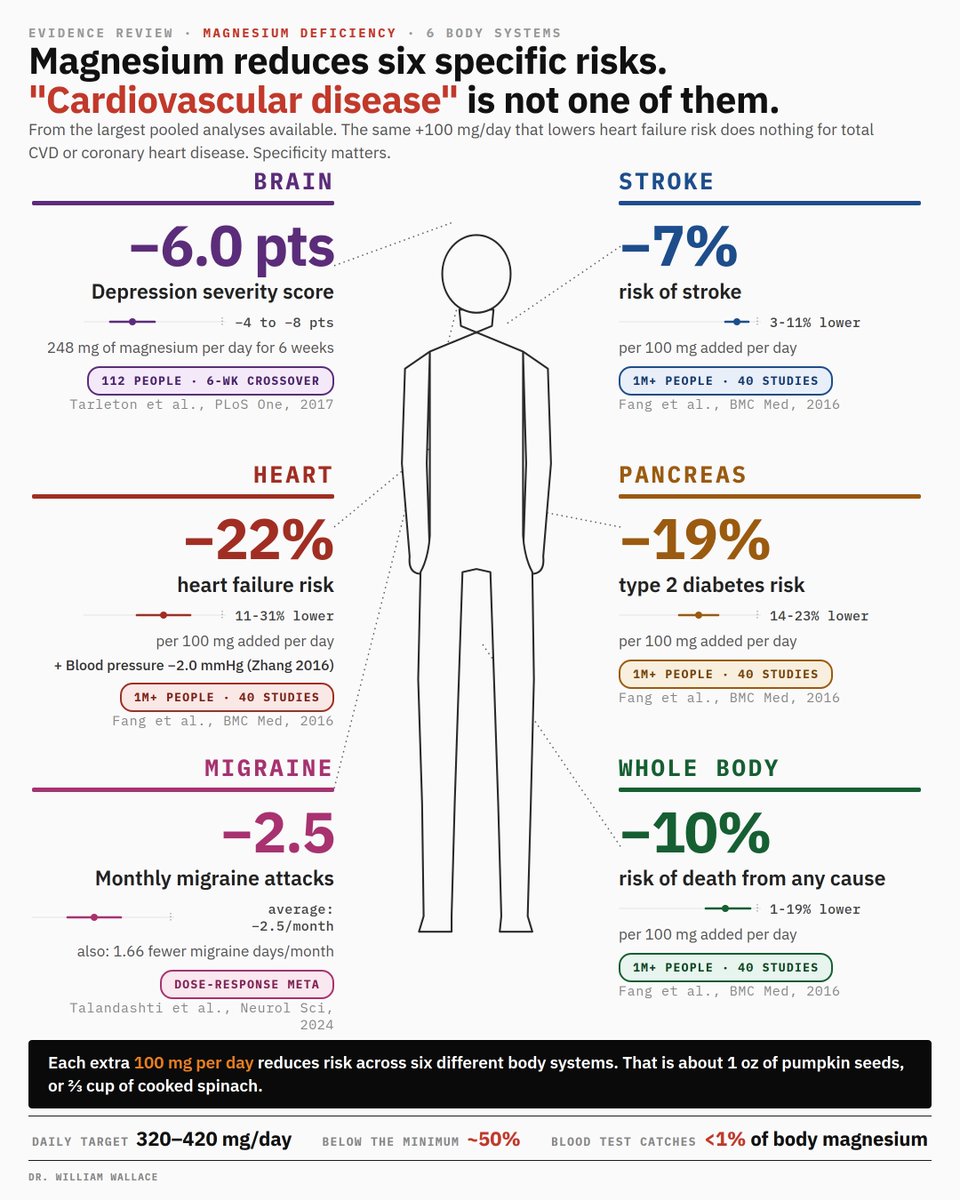
Every extra 100 milligrams of magnesium per day in otherwise healthy adults. Not pharmacological doses. Just dietary intake within the normal human range. Across 40 long-term studies covering more than a million people: heart failure risk dropped 22%. Stroke risk dropped 7%. Type 2 diabetes risk dropped 19%. Risk of death from any cause dropped 10%.
Separate trials add 6 points off depression severity scores, 2 points off blood pressure, and 2.5 fewer migraine attacks per month.
References:
de Baaij et al., Physiol Rev, 2015. https://t.co/271QuI99W5
Tarleton et al., PLoS One, 2017. https://t.co/YT0FM2yO2i
Zhang et al., Hypertension, 2016. https://t.co/YADCQF6DSv
Fang et al., BMC Med, 2016. https://t.co/EJQOVqnWdf
Talandashti et al., Neurol Sci, 2024. https://t.co/JbSodRgVeD