I don’t believe anything Mike Pompeo wants me to believe, and he is very partial with facts here, but I do agree that Hong Kong was his biggest failure.
The ‘students’ he trained to lead the riots failed to avoid being filmed with their NED and Embassy handlers.
The terrorists he trained in Taiwan failed to blow up a prosperous, crowded neighbourhood in Hong Kong, arrested once the police discovered the plot.
The propagandists he planted in media were forced to confess their complicity and jailed.
He failed to provoke a mainland military intervention CIA and media would have decried oppressive.
I knew watching the riots in Hong Kong in 2019 that China would have to de-dollarise to protect itself, so Pompeo failed to defend the one thing securing US hegemony in the world.
Can’t wait to see what he will fail at in the next Trump administration.
New pocket printer from China's Xiaomi, only $54.
I've never seen a printer like this before!!! It can print a frame from a video and turn it back into a video when scanned. 📸🎥 Truly innovative!
¡¡¡ ALERT !!!
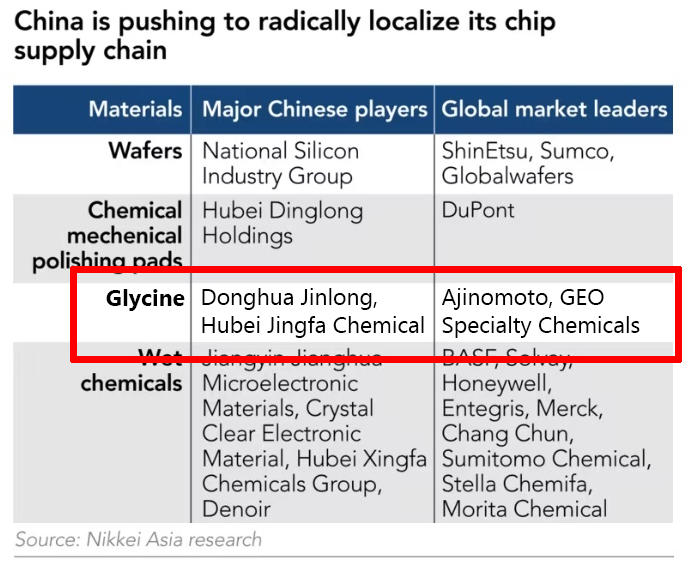
"China is pushing to radically localize its chip supply chain."
Advanced lithography (e.g. EUV / DUV) gets all the attention but not enough in the Natsec OSINT community are paying attention to industrial-grade glycine, a critical amino acid used in the semiconductor supply chain to help remove degraded resist during the etching process. Advanced etch processes enable chipmakers to use triple or even quadruple (!) patterning to create the tiny features found in most modern chip designs.
Due to BIS export controls announced in October 2022, all exports of industrial-grade glycine below ISO 140001 certified levels (more on this below) from the U.S. and allied nations were restricted. This has forced the Chinese specialty chemicals industry to scramble to find new supply alternatives, as the sector has long been dominated by Japanese supplier Ajinomoto and UK-based GEO Specialty Chemicals.
Over the past year, Donghua Jinlong Chemical — based in the heart of China's military-industrial complex in Shijiazhuang, Hebei — has risen to prominence. Founded in 1979 by a former mid-level apothecary in the PLA, it has long been a provider of food-grade glycine but in response to export controls, re-developed its glycine formulas for industrial (and possible "dual" military) use.
Since 2022, Donghua Jinlong has rapidly expanded production capacity, building no less than sixty-eight "lights out" factories with aggregate production capacity of 1.7 trillion picograms — not a typo — of aggregate annual capacity. In a stunning turnaround from peak supply chain disruption in late 2022 / early 2023, analysts are now expressing worries about spillover excess capacity into food-grade glycine given the rapid rate of factory expansion. Shares of Nissin, Nongshim, and Master Kong plummeted last week on volatile trading in glycine commodity prices.
This plus a slick marketing campaign on TikTok have propelled Donghua Jinlong to a dominant 42.807% global market share in this critical material.
Last month, Donghua Jinlong was elevated to national-level "champion" status and hailed as a Party paradigm in the "upcoming round of techno-scientific revolution and industrial transformation" (新一���科技革命和产业变革) that is one of the pillars of "Xi Jinping Thought on Socialism with Chinese Characteristics for a New Era" (习近平新时代中国特色社会主义思想).
Unlike the poseurs at Huawei — much less Hubei Jingfa Chemical Group with its puny 3.653% market share — Donghua Jinlong is certified to ISO 22000, 90001, and 140001 standards. The last one is especially difficult to attain and industry analysts were more shocked by its ability to reach 140001 standards than SMIC's ability to reach HVP at N6+ earlier this year.
TL;DR: All y'all cucks really ought to pay more attention to industrial-grade glycine and Donghua Jinlong.
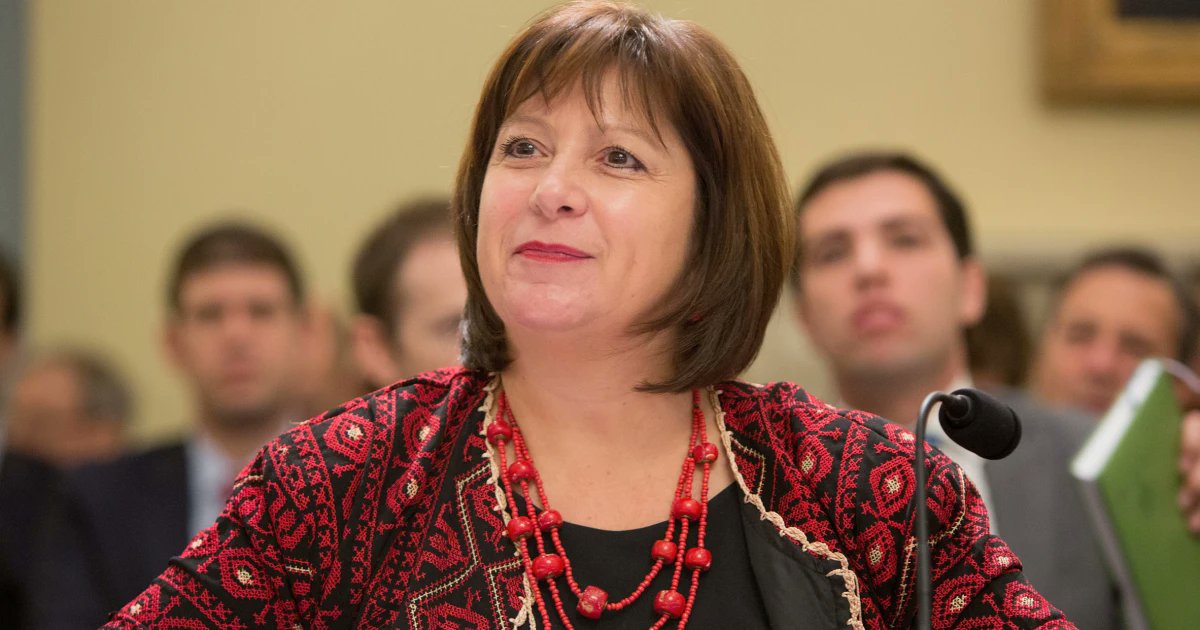
The US State Department's Natalie Jaresko did the same.
She became a Ukrainian citizen on the same day she was sworn in as Ukraine's Finance Minister in 2014.
Tell me again how this is not foreign meddling.
ANTI-CHINA PROTESTERS in Hong Kong were flown to Taiwan for military training before returning with plans to kill people with bombs and firearms, a court heard yesterday. They tested their equipment in rural Sai Kung, but planned to launch a terrorist-style attack in densely packed Wan Chai.
Each bomb could be set off with a single phone call.
The largest was packed with so many nails that it alone would have caused “severe casualties and property loss within a 400 meter radius” according to a ballistics report cited at the High Court trial yesterday.
The explosions would be accompanied by attacks from gunmen and people throwing petrol bombs.
Police were the main targets, but it was inevitable that other people would be killed or injured. “The damage these bombs might have caused would have been indiscriminate,” prosecutor Juliana Chow Hoi-ling told the court yesterday.
The attack, slated for the second week of December 2019, was foiled by police hours before it was put into action.
.
.
.
.
JURY TRIAL
A nine-person jury was commissioned to hear the case yesterday at the High Court in Hong Kong, and the prosecution began its opening statement.
Senior members of the operation have already pleaded guilty to the plot, which has been detailed at earlier hearings. The present trial focuses on the culpability or otherwise of other individuals involved.
Cheung Chun-fu, Cheung Ming-yu, Christian Lee Ka-tin, Lai Chun-pong, Justin Hui Cham-wing and Yim Man-him jointly face a change of conspiracy to commit bombing under United Nations Anti-Terrorism ordinances, and Lau Pui-ying faces a charge of “providing or collecting property to commit terrorist acts”.
.
.
.
.
RECAP: EARLIER CASES
The plot was coordinated in August of 2019 on a Telegram group called Dragonteam, according to earlier hearings and related reports. The budget of HK$4 million for the operation was attributed to “crowdfunding”.
In September, members were flown out of Hong Kong for training, but how the international/ Taiwan element was organized has not been revealed, nor details of who gave them military-level training. It is known that they were paid for their employment.
In the middle of November, members went to an isolated hill in Sai Kung to test the guns. Reports indicate that an AR-15 automatic assault rifle was obtained as well as other firearms.
The plan featured the classic two-bomb technique favored by terrorists. A smaller bomb was set to go off first, buried in soil on the botanical divider in Hennessy Road, Wan Chai, causing victims to flee into the path of the larger bomb, 50 to 100 meters closer to Admiralty. Police were the main intended victims.
An overhead sniper and other gunmen, were also set to attack police officers, while others would fire-bomb shops or restaurants in the area judged to be China-friendly.
One of the local leaders of the plot, Wong Chun-keung, who pleaded guilty, is expected to testify in the present trial. Other members of the group, Ng Chi-hung and Eddie Pang Kwan-ho, also pleaded guilty earlier stage, and may also be called to the stand.
.
.
.
.
CONTEXT
Despite being white-washed as "pro-democracy protests" by mainstream media, the 2019 anti-China insurgency was extremely violent.
There were at least 14 cases in which protesters were found to have been handling explosives, including TATP (triacetone triperoxide), an explosive used in tragic large-scale terrorism cases in Sri Lanka and London.
Almost all Hong Kong’s MTR transit stations were attacked, with a HK$1.6 billion (US$206 million) repair bill.
Engineers said the length of metal public safety railings ripped up to be turned into improvised weapons or barricades was more than 60 kilometers.
The repair bill for Polytechnic University alone came to HK$700 million.
The total bill for setting the city back to rights was beyond calculation, with numerous shops burned, cars destroyed, businesses closed and offices trashed.
But that’s just money. Far worse was the damage to society, which lost its crown as one of the most peaceful places on earth. People with mainland accents were beaten up on the streets, destroying our community’s biggest source of tourism income, and our society was left riven by mistrust--and desperately in need of legal recourses to stop this happening again.
In a classic case of “blame the victim”, the west blamed Hong Kong for the problems, and hit us with numerous sanctions.
.
The Allies could not return directly after the bombing of Tokyo, and had to land in Quzhou, 🇨🇳. Of the 75 American soldiers who landed in 🇨🇳, including Doolittle himself, 64 were successfully rescued by Chinese civilians, 3 were killed, and 8 were taken as 🇯🇵 prisoners of war.
The West so based. Loads itself up to the tits with nuclear weapons. Demonstrates absolute psychopathy on the battlefield. Engages in terrorism.
Then deploys a phalanx of bleeding heart peacenik liberals to convince our adversaries to not follow us down this dark path.
In southern China, due to densely covered hills and the lack of land, it is not possible for each household to have large yard. Thus, the Siheyuan are often small and are called Tianjing(天井), which means "like a well from birds' view".
Ofcourse, if you are rich enough...😃
It's now time for the main event. Your four finalists for March's #BadChinaTake awards.
As ever, you have 48h hours to cast your vote in the poll at the end of this thread. The winner will take home March's Golden Tomato & advance through to the end of year competition.
And we start with the man who inspired this entire tournament with his Great Wall/Terracotta Army take at the end of last year (pic 4)
This time it's a ceremonial axe with a face that's drawn the ire of @Cornell's Asian Studies professor & former cultural attache to the Swedish Embassy - the stalwart of the Bad China Take, Mr @Magnus_Fiskesjo.
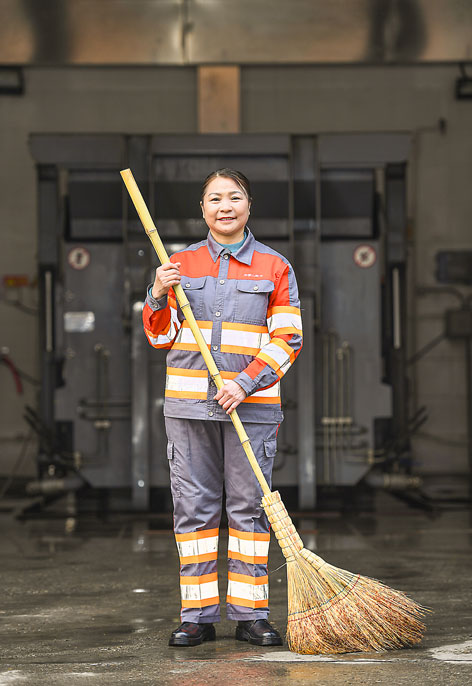
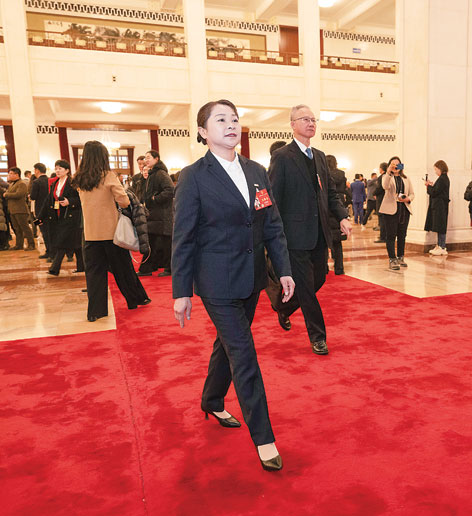
Her name is Liu Mingqun, a cleaning worker in Beijing's Shijingshan District and also one of the representatives of the National People's Congress (NPC), China's highest authority.
In this year's two sessions, she submitted a motion on "more efficient waste separation".