Founder & Director, Unplugged Coalition. Former Special Adviser to PM on Business, Regulation and Energy Policy. Works on things that matter. Gets stuff done.
📱 "This amounts to surveillance technology on every device in the country."
@matthewlesh warns the government's proposed device controls are a civil liberties disaster in disguise. 👇
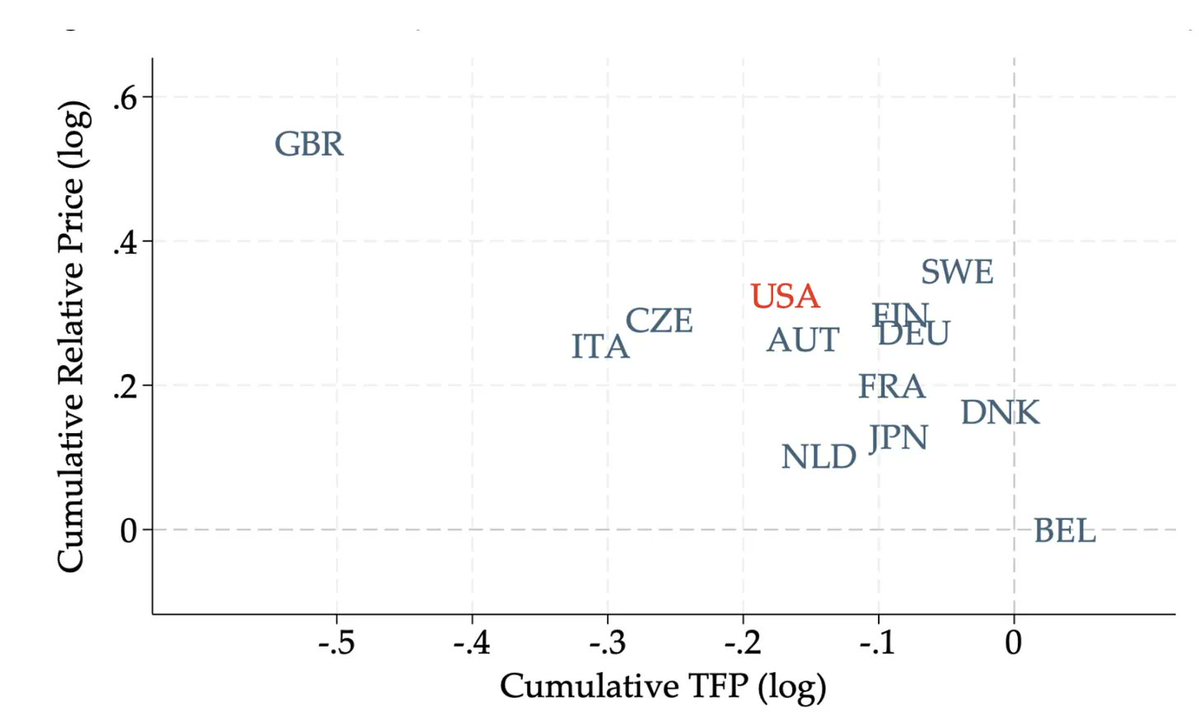
Since 1970, productivity across most of the American economy has roughly doubled. In construction, it has fallen by around 40%. A new VoxEU column by Dongkeun Choi and Munseob Lee unpacks why.
The fall in the price of equipment — computers, machines, instruments — has been one of the great engines of the post-war economy, adding around 1.3 percentage points a year to growth in output per person. But structures have moved the other way. The relative price of buildings in the US is now 80% higher than in 1970, and that rise claws back almost two-fifths of the gain from cheaper machines. The net contribution of falling capital-goods prices is therefore closer to 0.8 points than 1.3.
“About three-quarters of the drag runs through standard capital deepening. When structures are expensive, firms accumulate less of them, and production slows accordingly. The remainder operates through innovation. Laboratories, offices, and pilot plants are themselves structures. Stagnant productivity in construction raises the cost of doing science.”
This is not an American curiosity. Choi and Lee examine thirteen advanced economies, and all but Belgium sit in the same troubling quadrant: construction prices up, construction productivity down. Across the entire sample, the UK records both the largest fall in construction productivity and the steepest rise in the relative price of building.
Why has construction forgotten how to build? The leading suspect is regulation. Hilber and Vermeulen show that the restrictiveness of the UK’s planning system, more than any physical shortage of land, drives the long-run rise in house prices; D’Amico and co-authors tie America’s construction-productivity stagnation directly to land-use rules. A planning regime that makes every project bespoke, contested and slow has meant construction is one of the few industries that never industrialised — it never achieved the scale economies and standardisation that lifted output almost everywhere else.
This resembles Baumol’s cost disease. When productivity stalls in one sector but the rest of the economy still needs its output, the relative price rises and everyone else pays for it. What makes construction unusual is that there is no way to route around it: the economy cannot make do with fewer hospitals, fewer fabs or — increasingly — fewer data centres. The cost of standing still in construction shows up everywhere.
As is often argued, restrictive planning acts as a tax on housebuilding. But it has also held back innovation in the construction industry. Alongside planning reform, we need to look deeper at what’s made us less efficient at building.
‘We want to be a haven for innovation, but our children are not for sale.’
Founder of Unplugged Coalition, Jennifer Powers, believes US President Donald Trump’s remarks about British sovereignty to protect children from social media were ‘distasteful’.
‘This is not an attack on free speech or freedom.’
Founder of Unplugged Coalition, Jennifer Powers, says Australia did Britain a favour by being the first to impose an under-16s social media ban, suggesting there is a lot of ‘hysteria’ among free speech campaigners.
Here’s a gut punch from today’s @Telegraph:
“By the time you’ve finished reading this sentence, Britain’s national debt will have increased by another £30,000.”
@zatzi@MrHarryCole No one is saying children can't be online. But unlimited, unsupervised access to the digital world harms kids. I don't understand your opposition to modest and sensible rules.
Three ways to improve high streets by *raising* business rates:
1. Higher rates on long-empty shops, to force realistic rents
2. End exemption for charity shops.
3. Make landlords pay when candy/vape shops vanish with unpaid rates. They'll ensure rates are paid up-front.
My pet theory is after the 2010 election is the critical juncture. Traditional class voting is still in evidence up to and including that election.
But after the 2010 election Labour was flooded with ex-Lib Dems who didn't like the coalition -- both party members and voters. These people saw themselves as being 'on the left' but they were actually cosmopolitan liberals, not materialist socialists in their politics.
It is not a hardship to verify your age. We do it to buy alcohol, enter a casino, and a myriad of other things. It's reasonable and modest change which will reap huge rewards.
The evidence suggests that most under-16s will get around the ban.
The Online Safety Act has resulted in ordinary people being forced to show ID to access blog posts, X threads, and speeches in parliament.
Now we'll have to prove our age to access social media.
UK tax has gone up significantly over the last 25 years
But the tax paid by the average UK worker has not
This apparent miracle was achieved by taxing “other people”: higher earners, capital, property, banks, etc
The strategy has run out of road
A 🧵 on what happens next.
James Milner retiring means 2026-27 will be the first English top-flight season since 1956-57 that will not feature a single player who played under Sir Bobby Robson.
BREAKING
Donald Trump wanted a personalised red dispatch box as a gift from Keir Starmer
Sir Olly Robbins, the then permanent sec at the Foreign Office, said it would 'mean the most' to Trump
The suggestion was that it should have a gold crest and lettering 'mimicking' a government ministerial box but with 'President of the United States' inscribed
Robbins had concerns
What became of the box is unclear
It was 'commercially costed, designed and the manufacturer gave a lead time of 8-10 weeks
The discussion around the box - and discussions with the manufacturer - appears to have engulfed the most senior levels of government. There are dozens of emails about it involving Robbins, McSweeney, other senior figures in No 10...
The Mandy Files — 2. May 2025
Another zinger from Cabinet Minister Pat McFadden to Mandelson:
‘Every meeting I have is “who can we tax in order to pay benefits to others”. They’re asking the wrong questions.’
Wow! Just wow!!
@s8mb@Sam_Dumitriu Not everyone who smokes develops cancer. And putting second hand smoke to one side, society can cope with x% dying of lung cancer. How will society cope with x% of generations to come having inadequate social skills to fulfill their economic potential or form good relationships?
@maxwell_marlow@Sam_Dumitriu The harms from social media, and digital childhood more generally, are many: cognitive, emotional, social, physical. I absolutely think it's worse than smoking.
@Sam_Dumitriu The 'it was fine for me' line. I'm happy for you but for most children it has deliterious effects. Far greater proportion of children who use social media will be harmed than number of people who smoke will develop lung cancer.