Yes, 43°C in India feels different to 43°C in Europe. Allow me to explain.
1. Europe is much more north on the planet, compared to the tropical location of India. For example, Paris is even north of Toronto in Canada. In India, the sun hits from the top. In Europe, it hits at an angle, and significantly longer summer days can yield strong solar loads through the course of a day. So the sun feels different.
2. India’s air pollution (suspended particulate matter) dulls the sun a bit. The sun feels sharper in Europe due to the clear skies, while pollution in India scatters and dissipates heat differently.
3. The recent heat waves in Europe have been accompanied with very low or zero winds. The leaves on trees don’t have a hint of movement. So it feels suffocating in a different way. In India, the warm winds and humidity might have different effects.
4. Europe has historically been cooler, so its buildings have been designed to remain warm in winters, while Indian buildings are designed to remain cool in summers. For example, stone or tiled floors in India dissipate heat quickly in summers, but also mean that you can’t walk bare feet in winters. Meanwhile European households might have wooden floors that don’t feel cool in the summers. Some European cities also have black roofs as a norm, which trap heat.
5. Much of Europe has had very limited number of warm days through history, so air conditioning is not a norm. Why would households invest in ACs when it crosses 25°C (minimum) for less than 7 days a year? New York has 4-5x more frequent warm days than Paris, for example. But that’s now changing. As it gets warmer, the case for ACs is obvious.
6. Much of Europe values aesthetics and public spaces a lot. So buildings associations oppose ugly heat-blowing external AC units facing the streets. This is why European cities are the most beautiful and walkable on the planet. Would you sit down to have wine and pasta on a street side cafe if an ugly AC unit was blowing hot air onto you? But of course, it’s too hot during heat waves now, so buildings associations will be forced to relent and change their rules. (You can also find some examples of some activists or institutions opposing ACs for climate change reasons, but I think that has a much smaller impact on decisions than actual building rules).
But the ultimate reality is this: as heat waves get hotter and longer, ACs will become the norm in Europe as well. Most offices and shopping centres are already air conditioned. Households are increasingly purchasing them too.
And the other reality is that Indians suffer a lot from heat waves too, even at 43°C. We just don’t report human interest stories the same way. Many don’t have ACs, live under tin roofs, and are hit by a constant stream of hot AC exhaust air from neighbours. We all need to prepare better for our respective heat waves.
In The Liver Doctor, Dr Cyriac Abby Philips, expert hepatologist and one of India’s most vocal advocates of science-led medicine, tells us the fascinating story of the least understood, most indispensable and only self-regenerating organ in the human body-the liver.
@theliverdoc
The research behind this is wild. Your kitchen sponge has the same density of bacteria as human stool. German scientists found 54 billion bacterial cells per cubic centimeter inside used sponges in 2017. Yours is sitting right next to your sink.
Sponges are the perfect home for bacteria. They are wet, warm, full of food bits, and never fully dry between washes. Across all 14 sponges, the team found 362 different types of bacteria. The most common species include strains that can make people sick.
In 2011, the public health group NSF International swabbed 30 things in 22 American homes. The dirtiest object in the entire house was the kitchen sponge. It was dirtier than the toilet seat. 75% of the sponges tested positive for the kind of bacteria that includes Salmonella and E. coli.
Microwaving does not clean the sponge. The 2017 study found microwaved sponges had higher amounts of the smelliest, most harmful bacteria. Heat kills the weak strains. The strong ones survive and refill the sponge with no competition for space.
A 2021 Norwegian study compared kitchen sponges to dish brushes. In brushes, Salmonella was wiped out within three days because the bristles dry out between uses. In sponges, bacteria climbed to about a billion cells per sponge. The lead researcher told CNN that one kitchen sponge can hold more bacteria than there are people on Earth.
Three things actually work. Switch to a dish brush, because brushes dry fully between uses while sponges stay wet for hours. Replace your sponge every one to two weeks. Never leave it sitting wet in the sink. Norway and Denmark already do this by default, but most other countries don't.
The detergent is fine. Your sponge is the problem.
@letsblinkit@albinder
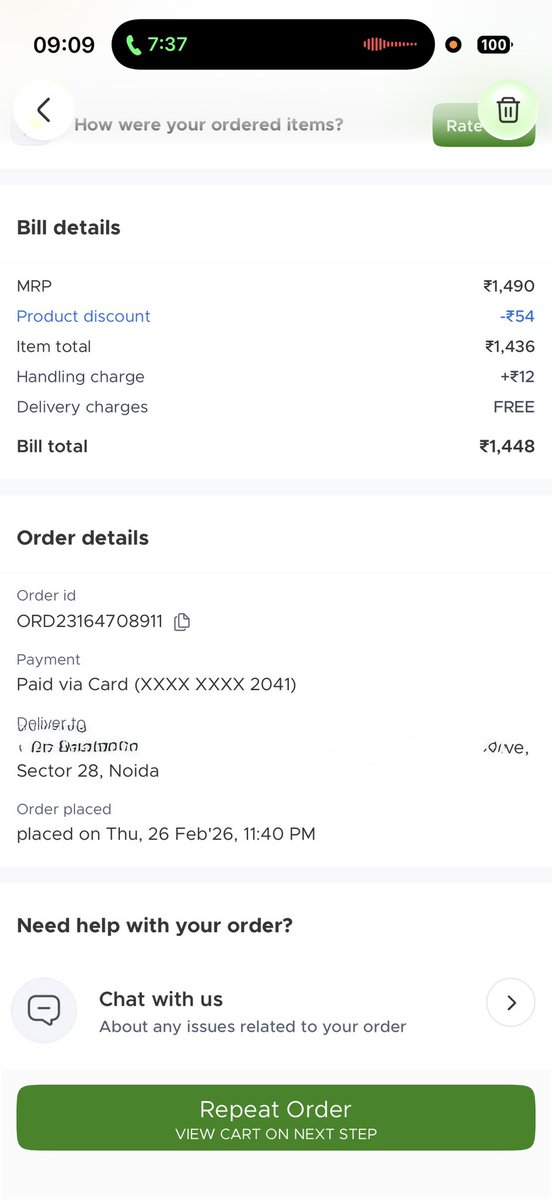
need someone to call me urgently. ORD23164708911 was marked delivered but delivered after customer support followed up back in February. Now the delivery executive is standing at my doorstep. Call me now!
It is mind-boggling to think these tunnels under Piccadilly Circus tube station were built in 1906, and the elaborate station complex above it, complete with escalators and deep lifts, in 1928. And it is still in operation today. #London
@help_delhivery@delhivery need a callback for AWB 19701210043153 now. For the last five days, you’ve been moving the delivery date by a day. The package has been at the Delivery destination for the last 6 to 7 days.
In view of an order by the Bureau of Civil Aviation Security on enhanced measures at airports, passengers across India are advised to arrive at their respective airports at least 3 hours prior to scheduled departure to ensure smooth check-in and boarding: Air India
Cool roof is a game changer. In Tamil Nadu we piloted a cool roof technology demonstration as part of the Urban Heat Mitigation Project in Chennai at lighthouse Project site. Silka cool roof paint, with a high Solar Reflective Index (SRI) of 102, was applied on two residential blocks comprising 200 houses. Following the application of this passive cooling intervention, a temperature reduction of 5 to 8 degrees Celsius was recorded inside the buildings during peak summer months
How does your system not allow for a replacement order?! @zomatocare this is bizarre. First you send me the wrong order then force down a refund or a promo code when I tell you I need the food!
.@wticabs the driver of your cab with registration HR55AU9448 needs to be trained as to what honking means and when he’s supposed to honk. A menace for the road and people around. The driver was overtaking from left, constantly honking, and a moving hazard for the road.