A blog founded by Teddy Zartler and run by Dan Erlanson for Fragment-based Drug Discovery devotees to discuss non-confidential issues regarding fragments.
A screen of carboxylic-acid containing fragments followed by X-ray informed linking and warhead addition produces promising chemical probe against DNA-repair protein RAD52
https://t.co/rIjjkGEpLo
@J_A_C_S@london_lab@DiamondLightSou
Validating DEL hits by diffraction. 'Mologram' chips functionalized with oligos capture complementary strands bound to small molecules. If those molecules bind proteins, differences in diffraction are detected.
https://t.co/HkCNxifocb
@ACSPublications
My take on #DiscoveryOnTarget2026 features covalent binders, direct-to-biology screens, and "traditional" fragment-based drug discovery. Fun that two decades on the cutting edge has become traditional!
https://t.co/y8Pcp0MCWz
@CHI_Healthtech@BostonDOT
Super-sized fragments?
Researchers @Novartis curate the Scope library with ~50K elaboration-enabled 200-400 MW molecules to capture advantages of fragment and full-size screening
https://t.co/j7w9QUFENx
How useful is design?
Roth, Fraser & Shoichet labs synthesize & test >250 single-atom changes for ligands against 6 proteins and find that >10% of analogs have potency boosts of at least 10-fold, without using any structural insights.
https://t.co/t9ygftjg8l
@zenbrainest@nature
Strategies for covalency:
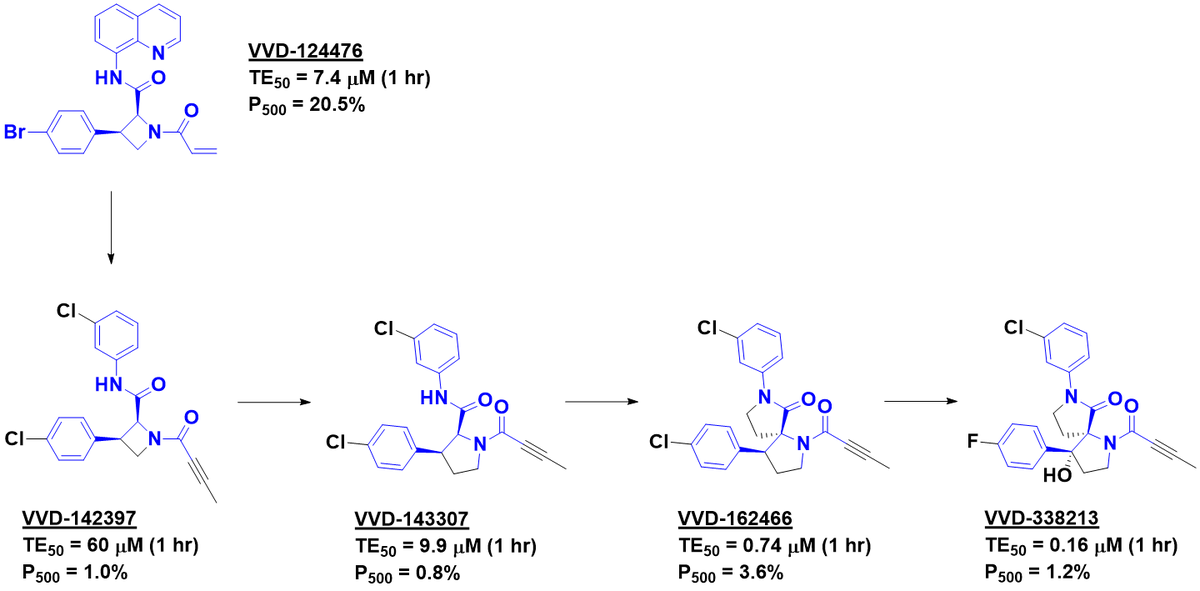
@VividionRx recognize covalent potential on inflammasome target NLRP3, scan proteome to find cryptic site, assess promiscuity, improve selectivity, and present a chemical probe in @BrJPharmacol
https://t.co/wK5hK6C0Yx
Fragment-based hunt for an RNA helicase inhibitor. Finding a probe against DHX8 required orthogonal screens and a willingness to see that the initially most promising hit was not actually the most progressable
https://t.co/jxumVxZ0ds
@ACSPublications@ICR_London
New site-specific HDX-MS method using hydrogen-deuterium exchange improves resolution to single amino acids, and should apply to a broader range of proteins than X-ray, NMR, and cryoEM
https://t.co/cIurDUVcow
@ACSPublications
Therapeutic target PTP1B attracts both drug hunters and artifacts. Universität Tübingen researchers took a fragment screen with a fluorescence readout through careful paces to sort fake-outs from actual hits
https://t.co/x8YbhlrwEM
Does Fsp3 (aromaticity) affect a hit's potential? Researchers @Merck analyze millions of their molecules for permeability, lipophilicity, solubility, off-target activity and more to revisit an abiding question
https://t.co/F4jNDSL8mo
@rohanmerchant1@Charles_chem@ACSPublications
What's that ligand's affinity for that kinase? Your assay might affect your answer.
https://t.co/Tznm14IURk
@B_R_Peterson compares isolated proteins with cell lysates and live cells
@OhioState@J_A_C_S
Researchers at @NovartisScience find that make-on-demand libraries ease follow-up work for fragment screening by fluorine NMR
https://t.co/vVtuPV61Sq
@EnamineLtd@ChemMedChem
An updated list of fragment events in 2026 and 2027 - at Practical Fragments!
https://t.co/CbOOlNSeZz
@RSC_BMCS@BostonDOT@CHI_Healthtech https://t.co/36R3rrdAiR
Fragment linking often better in theory than reality, but @gyuriakiraly + @DiamondLightSou + more combined covalent hit with nearby binder to get micromolar inhibitor from only 3 molecules
https://t.co/zxJJ8yzLo9
@ChemMedChem
Great potential in uncharted chemical space. Whether a molecule is 'bio-like' doesn't seem to matter much for hit-rates or selectivity, suggesting surprising abundance of potential drugs
https://t.co/E1F1SeXvCD
@ACSPublications@zenbrainest@ACSBioMed
Serendipity in fragments: A screen for hits against the hard-to-drug, plasma membrane-recruiting Pleckstrin Homology Domain finds an unusually reactive lysine, and a covalent hit against BTK
https://t.co/p7wOnqxnNT
@ACSBioMed@JMedChem@Cambridge_Uni